Department of Orthopedics, University Medical Centre, Utrecht, The Netherlands.
Acta Orthop. 2009 Aug;80(4):435-9. doi: 10.3109/17453670903153535.
Failed treatment of fractures may be corrected by the Ilizarov technique but complications are common. In 52 patients with compromised healing of femoral and tibial fractures, the results of secondary reconstruction with Ilizarov treatment were investigated retrospectively in order to identify the factors that contribute to the risk of complications.
52 consecutive patients was analyzed. The median interval between injury and secondary reconstruction was 3 (0.1-27) years. The patients had failed fracture treatment resulting in bone defects, pseudarthrosis, infection, limb length discrepancy (LLD) caused by bone consolidation after bone loss, malunion, soft-tissue loss, and stiff joints. Most patients had a combination of these deformities. The results were analyzed by using logistic regression in a polytomous universal mode (PLUM) logistic regression model.
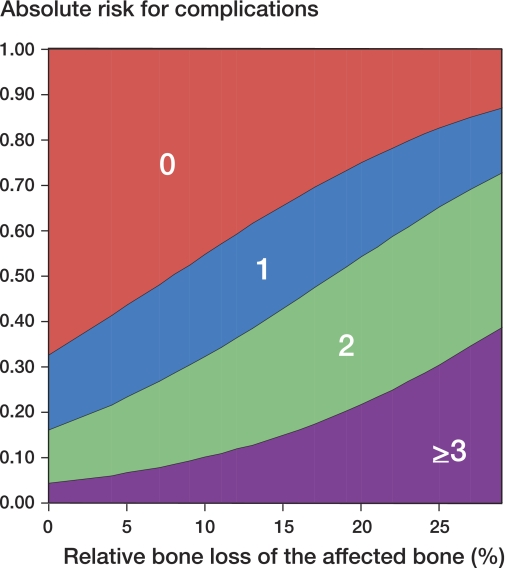
The median treatment time was 9 (4-30) months, and the obstacle and complication rate was 105% per corrected bone segment. In 2 patients treatment failed, which resulted in amputation. In all other patients healing of nonunion could be established, malunion could be corrected, and infections were successfully treated. The statistical analysis revealed that relative bone loss of the affected bone was the only predictor for occurrence of complications. From these data, we constructed a simple graph that shows the relationship between relative bone loss of the affected bone and risk of complications.
Relative bone loss of the affected bone segment is the main predictor of complications after Ilizarov treatment of previously failed fracture treatment. The visualization of the analysis in a simple graph may assist comparison of the complication rates in the literature.
骨折的治疗失败可以通过伊利扎罗夫技术进行纠正,但并发症较为常见。在 52 例股骨和胫骨骨折愈合不良的患者中,我们回顾性研究了伊利扎罗夫治疗的二次重建的结果,以确定导致并发症风险的因素。
对 52 例连续患者进行了分析。损伤与二次重建之间的中位数间隔为 3(0.1-27)年。这些患者的骨折治疗失败导致骨缺损、假关节、感染、因骨丢失后骨愈合导致的肢体长度差异(LLD)、畸形愈合、软组织丢失和关节僵硬。大多数患者都存在这些畸形的组合。结果采用多元通用模式(PLUM)逻辑回归模型进行逻辑回归分析。
中位治疗时间为 9(4-30)个月,每纠正一个骨段的障碍和并发症发生率为 105%。2 例患者的治疗失败,导致截肢。在所有其他患者中,均可以建立骨不连的愈合,矫正畸形愈合,并成功治疗感染。统计分析显示,受累骨的相对骨丢失是并发症发生的唯一预测因素。根据这些数据,我们构建了一个简单的图表,显示了受累骨的相对骨丢失与并发症风险之间的关系。
受累骨段的相对骨丢失是伊利扎罗夫治疗既往骨折治疗失败后并发症的主要预测因素。通过简单图表对分析进行可视化,可能有助于比较文献中的并发症发生率。