Chamnan P, Simmons R K, Sharp S J, Griffin S J, Wareham N J
Institute of Metabolic Science, Addenbrooke's Hospital, Cambridge, UK.
Diabetologia. 2009 Oct;52(10):2001-14. doi: 10.1007/s00125-009-1454-0. Epub 2009 Jul 24.
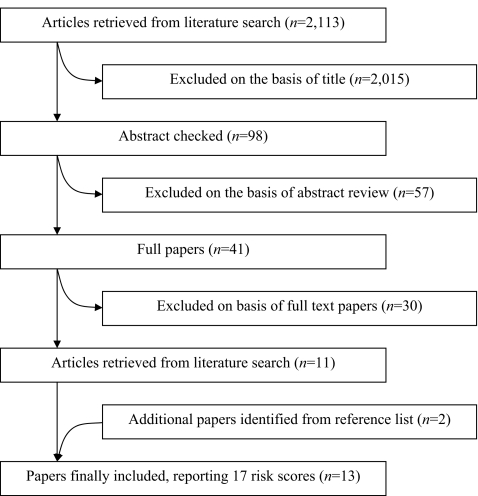
People with type 2 diabetes have an increased risk of cardiovascular disease (CVD). Multivariate cardiovascular risk scores have been used in many countries to identify individuals who are at high risk of CVD. These risk scores include those originally developed in individuals with diabetes and those developed in a general population. This article reviews the published evidence for the performance of CVD risk scores in diabetic patients by: (1) examining the overall rationale for using risk scores; (2) systematically reviewing the literature on available scores; and (3) exploring methodological issues surrounding the development, validation and comparison of risk scores. The predictive performance of cardiovascular risk scores varies substantially between different populations. There is little evidence to suggest that risk scores developed in individuals with diabetes estimate cardiovascular risk more accurately than those developed in the general population. The inconsistency in the methods used in evaluation studies makes it difficult to compare and summarise the predictive ability of risk scores. Overall, CVD risk scores rank individuals reasonably accurately and are therefore useful in the management of diabetes with regard to targeting therapy to patients at highest risk. However, due to the uncertainty in estimation of true risk, care is needed when using scores to communicate absolute CVD risk to individuals.
2型糖尿病患者患心血管疾病(CVD)的风险增加。多变量心血管风险评分已在许多国家用于识别心血管疾病高风险个体。这些风险评分包括最初在糖尿病患者中开发的评分以及在普通人群中开发的评分。本文通过以下方式综述了已发表的关于糖尿病患者心血管疾病风险评分表现的证据:(1)审视使用风险评分的总体基本原理;(2)系统回顾关于现有评分的文献;(3)探讨围绕风险评分的开发、验证和比较的方法学问题。心血管疾病风险评分在不同人群中的预测表现差异很大。几乎没有证据表明在糖尿病患者中开发的风险评分比在普通人群中开发的评分更准确地估计心血管疾病风险。评估研究中使用的方法不一致,使得难以比较和总结风险评分的预测能力。总体而言,心血管疾病风险评分对个体的排名相当准确,因此在糖尿病管理中,针对风险最高的患者进行靶向治疗时很有用。然而,由于真实风险估计存在不确定性,在使用评分向个体传达绝对心血管疾病风险时需要谨慎。