Zhang Lei, Bowen Timothy, Grennan-Jones Fiona, Paddon Carol, Giles Peter, Webber Jason, Steadman Robert, Ludgate Marian
Centre for Endocrine & Diabetes Sciences, Cardiff University, Cardiff CF14 4XN, United Kingdom.
J Biol Chem. 2009 Sep 25;284(39):26447-55. doi: 10.1074/jbc.M109.003616. Epub 2009 Jul 24.
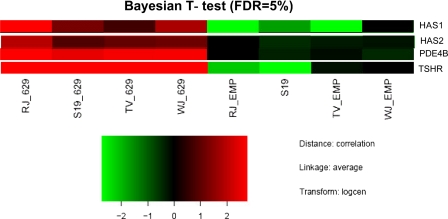
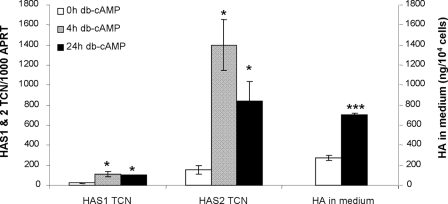
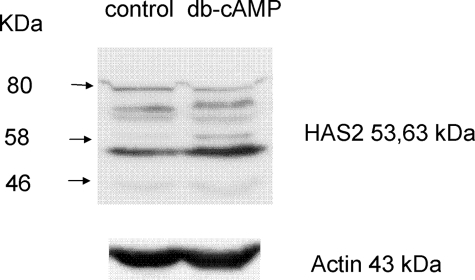
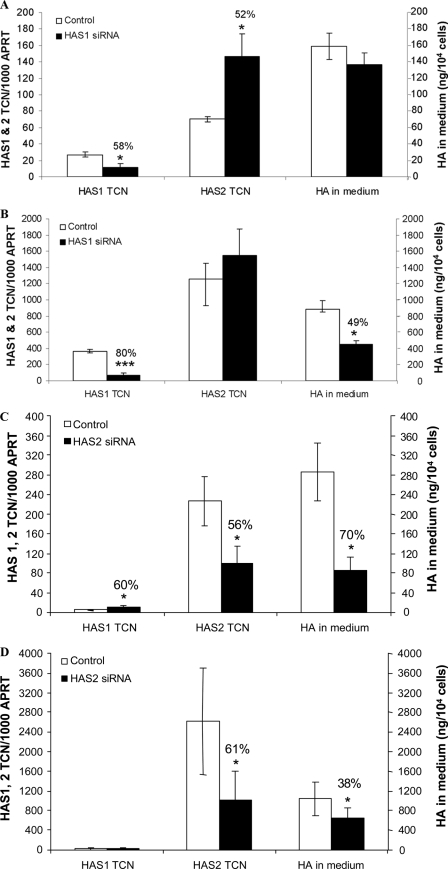
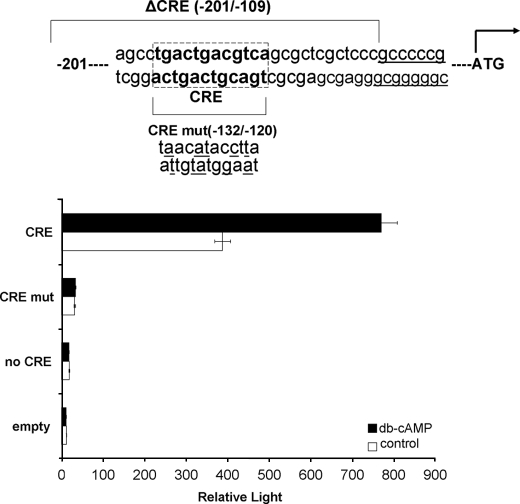
The thyrotropin receptor (TSHR) is expressed during lineage-specific differentiation (e.g. adipogenesis) and is activated by TSH, thyroid-stimulating antibodies, and gain-of-function mutations (TSHR*). Comparison of gene expression profiles of nonmodified human preadipocytes (n = 4) with the parallel TSHR* population revealed significant up-regulation of 27 genes including hyaluronan (HA) synthases (HAS) 1 and 2. The array data were confirmed by quantitative PCR of HAS1 and HAS2 and enzyme-linked immunosorbent assay measurement of HA; all values were significantly increased (p < 0.03) in TSHR*-expressing preadipocytes (n = 10). Preadipocytes (n = 8) treated with dibutyryl (db)-cAMP display significantly increased HAS1 and HAS2 transcripts, HAS2 protein, and HA production (p < 0.02). HAS1 or HAS2 small interfering RNA treatment of db-cAMP-stimulated preadipocytes (n = 4) produced 80% knockdown in HAS1 or 61% knockdown in HAS2 transcripts (compared with scrambled), respectively; the corresponding HA production was reduced by 49 or 38%. Reporter assays using A293 cells transfected with HAS1 promoter-driven plasmids containing or not containing the proximal CRE and treated with db-cAMP revealed that it is functional. Chromatin immunoprecipitation, using a cAMP-responsive element-binding protein antibody, of db-cAMP-treated preadipocytes (n = 4) yielded products for HAS1 and HAS2 with relative fold increases of 3.3 +/- 0.8 and 2.6 +/- 0.9, respectively. HA accumulates in adipose/connective tissues of patients with thyroid dysfunction. We investigated the contributions of TSH and thyroid-stimulating antibodies and obtained small (9-24%) but significant (p < 0.02) increases in preadipocyte HA production with both ligands. Similar results were obtained with a TSHR monoclonal antibody lacking biological activity (p < 0.05). We conclude that TSHR activation is implicated in HA production in preadipocytes, which, along with thyroid hormone level variation, explains the HA overproduction in thyroid dysfunction.
促甲状腺激素受体(TSHR)在谱系特异性分化过程(如脂肪生成)中表达,并可被促甲状腺激素、促甲状腺刺激抗体及功能获得性突变(TSHR*)激活。将未修饰的人前脂肪细胞(n = 4)与平行的TSHR细胞群体的基因表达谱进行比较,发现包括透明质酸(HA)合成酶(HAS)1和2在内的27个基因显著上调。通过对HAS1和HAS2进行定量PCR以及对HA进行酶联免疫吸附测定,证实了芯片数据;在表达TSHR的前脂肪细胞(n = 10)中,所有值均显著升高(p < 0.03)。用二丁酰(db)-cAMP处理的前脂肪细胞(n = 8)显示HAS1和HAS2转录本、HAS2蛋白及HA产生均显著增加(p < 0.02)。对经db-cAMP刺激的前脂肪细胞(n = 4)进行HAS1或HAS2小干扰RNA处理,HAS1转录本分别降低80%,HAS2转录本降低61%(与乱序序列相比);相应的HA产生分别减少49%或38%。使用转染了含或不含近端CRE的HAS1启动子驱动质粒的A293细胞进行报告基因检测,并经db-cAMP处理,结果显示其具有功能。使用cAMP反应元件结合蛋白抗体对经db-cAMP处理的前脂肪细胞(n = 4)进行染色质免疫沉淀,得到HAS1和HAS2的产物,相对倍数分别增加3.3±0.8和2.6±0.9。HA在甲状腺功能障碍患者的脂肪/结缔组织中蓄积。我们研究了促甲状腺激素和促甲状腺刺激抗体的作用,发现两种配体均可使前脂肪细胞HA产生小幅(9 - 24%)但显著(p < 0.02)增加。使用缺乏生物活性的TSHR单克隆抗体也得到了类似结果(p < 0.05)。我们得出结论,TSHR激活与前脂肪细胞中HA产生有关,这与甲状腺激素水平变化一起,解释了甲状腺功能障碍中HA的过度产生。