Center for Human Genetics, University Hospital Gasthuisberg, Catholic University of Leuven, Leuven, Belgium.
Hum Reprod. 2009 Nov;24(11):2679-82. doi: 10.1093/humrep/dep266. Epub 2009 Jul 24.
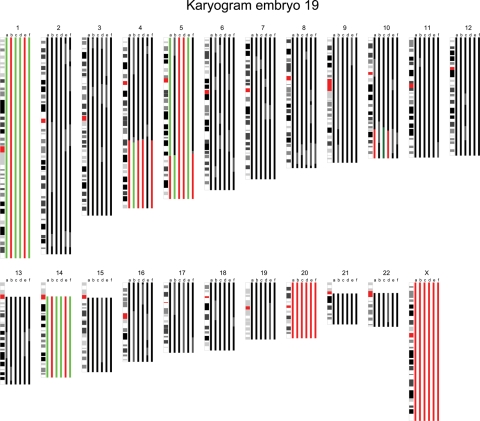
Preimplantation genetic screening is being scrutinized, as recent randomized clinical trials failed to observe the expected significant increase in live birth rates following fluorescence in situ hybridization (FISH)-based screening. Although these randomized clinical trials are criticized on their design, skills or premature stop, it is generally believed that well-designed and well-executed randomized clinical trials would resolve the debate about the potential benefit of preimplantation genetic screening. Since FISH can analyze only a limited number of chromosomal loci, some of the embryos transferred might be diagnosed as 'normal' but in fact be aneuploid for one or more chromosomes not tested. Hence, genome-wide array comparative genome hybridization screening enabling aneuploidy detection of all chromosomes was thought to be a first step toward a better design. We recently showed array screening indeed enables accurate determination of the copy number state of all chromosomes in a single cell. Surprisingly, however, this genome-wide array screening revealed a much higher frequency and complexity of chromosomal aberrations in early embryos than anticipated, with imbalances in a staggering 90% of all embryos. The mitotic error rate in cleavage stage embryos was proven to be higher than the meiotic aneuploidy rate and as a consequence, the genome of a single blastomere is not representative for the genome of the other cells of the embryo. Hence, potentially viable embryos will be discarded upon screening a single blastomere. This observation provides a biological basis for the failure of the randomized clinical trials to increase baby-take-home rates using FISH on cleavage stage embryos.
胚胎植入前遗传学筛查(PGS)正受到严格审视,因为最近的随机临床试验未能观察到荧光原位杂交(FISH)为基础的筛查后活产率的预期显著增加。尽管这些随机临床试验因其设计、技术或过早停止而受到批评,但人们普遍认为,精心设计和执行的随机临床试验将解决关于胚胎植入前遗传学筛查潜在益处的争论。由于 FISH 只能分析有限数量的染色体位置,因此一些被转移的胚胎可能被诊断为“正常”,但实际上可能存在一个或多个未检测到的染色体非整倍体。因此,人们认为全基因组阵列比较基因组杂交(aCGH)筛查能够对所有染色体进行非整倍体检测,这是更好设计的第一步。我们最近表明,阵列筛查确实能够准确确定单个细胞中所有染色体的拷贝数状态。然而,令人惊讶的是,这种全基因组阵列筛查揭示了早期胚胎中染色体异常的频率和复杂性比预期的要高得多,所有胚胎中有 90%存在不平衡。卵裂期胚胎的有丝分裂错误率被证明高于减数分裂非整倍体率,因此,单个卵裂球的基因组不能代表胚胎其他细胞的基因组。因此,在单个卵裂球筛查时,可能有活力的胚胎将被丢弃。这一观察结果为使用 FISH 对卵裂期胚胎进行随机临床试验未能提高活产率提供了生物学基础。