Barraclough Katherine A, Noble Euan, Leary Diana, Brown Fiona, Hawley Carmel M, Campbell Scott B, Isbel Nicole M, Mudge David W, van Eps Carolyn L, Sturtevant Joanna M, Johnson David W
Department of Nephrology, University of Queensland at Princess Alexandra Hospital, Brisbane, Australia.
BMC Nephrol. 2009 Jul 28;10:20. doi: 10.1186/1471-2369-10-20.
The main hypothesis of this study is that oral heme iron polypeptide (HIP; Proferrin ES) administration will more effectively augment iron stores in erythropoietic stimulatory agent (ESA)-treated peritoneal dialysis (PD) patients than conventional oral iron supplementation (Ferrogradumet).
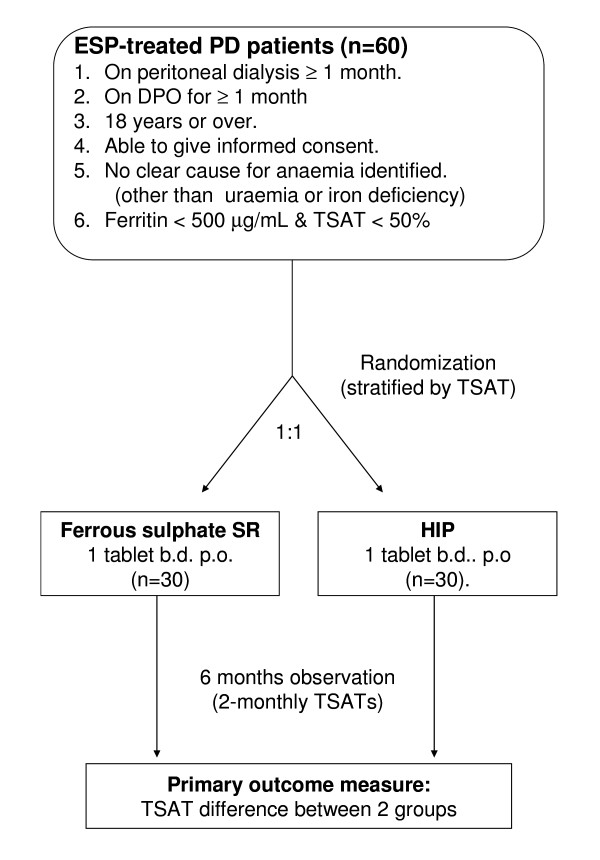
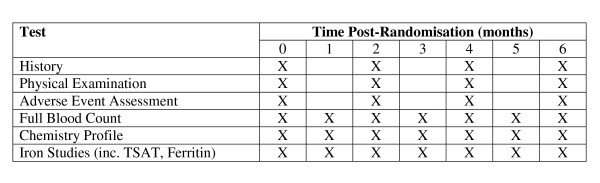
Inclusion criteria are peritoneal dialysis patients treated with darbepoietin alpha (DPO; Aranesp(R), Amgen) for >or= 1 month. Patients will be randomized 1:1 to receive either slow-release ferrous sulphate (1 tablet twice daily; control) or HIP (1 tablet twice daily) for a period of 6 months. The study will follow an open-label design but outcome assessors will be blinded to study treatment. During the 6-month study period, haemoglobin levels will be measured monthly and iron studies (including transferring saturation [TSAT] measurements) will be performed bi-monthly. The primary outcome measure will be the difference in TSAT levels between the 2 groups at the end of the 6 month study period, adjusted for baseline values using analysis of covariance (ANCOVA). Secondary outcome measures will include serum ferritin concentration, haemoglobin level, DPO dosage, Key's index (DPO dosage divided by haemoglobin concentration), and occurrence of adverse events (especially gastrointestinal adverse events).
This investigator-initiated multicentre study has been designed to provide evidence to help nephrologists and their peritoneal dialysis patients determine whether HIP administration more effectively augments iron stores in ESP-treated PD patients than conventional oral iron supplementation.
Australia New Zealand Clinical Trials Registry number ACTRN12609000432213.
本研究的主要假设是,与传统口服铁剂补充剂(Ferrogradumet)相比,口服血红素铁多肽(HIP;Proferrin ES)能更有效地增加接受促红细胞生成刺激剂(ESA)治疗的腹膜透析(PD)患者的铁储备。
纳入标准为接受α-达贝泊汀(DPO;Aranesp(R),安进公司)治疗≥1个月的腹膜透析患者。患者将按1:1随机分组,接受缓释硫酸亚铁(每日2次,每次1片;对照组)或HIP(每日2次,每次1片)治疗6个月。本研究将采用开放标签设计,但结果评估者将对研究治疗方案不知情。在6个月的研究期间,每月测量血红蛋白水平,每两个月进行一次铁代谢指标检测(包括转铁蛋白饱和度[TSAT]测量)。主要结局指标将是6个月研究期结束时两组TSAT水平的差异,并使用协方差分析(ANCOVA)对基线值进行校正。次要结局指标将包括血清铁蛋白浓度、血红蛋白水平、DPO剂量、凯氏指数(DPO剂量除以血红蛋白浓度)以及不良事件的发生情况(尤其是胃肠道不良事件)。
这项由研究者发起的多中心研究旨在提供证据,帮助肾病学家及其腹膜透析患者确定与传统口服铁剂补充相比,给予HIP是否能更有效地增加接受ESA治疗的PD患者的铁储备。
澳大利亚新西兰临床试验注册中心编号ACTRN12609000432213。