Johnson David Wayne, Hawley Carmel Mary, Rosser Brenda, Beller Elaine, Thompson Charles, Fassett Robert G, Ferrari Paolo, MacDonald Stephen, Pedagogos Eugenie, Cass Alan
Australian Kidney Trials Network, School of Population Health, University of Queensland, Brisbane, Australia.
BMC Nephrol. 2008 Aug 1;9:8. doi: 10.1186/1471-2369-9-8.
The main hypothesis of this study is that Oxpentifylline administration will effectively treat erythropoietin- or darbepoietin-resistant anaemia in chronic kidney disease patients.
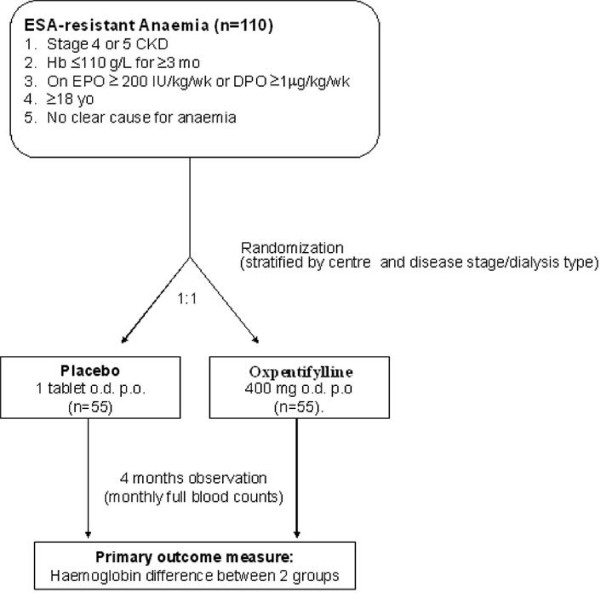
METHODS/DESIGN: Inclusion criteria are adult patients with stage 4 or 5 chronic kidney disease (including dialysis patients) with significant anaemia (haemoglobin <or= 110 g/L) for at least 3 months for which there is no clear identifiable cause and that is unresponsive to large doses of either erythropoietin (>or= 200 IU/kg/week) or darbepoetin (>or= 1 microg/kg/week). Patients will be randomized 1:1 to receive either placebo (1 tablet daily) or oxpentifylline (400 mg daily) per os for a period of 4 months. During this 4 month study period, haemoglobin measurements will be performed monthly. The primary outcome measure will be the difference in haemoglobin level between the 2 groups at the end of the 4 month study period, adjusted for baseline values. Secondary outcome measures will include erythropoiesis stimulating agent dosage, Key's index (erythropoiesis stimulating agent dosage divided by haemoglobin concentration), and blood transfusion requirement.
This investigator-initiated multicentre study has been designed to provide evidence to help nephrologists and their chronic kidney disease patients determine whether oxpentifylline represents a safe and effective strategy for treating erythropoiesis stimulating agent resistance in chronic kidney disease.
本研究的主要假设是,给予己酮可可碱可有效治疗慢性肾病患者中对促红细胞生成素或达比加群酯耐药的贫血。
方法/设计:纳入标准为4期或5期慢性肾病成年患者(包括透析患者),患有严重贫血(血红蛋白≤110 g/L)至少3个月,且无明确可识别病因,对大剂量促红细胞生成素(≥200 IU/kg/周)或达比加群酯(≥1 μg/kg/周)均无反应。患者将按1:1随机分组,口服安慰剂(每日1片)或己酮可可碱(每日400 mg),为期4个月。在这4个月的研究期间,每月进行血红蛋白测量。主要结局指标将是在4个月研究期结束时两组之间血红蛋白水平的差异,并根据基线值进行调整。次要结局指标将包括促红细胞生成素刺激剂剂量、凯氏指数(促红细胞生成素刺激剂剂量除以血红蛋白浓度)和输血需求。
这项由研究者发起的多中心研究旨在提供证据,以帮助肾病学家及其慢性肾病患者确定己酮可可碱是否是治疗慢性肾病中促红细胞生成素刺激剂耐药的安全有效策略。