Ministry of Health, Government of Southern Sudan, Juba, Southern Sudan.
PLoS Negl Trop Dis. 2009 Jul 28;3(7):e492. doi: 10.1371/journal.pntd.0000492.
Trachoma is thought to be common over large parts of Southern Sudan. However, many areas of the country, particularly west of the Nile, have not yet been surveyed. The aim of this study was to confirm whether trachoma extends into Western Equatoria State from neighboring Central Equatoria, where trachoma is highly prevalent, and whether intervention with the SAFE strategy is required.
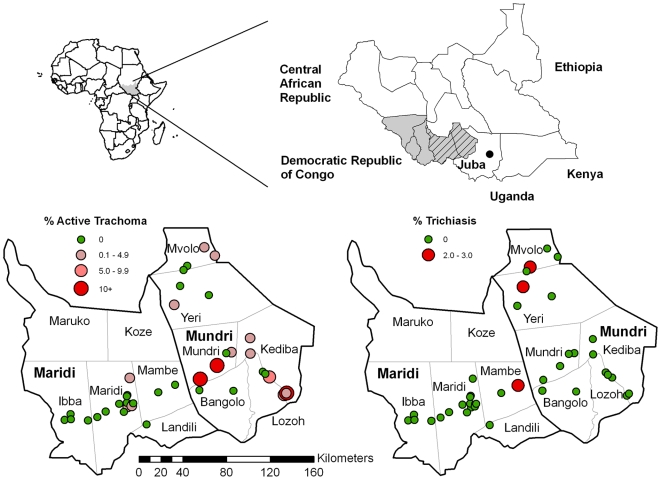
Population-based cross-sectional surveys were conducted using a two-stage cluster random sampling method to select the study population. Subjects were examined for trachoma by experienced graders using the World Health Organization (WHO) simplified grading scheme. Two counties thought to be most likely to have trachoma were surveyed, Maridi and Mundri. In Maridi, prevalence of one of the signs of active trachoma (trachomatous inflammation-follicular (TF)) in children aged 1-9 years was 0.4% (95% confidence interval (CI), 0.0%-0.8%), while no children showing the other possible sign, trachomatous inflammation-intense (TI), were identified. No trachomatous trichiasis (TT) was found in those aged under 15, and prevalence was 0.1% (95% CI, 0.0%-0.4%) in those aged 15 years and above. In Mundri, active trachoma was also limited to signs of TF, with a prevalence of 4.1% (95% CI, 1.4%-6.9%) in children aged 1-9 years. Again, no TT was found in those aged under 15, and prevalence in those aged 15 years and above was 0.3% (95% CI, 0.0%-0.8%).
Trachoma prevalence in the east of Western Equatoria State is below the WHO recommended intervention threshold for mass drug administration of antibiotic treatment in all villages. However, the prevalence of TF and TT in some villages, particularly in Mundri County, is sufficiently high to warrant targeted interventions at the community level. These results demonstrate that trachoma is not a major public health problem throughout Southern Sudan. Further studies will be required to determine trachoma prevalence in other areas, particularly west of the Nile, but there are presently no resources to survey each county. Studies should thus be targeted to areas where collection of new data would be most informative.
据认为,南苏丹的大部分地区都有沙眼。然而,该国许多地区,特别是尼罗河以西地区,尚未进行调查。本研究的目的是确认沙眼是否从沙眼高度流行的中赤道州延伸到西赤道州,以及是否需要采用 SAFE 策略进行干预。
采用两阶段整群随机抽样方法进行基于人群的横断面调查,选择研究人群。经验丰富的分级员使用世界卫生组织(世卫组织)简化分级方案对沙眼进行检查。调查了两个被认为最有可能有沙眼的县,即马里迪县和蒙德里县。在马里迪县,1-9 岁儿童中活动性沙眼(滤泡性沙眼(TF))的一种体征的流行率为 0.4%(95%置信区间(CI),0.0%-0.8%),而未发现另一种可能的体征,即重度沙眼(TI)。15 岁以下人群中未发现沙眼性倒睫(TT),15 岁及以上人群的患病率为 0.1%(95%CI,0.0%-0.4%)。在蒙德里县,活动性沙眼也仅限于 TF 体征,1-9 岁儿童的流行率为 4.1%(95%CI,1.4%-6.9%)。同样,15 岁以下人群中未发现 TT,15 岁及以上人群的患病率为 0.3%(95%CI,0.0%-0.8%)。
西赤道州东部的沙眼流行率低于世卫组织建议的在所有村庄大规模用抗生素治疗沙眼的药物干预阈值。然而,在一些村庄,特别是在蒙德里县,TF 和 TT 的流行率足够高,需要在社区一级进行有针对性的干预。这些结果表明,沙眼不是南苏丹全境的一个主要公共卫生问题。还需要进一步研究以确定其他地区,特别是尼罗河以西地区的沙眼流行率,但目前没有资源对每个县进行调查。因此,研究应针对那些收集新数据最有意义的地区。