Department of Emergency Medicine, Medical University of Vienna, Währinger Gürtel, Wien, 1090, Austria.
Crit Care. 2009;13(4):R127. doi: 10.1186/cc7984. Epub 2009 Jul 31.
The usefulness of CPR training in schools has been questioned because young students may not have the physical and cognitive skills needed to correctly perform such complex tasks correctly.
In pupils, who received six hours of CPR training from their teachers during a standard school semester at four months post training the following outcome parameters were assessed: CPR effectiveness, AED deployment, accuracy in checking vital signs, correctness of recovery position, and whether the ambulance service was effectively notified. Possible correlations of age, gender, body mass index (BMI), and outcome parameters were calculated.
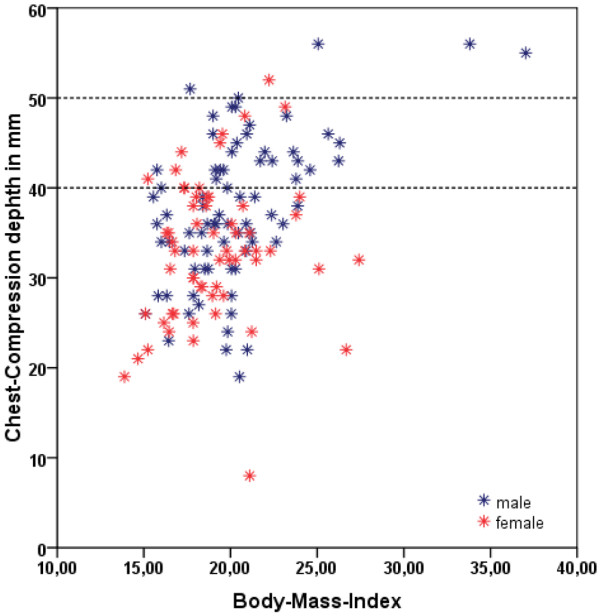
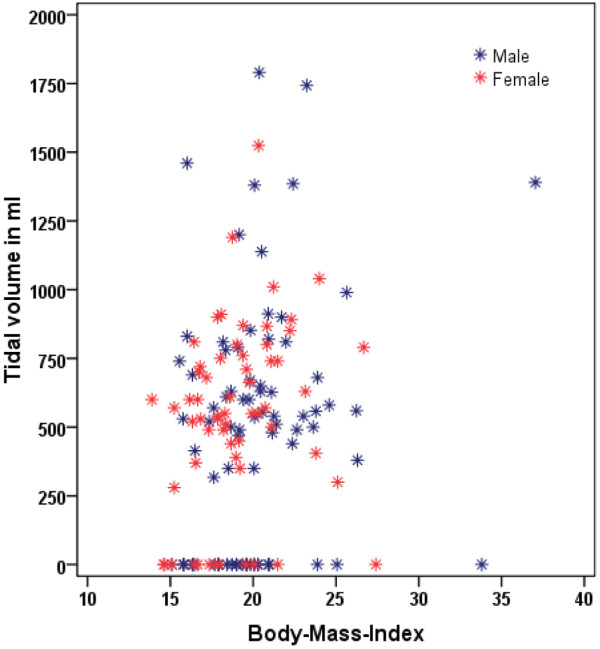
Of 147 students (mean age 13 +/- 2 years), 86% performed CPR correctly. Median depth of chest compressions was 35 mm (inter quartile range (IQR) 31 to 41), and the median number of compressions per minute was 129 bpm (IQR 108 to 143). Sixty nine percent of the students tilted the mannequin head sufficiently for mouth to mouth resuscitation, and the median air volume delivered was 540 ml (IQR 0 to 750). Scores on other life supporting techniques were at least 80% or higher. Depth of chest compressions showed a correlation with BMI (r = 0.35; P < 0.0001), body weight (r = 0.38; P < 0.0001), and body height (r = 0.31; P = 0.0002) but not with age. All other outcomes were found to be unrelated to gender, age, or BMI.
Students as young as 9 years are able to successfully and effectively learn basic life support skills including AED deployment, correct recovery position and emergency calling. As in adults, physical strength may limit depth of chest compressions and ventilation volumes but skill retention is good.
学校中的心肺复苏(CPR)培训的有效性一直受到质疑,因为年轻学生可能不具备正确执行此类复杂任务所需的身体和认知技能。
在接受过教师为期 6 小时的 CPR 培训的学生中,在培训后的 4 个月评估以下结果参数:CPR 效果、AED 部署、生命体征检查的准确性、复苏体位的正确性以及急救服务是否得到有效通知。计算了年龄、性别、体重指数(BMI)与结果参数之间的可能相关性。
在 147 名学生(平均年龄 13 ± 2 岁)中,86%的学生正确实施了 CPR。中位数的胸部按压深度为 35mm(四分位距(IQR)为 31 至 41),每分钟的按压次数中位数为 129 bpm(IQR 为 108 至 143)。69%的学生将模型头部倾斜足够进行口对口复苏,中位数输送的空气量为 540ml(IQR 为 0 至 750)。其他生命支持技术的得分至少为 80%或更高。胸部按压深度与 BMI(r = 0.35;P < 0.0001)、体重(r = 0.38;P < 0.0001)和身高(r = 0.31;P = 0.0002)呈相关性,但与年龄无关。其他所有结果均与性别、年龄或 BMI 无关。
年龄小至 9 岁的学生能够成功有效地学习基本的生命支持技能,包括 AED 部署、正确的复苏体位和紧急呼救。与成年人一样,体力可能限制胸部按压深度和通气量,但技能保持良好。