Department of Internal Medicine, University of California, Davis, Davis, CA, USA.
J Cardiovasc Transl Res. 2009 Sep;2(3):289-99. doi: 10.1007/s12265-009-9103-z. Epub 2009 May 2.
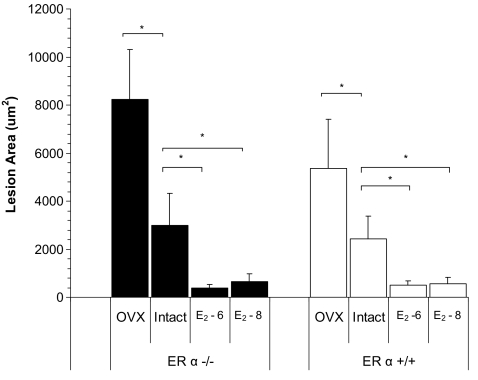
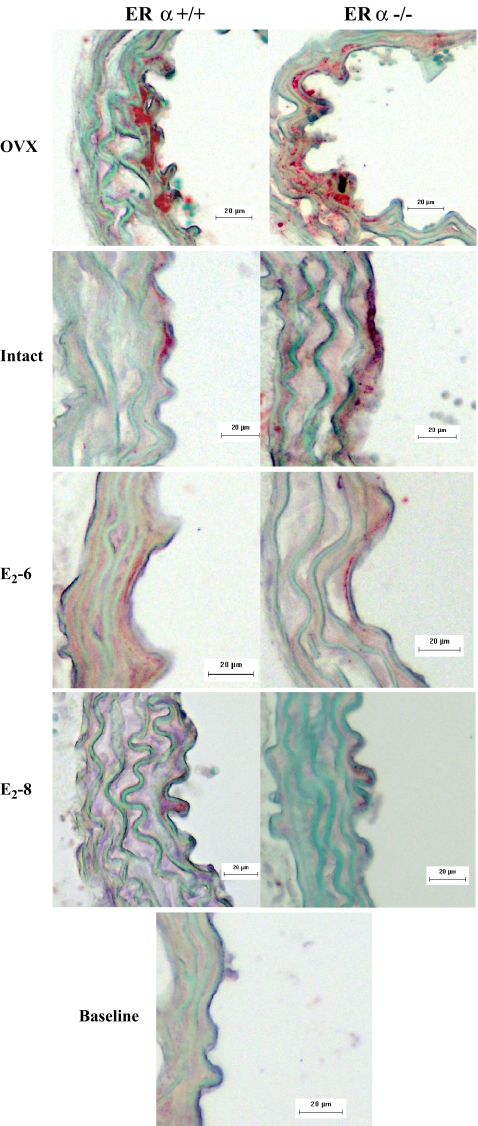
Estrogen is atheroprotective and a high-affinity ligand for both known estrogen receptors, ERalpha and ERbeta. However, the role of the ERalpha in early-stage atherosclerosis has not been directly investigated and is incompletely understood. ERalpha-deficient (ERalpha-/-) and wild-type (ERalpha+/+) female mice consuming an atherogenic diet were studied concurrent with estrogen replacement to distinguish the actions of 17beta-estradiol (E(2)) from those of ERalpha on the development of early atherosclerotic lesions. Mice were ovariectomized and implanted with subcutaneous slow-release pellets designed to deliver 6 or 8 mug/day of exogenous 17beta-estradiol (E(2)) for a period of up to 4 months. Ovariectomized mice (OVX) with placebo pellets (E(2)-deficient controls) were compared to mice with endogenous E(2) (intact ovaries) and exogenous E(2). Aortas were analyzed for lesion area, number, and distribution. Lipid and hormone levels were also determined. Compared to OVX, early lesion development was significantly (p < 0.001) attenuated by E(2) with 55-64% reduction in lesion area by endogenous E(2) and >90% reduction by exogenous E(2). Compared to OVX, a decline in lesion number (2- to 4-fold) and lesser predilection (~4-fold) of lesion formation in the proximal aorta also occurred with E(2). Lesion size, development, number, and distribution inversely correlated with circulating plasma E(2) levels. However, atheroprotection was independent of ERalpha status, and E(2) athero-protection in both genotypes was not explained by changes in plasma lipid levels (total cholesterol, triglyceride, and high-density lipoprotein cholesterol). The ERalpha is not essential for endogenous/exogenous E(2)-mediated protection against early-stage atherosclerosis. These observations have potentially significant implications for understanding the molecular and cellular mechanisms and timing of estrogen action in different estrogen receptor (ER) deletion murine models of atherosclerosis, as well as implications to human studies of ER polymorphisms and lipid metabolism. Our findings may contribute to future improved clinical decision-making concerning the use of hormone therapy.
雌激素对已知的雌激素受体 ERalpha 和 ERbeta 均具有保护作用,是它们的高亲和力配体。然而,ERalpha 在早期动脉粥样硬化中的作用尚未被直接研究,其机制也不完全清楚。本研究通过同时给予雌激素替代治疗,以区分 17β-雌二醇(E2)和 ERalpha 对早期动脉粥样硬化病变发展的作用,对接受致动脉粥样硬化饮食的 ERalpha 缺失(ERalpha-/-)和野生型(ERalpha+/+)雌性小鼠进行了研究。小鼠接受卵巢切除术,并植入皮下缓释丸,以在长达 4 个月的时间内每天提供 6 或 8μg 外源性 17β-雌二醇(E2)。将接受安慰剂丸(E2 缺乏对照)的卵巢切除术(OVX)小鼠与接受内源性 E2(完整卵巢)和外源性 E2 的小鼠进行比较。分析主动脉的病变面积、数量和分布。还测定了血脂和激素水平。与 OVX 相比,E2 明显(p<0.001)减轻了早期病变的发展,内源性 E2 使病变面积减少了 55-64%,外源性 E2 减少了 90%以上。与 OVX 相比,E2 还使病变数量减少(2-4 倍),且病变在主动脉近端形成的倾向性降低(4 倍)。病变大小、发展、数量和分布与循环血浆 E2 水平呈负相关。然而,动脉粥样硬化保护与 ERalpha 状态无关,两种基因型的 E2 动脉粥样硬化保护不能用血浆脂质水平(总胆固醇、甘油三酯和高密度脂蛋白胆固醇)的变化来解释。ERalpha 对于内源性/外源性 E2 介导的早期动脉粥样硬化保护并非必需。这些发现可能对理解不同雌激素受体(ER)缺失的动脉粥样硬化小鼠模型中雌激素作用的分子和细胞机制以及时间具有重要意义,也对人类 ER 多态性和脂质代谢研究具有重要意义。我们的发现可能有助于未来在激素治疗的临床决策方面做出改进。