Moodley Jennifer R, Constant Deborah, Hoffman Margaret, Salimo Anna, Allan Bruce, Rybicki Ed, Hitzeroth Inga, Williamson Anna-Lise
School of Public Health and Family Medicine, Women's Health Research Unit, University of Cape Town, Cape Town, South Africa.
BMC Cancer. 2009 Aug 7;9:275. doi: 10.1186/1471-2407-9-275.
Cervical cancer and infection with human immunodeficiency virus (HIV) are both important public health problems in South Africa (SA). The aim of this study was to determine the prevalence of cervical squamous intraepithelial lesions (SILs), high-risk human papillomavirus (HR-HPV), HPV viral load and HPV genotypes in HIV positive women initiating anti-retroviral (ARV) therapy.
A cross-sectional survey was conducted at an anti-retroviral (ARV) treatment clinic in Cape Town, SA in 2007. Cervical specimens were taken for cytological analysis and HPV testing. The Digene Hybrid Capture 2 (HC2) test was used to detect HR-HPV. Relative light units (RLU) were used as a measure of HPV viral load. HPV types were determined using the Roche Linear Array HPV Genotyping test. Crude associations with abnormal cytology were tested and multiple logistic regression was used to determine independent risk factors for abnormal cytology.
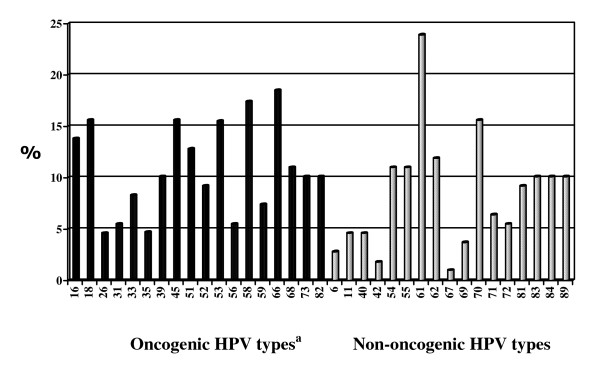
The median age of the 109 participants was 31 years, the median CD4 count was 125/mm3, 66.3% had an abnormal Pap smear, the HR-HPV prevalence was 78.9% (Digene), the median HPV viral load was 181.1 RLU (HC2 positive samples only) and 78.4% had multiple genotypes. Among women with abnormal smears the most prevalent HR-HPV types were HPV types 16, 58 and 51, all with a prevalence of 28.5%. On univariate analysis HR-HPV, multiple HPV types and HPV viral load were significantly associated with the presence of low and high-grade SILs (LSIL/HSIL). The multivariate logistic regression showed that HPV viral load was associated with an increased odds of LSIL/HSIL, odds ratio of 10.7 (95% CI 2.0 - 57.7) for those that were HC2 positive and had a viral load of <or= 181.1 RLU (the median HPV viral load), and 33.8 (95% CI 6.4 - 178.9) for those that were HC2 positive with a HPV viral load > 181.1 RLU.
Women initiating ARVs have a high prevalence of abnormal Pap smears and HR-HPV. Our results underscore the need for locally relevant, rigorous screening protocols for the increasing numbers of women accessing ARV therapy so that the benefits of ARVs are not partially offset by an excess risk in cervical cancer.
宫颈癌和人类免疫缺陷病毒(HIV)感染都是南非重要的公共卫生问题。本研究的目的是确定开始抗逆转录病毒(ARV)治疗的HIV阳性女性中宫颈鳞状上皮内病变(SILs)、高危型人乳头瘤病毒(HR-HPV)、HPV病毒载量及HPV基因型的患病率。
2007年在南非开普敦的一家抗逆转录病毒(ARV)治疗诊所进行了一项横断面调查。采集宫颈标本进行细胞学分析和HPV检测。采用Digene Hybrid Capture 2(HC2)检测法检测HR-HPV。相对光单位(RLU)用作HPV病毒载量的指标。使用罗氏线性阵列HPV基因分型检测法确定HPV类型。对与异常细胞学的粗略关联进行检测,并采用多因素logistic回归确定异常细胞学的独立危险因素。
109名参与者的中位年龄为31岁,中位CD4细胞计数为125/mm³,66.3%的巴氏涂片异常,HR-HPV患病率为78.9%(Digene检测法),HPV病毒载量中位数为181.1 RLU(仅HC2阳性样本),78.4%有多种基因型。在涂片异常的女性中,最常见的HR-HPV类型为HPV 16、58和51型,患病率均为28.5%。单因素分析显示,HR-HPV、多种HPV类型和HPV病毒载量与低级别和高级别SILs(LSIL/HSIL)的存在显著相关。多因素logistic回归显示,HPV病毒载量与LSIL/HSIL的发生几率增加相关,HC2阳性且病毒载量≤181.1 RLU(HPV病毒载量中位数)者的比值比为10.7(95%CI 2.0 - 57.7),HC2阳性且HPV病毒载量>181.1 RLU者的比值比为33.8(95%CI 6.4 - 178.9)。
开始接受抗逆转录病毒治疗的女性巴氏涂片异常和HR-HPV患病率较高。我们的结果强调,对于越来越多接受抗逆转录病毒治疗的女性,需要制定与当地情况相关的严格筛查方案,以使抗逆转录病毒治疗的益处不会因宫颈癌额外风险而部分抵消。