Universidade Federal do Amazonas (UFAM), 6200, Coroado I, General Rodrigo Octávio Ave, Manaus, Amazon, 69080-900, Brazil.
TransLab. Departament de Ciències Mèdiques, Facultat de Medicina, Girona, Catalunya, Spain.
Virol J. 2018 Feb 17;15(1):36. doi: 10.1186/s12985-018-0942-6.
Human immunodeficiency virus (HIV)-positive women have a high prevalence of human papillomavirus (HPV), and are infected with a broader range of HPV types than HIV-negative women. We aimed to determine the prevalence of cervical cytologic abnormalities, high-risk (HR)-HPV prevalence, type distribution according to the severity of cervical lesions and CD4 cell count and identify factors associated with HR-HPV infection among women living with HIV in Manaus, Amazonas.
We enrolled 325 women living with HIV that attended an infectious diseases referral hospital. Each woman underwent a gynecological exam, cervical cytology, HR-HPV detection by Polymerase chain Reaction (PCR) using the BD Onclarity™ HPV Assay, colposcopy and biopsy, when necessary. We assessed the associations between potential risk factors and HR-HPV infection.
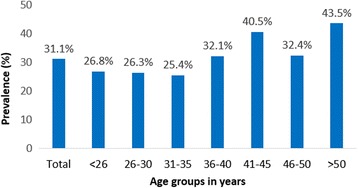
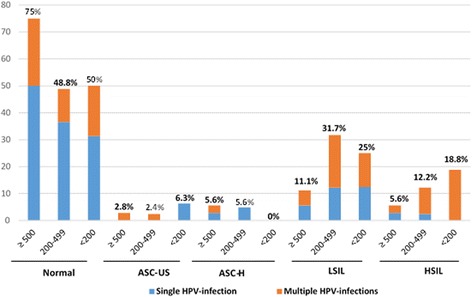
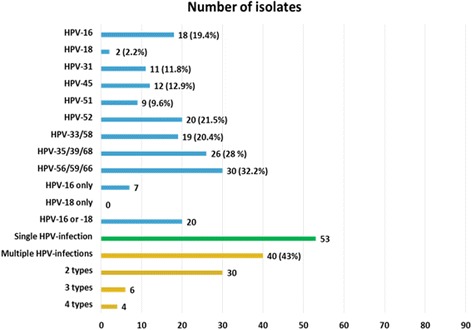
Overall, 299 (92.0%) women had a PCR result. The prevalence of HR-HPV- infection was 31.1%. The most prevalent HR-HPV types were: 56/59/66 (32.2%), 35/39/68 (28.0%), 52 (21.5%), 16 (19.4%), and 45 (12.9%). Among the women with HR-HPV infection (n = 93), 43.0% had multiple infections. Women with HPV infection showed higher prevalence of cervical abnormalities than that HPV-negative (LSIL: 22.6% vs. 1.5%; HSIL: 10.8% vs. 0.0%). The prevalence of HR-HPV among women with cytological abnormalities was 87.5% for LSIL and 100.0% for HSIL. Women with CD4 < 200 cell/mm showed the highest HR-HPV prevalence (59.3%) although this trend was not statistically significant (p-value = 0.62). The mean CD4 cell count decreased with increasing severity of cervical lesions (p-value = 0.001). The multivariable analysis showed that increasing age was associated with a decreased risk of HR-HPV infection with an adjusted prevalence odds ratio of 0.9 (95.0% CI: 0.9-1.0, p-value: 0.03) for each additional year. The only factor statistically significant associated with HR-HPV infection was CD4 cell count.
HR-HPV and abnormal cytology prevalence are high among women in the Amazonas. The low CD4 cell count was an important determinant of HPV infection and abnormal cytological findings. HPV quadrivalent vaccination used in Brazil might not offer protection for an important fraction of HPV-related disease burden in women living with HIV. This is partly explained by the high presence of non targeted vaccine HR-HPVs, such as the HPV genotype groups 56/59/66, 35/39/68 and individually HPV-52 and HPV-45, some of which contribute to high-grade lesion.
人类免疫缺陷病毒(HIV)阳性妇女人乳头瘤病毒(HPV)感染率较高,感染 HPV 类型比 HIV 阴性妇女更为广泛。本研究旨在确定在亚马逊州马瑙斯市 HIV 阳性妇女中,宫颈细胞学异常、高危型(HR)-HPV 流行率、根据宫颈病变严重程度的 HPV 型别分布以及 CD4 细胞计数,并确定与 HR-HPV 感染相关的因素。
我们招募了 325 名在传染病转诊医院就诊的 HIV 阳性妇女。每位女性均接受妇科检查、宫颈细胞学检查、HR-HPV 检测(采用 BD Onclarity HPV 检测试剂盒)、阴道镜检查和必要时的活检。我们评估了潜在危险因素与 HR-HPV 感染之间的关联。
总体而言,299 名(92.0%)女性的 PCR 结果可评估。HR-HPV 感染率为 31.1%。最常见的 HR-HPV 类型是:56/59/66(32.2%)、35/39/68(28.0%)、52(21.5%)、16(19.4%)和 45(12.9%)。在 HR-HPV 感染的女性中(n=93),43.0%有多重感染。HPV 感染的女性比 HPV 阴性女性更易出现宫颈异常(LSIL:22.6% vs. 1.5%;HSIL:10.8% vs. 0.0%)。LSIL 患者 HR-HPV 感染率为 87.5%,HSIL 患者为 100.0%。CD4 细胞计数<200 个/mm 的女性 HR-HPV 感染率最高(59.3%),但这种趋势无统计学意义(p 值=0.62)。随着宫颈病变严重程度的增加,HR-HPV 感染率逐渐升高(p 值=0.001)。多变量分析显示,年龄每增加 1 岁,HR-HPV 感染的风险降低,调整后的患病率比值比为 0.9(95.0%CI:0.9-1.0,p 值:0.03)。唯一与 HR-HPV 感染相关的统计学显著因素是 CD4 细胞计数。
在亚马逊地区,HR-HPV 和异常细胞学的流行率很高。低 CD4 细胞计数是 HPV 感染和异常细胞学发现的重要决定因素。在巴西使用的 HPV 四价疫苗可能无法为 HIV 阳性妇女中 HPV 相关疾病负担的重要部分提供保护。这部分原因是存在非靶向疫苗 HR-HPV,如 HPV 基因型 56/59/66、35/39/68 和 HPV-52 及 HPV-45 单独感染,其中一些与高级别病变有关。