Feucht Nikolaus, Matthias Huebner, Lohmann Chris P, Maier Mathias
Augenklinik rechts der Isar, Technical University Munich, Germany.
Clin Ophthalmol. 2008 Jun;2(2):253-9. doi: 10.2147/opth.s2842.
The VEGF Inhibition Study In Ocular Neovascularisation (VISION) reported the efficacy of intravitreal (ITV) vascular endothelial growth factor (VEGF) inhibition with pegaptanib sodium (Macugen((R))) for the treatment of neovascular age-related macular degeneration (AMD). This paper reports clinical experience with pegaptanib sodium for the treatment of occult or minimally classic choroidal neovascularization (CNV) due to AMD.
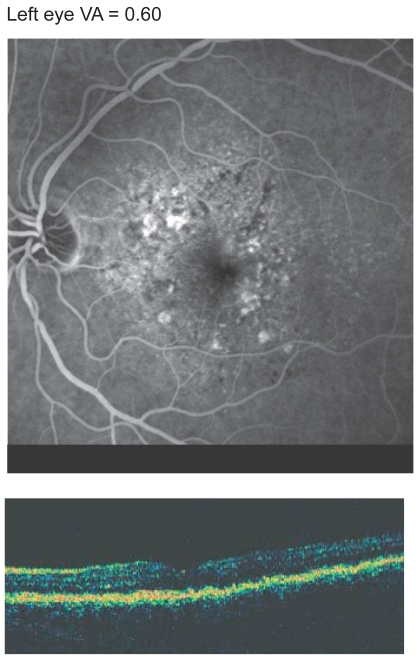
The study included 50 eyes (in 49 patients) with either occult CNV or minimally classic CNV secondary to neovascular AMD who were not eligible for photodynamic therapy (PDT). Study data were analyzed retrospectively. During the 6-month study, patients were administered an average 2.74 injections of 0.3 mg ITV pegaptanib sodium. Angiography and optical coherence tomography (OCT) examinations were carried out and intraocular pressure (IOP) and visual acuity (VA) were measured at baseline, at 3 months and at 6 months. An eye examination was performed and VA was measured the 2 days following treatment and then again at weeks 4-6, and at 3 and 6 months. OCT, VA, and IOP were also assessed at 1 month.
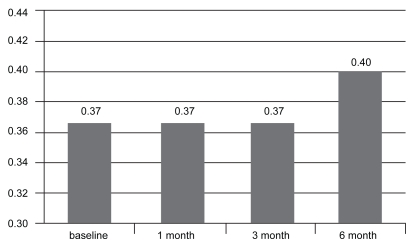
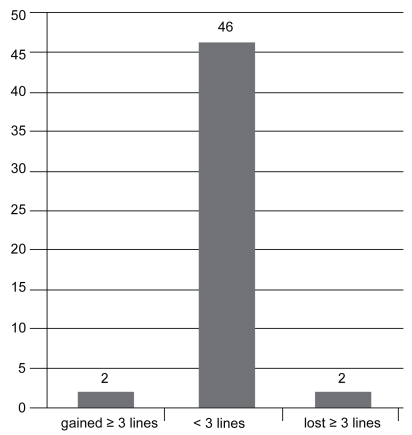
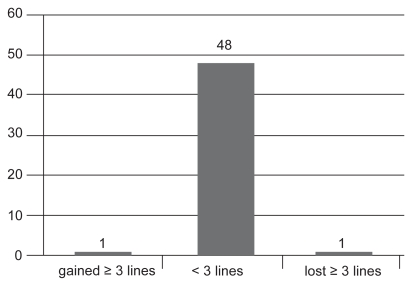
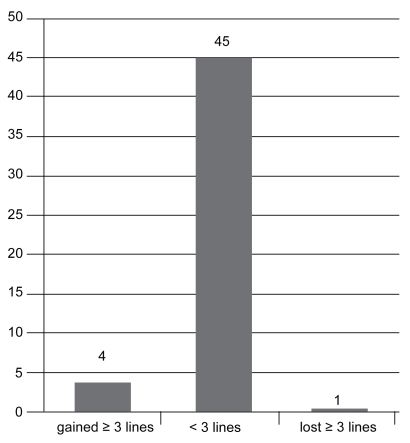
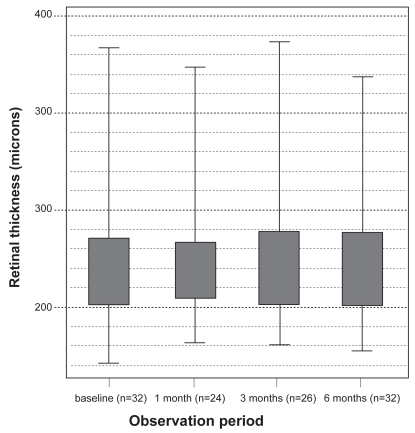
ITV pegaptanib sodium was well tolerated and no treatment complications arose. Mean VA was measured as: 0.37 +/- 0.24 at baseline; 0.37 +/- 0.25 at 1 month; 0.37 +/- 0.25 at 3 months and 0.40 +/- 0.26 at 6 months. VA was stabilized in approximately 90% of eyes treated with pegaptanib sodium. OCT examination showed a minimal change in central retinal thickness (CRT) during the course of the study, from 251.19 mum at baseline to 251.63 mum at 6 months. No elevation in IOP was measured during treatment at 4-6 months in patients receiving pegaptanib sodium.
ITV therapy with pegaptanib sodium for occult and minimally classic CNV secondary to neovascular AMD offered good efficacy with a favorable adverse events profile. The majority of patients showed stabilization in all assessed parameters. In clinical practice, careful consideration should be given to the use of nonselective VEGF inhibition in patients with a high cardiovascular risk profile or in those with a history of thromboembolic events.
眼部新生血管化中的VEGF抑制研究(VISION)报告了玻璃体内(ITV)注射培加替尼钠(Macugen®)抑制血管内皮生长因子(VEGF)治疗新生血管性年龄相关性黄斑变性(AMD)的疗效。本文报告了培加替尼钠治疗AMD所致隐匿性或轻微典型性脉络膜新生血管(CNV)的临床经验。
该研究纳入了50只眼(49例患者),这些患者患有继发于新生血管性AMD的隐匿性CNV或轻微典型性CNV,且不符合光动力疗法(PDT)的条件。对研究数据进行回顾性分析。在为期6个月的研究中,患者平均接受2.74次0.3mg的ITV培加替尼钠注射。在基线、3个月和6个月时进行血管造影和光学相干断层扫描(OCT)检查,并测量眼压(IOP)和视力(VA)。在治疗后2天、第4 - 6周、3个月和6个月时进行眼部检查并测量VA。在1个月时也评估OCT、VA和IOP。
ITV培加替尼钠耐受性良好,未出现治疗并发症。平均视力测量结果为:基线时0.37±0.24;1个月时0.37±0.25;3个月时0.37±0.25;6个月时0.40±0.26。接受培加替尼钠治疗的眼睛中约90%视力稳定。OCT检查显示在研究过程中中心视网膜厚度(CRT)变化极小,从基线时的251.19μm变为6个月时的251.63μm。接受培加替尼钠治疗的患者在4 - 6个月治疗期间未测量到眼压升高。
ITV注射培加替尼钠治疗继发于新生血管性AMD的隐匿性和轻微典型性CNV疗效良好,不良事件情况有利。大多数患者在所有评估参数方面表现稳定。在临床实践中,对于心血管风险高或有血栓栓塞事件病史的患者,应谨慎考虑使用非选择性VEGF抑制治疗。