Hessel Franz, Grill Eva, Schnell-Inderst Petra, Siebert Uwe, Kunze Silke, Nickisch Andreas, von Voss Hubertus, Wasem Jürgen
Institute for Health Care Management, University of Duisburg-Essen, Germany.
Ger Med Sci. 2003 Dec 15;1:Doc09.
The prevalence of newborn hearing disorders is 1-3 per 1,000. Crucial for later outcome are correct diagnosis and effective treatment as soon as possible. With BERA and TEOAE low-risk techniques for early detection are available. Universal screening is recommended but not realised in most European health care systems. Aim of the study was to examine the scientific evidence of newborn hearing screening and a comparison of medical outcome and costs of different programmes, differentiated by type of strategy (risk screening, universal screening, no systematical screening).
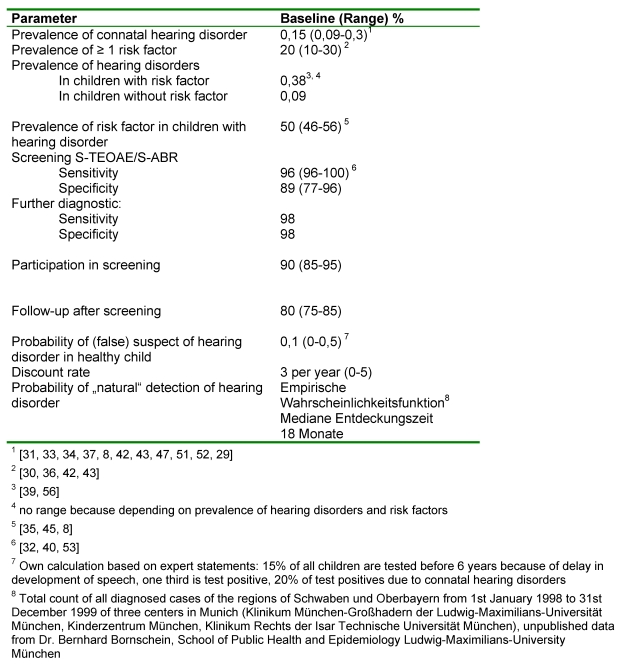
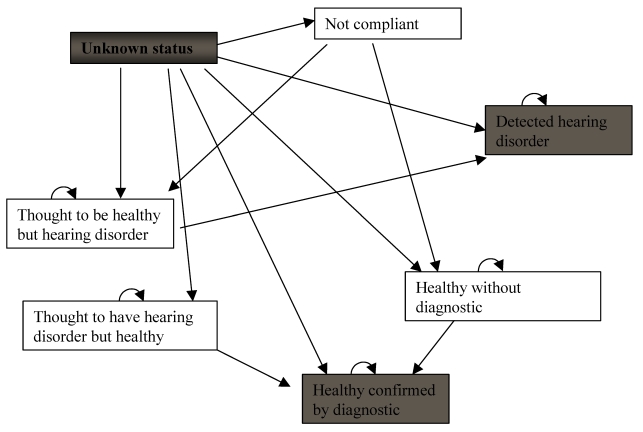
In an interdisciplinary health technology assessment project all studies on newborn hearing screening detected in a standardized comprehensive literature search were identified and data on medical outcome, costs, and cost-effectiveness extracted. A Markov model was designed to calculate cost-effectiveness ratios.
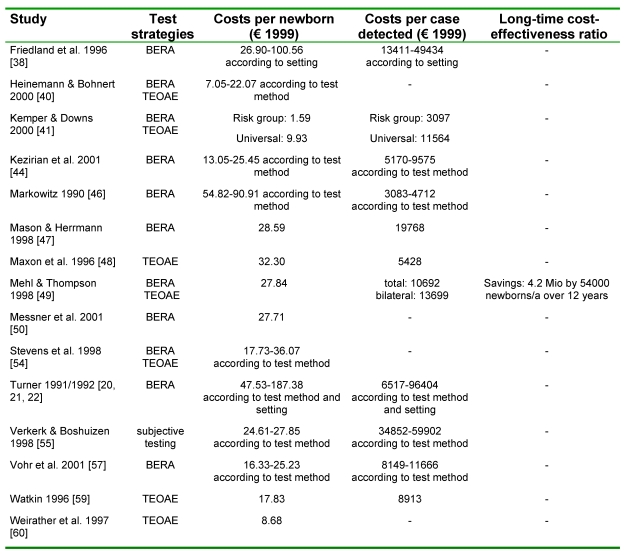
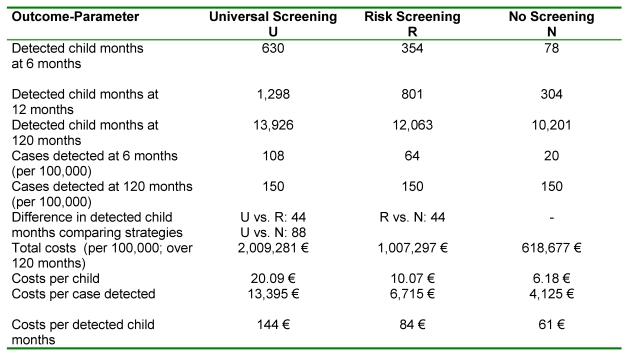
Economic data were extracted from 20 relevant publications out of 39 publications found. In the model total costs for screening of 100,000 newborns with a time horizon of ten years were calculated: 2.0 Mio.euro for universal screening (U), 1.0 Mio.euro for risk screening (R), and 0.6 Mio.euro for no screening (N). The costs per child detected: 13,395 euro (U) respectively 6,715 euro (R), and 4,125 euro (N). At 6 months of life the following percentages of cases are detected: U 72%, R 43%, N 13%.
A remarkable small number of economic publications mainly of low methodological quality was found. In our own model we found reasonable cost-effectiveness ratios also for universal screening. Considering the outcome advantages of higher numbers of detected cases a universal newborn hearing screening is recommended.
新生儿听力障碍的患病率为每1000例中有1 - 3例。尽早进行正确诊断和有效治疗对后期预后至关重要。借助脑干听觉诱发电位(BERA)和瞬态诱发耳声发射(TEOAE)可实现早期检测的低风险技术。推荐进行普遍筛查,但在大多数欧洲医疗保健系统中尚未实现。本研究的目的是检验新生儿听力筛查的科学证据,并比较不同筛查方案(按策略类型区分:风险筛查、普遍筛查、无系统筛查)的医疗结局和成本。
在一个跨学科卫生技术评估项目中,通过标准化的全面文献检索确定了所有关于新生儿听力筛查的研究,并提取了有关医疗结局、成本和成本效益的数据。设计了一个马尔可夫模型来计算成本效益比。
从找到的39篇相关出版物中提取了20篇的经济数据。在该模型中,计算了对100,000名新生儿进行为期十年的筛查总成本:普遍筛查(U)为200万欧元,风险筛查(R)为100万欧元,不筛查(N)为60万欧元。每个被检测出的儿童的成本分别为:13,395欧元(U)、6,715欧元(R)和4,125欧元(N)。在出生6个月时检测出的病例百分比分别为:U组72%,R组43%,N组13%。
发现数量极少的经济类出版物,且方法学质量大多较低。在我们自己的模型中,我们也发现普遍筛查具有合理的成本效益比。考虑到检测出更多病例在结局方面的优势,推荐进行新生儿普遍听力筛查。