Brelsfoard Corey L, St Clair William, Dobson Stephen L
Department of Entomology, University of Kentucky, S-225 Ag, Science Center North, Lexington, KY 40546, USA.
Parasit Vectors. 2009 Aug 14;2(1):38. doi: 10.1186/1756-3305-2-38.
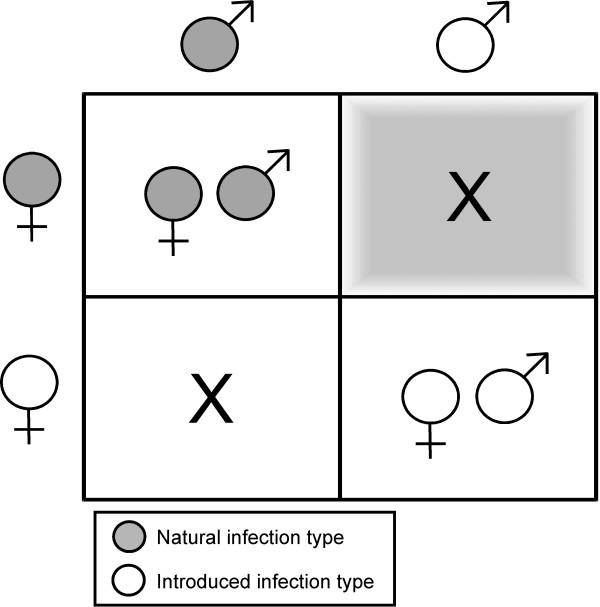
Mass drug administration (MDA) is the emphasis of an ongoing global lymphatic filariasis (LF) elimination program by the World Health Organization, in which the entire 'at risk' human population is treated annually with anti-filarial drugs. However, there is evidence that the MDA strategy may not be equally appropriate in all areas of LF transmission, leading to calls for the augmentation of MDA with anti-vector interventions. One potential augmentative intervention is the elimination of vectors via repeated inundative releases of male mosquitoes made cytoplasmically incompatible via an infection with Wolbachia bacteria. However, with a reduction in the vector population size, there is the risk that an accidental female release would permit the establishment of the incompatible Wolbachia infection type, resulting in population replacement instead of population elimination. To avoid the release of fertile females, we propose the exposure of release individuals to low doses of radiation to sterilize any accidentally released females, reducing the risk of population replacement.
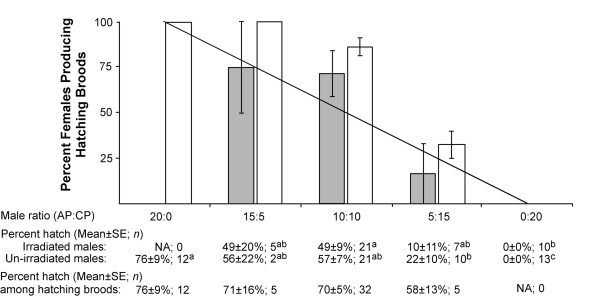
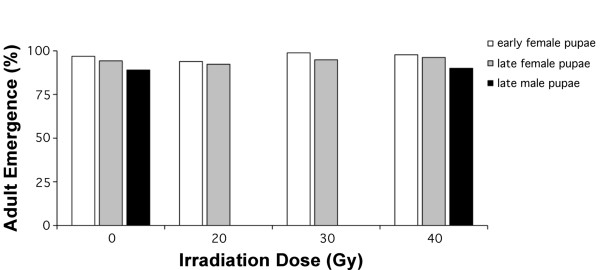
Aedes polynesiensis pupae of differing ages were irradiated to determine a radiation dose that results in sterility but that does not affect the survival and competitiveness of males. Laboratory assays demonstrate that males irradiated at a female sterilizing dosage of 40 Gy are equally competitive with un-irradiated males. No effect of irradiation on the ability of Wolbachia to affect egg hatch was observed.
An irradiation dose of 40 Gy is sufficient to cause female sterility, but has no observed negative effect on male fitness. The results support further development of this approach as a preventative measure against accidental population replacement.
群体药物给药(MDA)是世界卫生组织正在进行的全球淋巴丝虫病(LF)消除计划的重点,即每年对所有“高危”人群使用抗丝虫药物进行治疗。然而,有证据表明MDA策略在所有淋巴丝虫病传播地区可能并非同样适用,因此有人呼吁通过抗媒介干预措施来加强MDA。一种潜在的强化干预措施是通过反复大量释放经沃尔巴克氏体细菌感染而产生胞质不亲和的雄蚊来消灭媒介。然而,随着媒介种群数量的减少,存在意外释放雌蚊从而使不亲和的沃尔巴克氏体感染类型得以建立的风险,这将导致种群替代而非种群消除。为避免释放可育雌蚊,我们建议对释放的个体进行低剂量辐射,以使任何意外释放的雌蚊绝育,从而降低种群替代的风险。
对不同年龄的波利尼西亚伊蚊蛹进行辐射,以确定能导致绝育但不影响雄蚊生存和竞争力的辐射剂量。实验室检测表明,以40 Gy的雌蚊绝育剂量进行辐射的雄蚊与未辐射的雄蚊具有同等竞争力。未观察到辐射对沃尔巴克氏体影响卵孵化能力有任何作用。
40 Gy的辐射剂量足以导致雌蚊绝育,但未观察到对雄蚊适应性有负面影响。这些结果支持将这种方法作为防止意外种群替代的预防措施进一步开发。