Department of Epidemiology, Rollins School of Public Health, Emory University, 1518 Clifton Rd, Atlanta, Georgia 30322, USA.
Environ Health. 2009 Aug 15;8:35. doi: 10.1186/1476-069X-8-35.
Polybrominated biphenyl (PBB), a brominated flame retardant, was accidently mixed into animal feed in Michigan (1973-1974) resulting in human exposure through consumption of contaminated meat, milk and eggs. Beginning in 1976 individuals who consumed contaminated products were enrolled in the Michigan Long-Term PBB Study. This cohort presents a unique opportunity to study the association between parental exposures to PBB and offspring sex ratio.
We identified offspring of female PBB cohort participants (born 1975-1988) and obtained electronic birth records for those born in the state of Michigan. We linked this information to parental serum PBB and PCB concentrations collected at enrollment into the cohort. We modeled the odds of a male birth with generalized estimating equations accounting for the non-independence of siblings born to the same parents. We explored potential confounders: parental age and education at offspring's birth, parental body mass index at cohort enrollment, birth order, gestational age and year of offspring's birth.
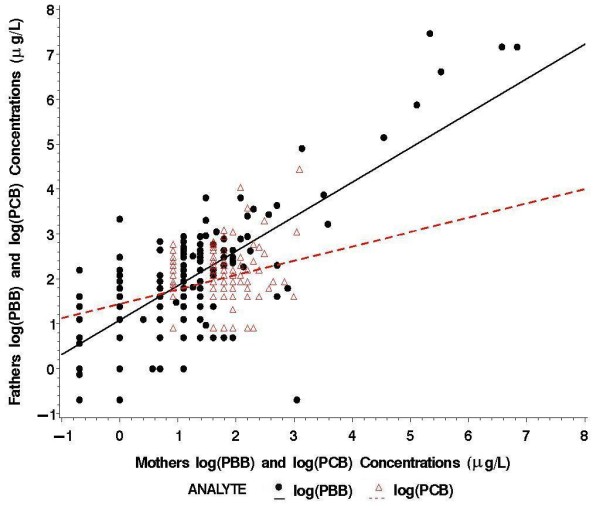
The overall proportion of male offspring among 865 live births to cohort mothers was 0.542. This was higher than the national male proportion of 0.514 (binomial test: p = 0.10). When both parents were in the cohort (n = 300), we found increased odds of a male birth with combined parents' enrollment PBB exposure > or = the median concentrations (3 microg/L for mothers; 6 microg/L for fathers) compared to combined parents' PBB exposure < the median concentrations (AOR = 1.43, 95% CI: 0.89-2.29), although this did not reach statistical significance. In addition, there was a suggestion of increased odds of a male birth for combined parents' enrollment PCB exposure > or = the median concentrations (6 microg/L for mothers; 8 microg/L for fathers) compared to combined parents' enrollment PCB exposure < the median concentrations (AOR = 1.53, 95% CI: 0.93-2.52).
This study adds to the body of literature on secondary sex ratio and exposure to environmental contaminants. In this population, combined parental exposure to PBBs or PCBs increased the odds of a male birth. Further research is needed to corroborate these findings and shed light on the biological mechanisms by which these types of chemicals may influence the secondary sex ratio.
多溴联苯(PBB)是一种溴化阻燃剂,于 1973-1974 年意外混入密歇根州的动物饲料中,导致人类通过食用受污染的肉类、牛奶和鸡蛋而暴露于其中。自 1976 年以来,食用受污染产品的个体被纳入密歇根州 PBB 长期研究。该队列为研究父母接触 PBB 与后代性别比例之间的关联提供了独特的机会。
我们确定了女性 PBB 队列参与者(1975-1988 年出生)的后代,并获得了在密歇根州出生的那些人的电子出生记录。我们将这些信息与队列入组时父母血清中的 PBB 和 PCB 浓度联系起来。我们使用广义估计方程对兄弟姐妹出生于同一父母的非独立性进行建模,以分析男性出生的可能性。我们探索了潜在的混杂因素:后代出生时父母的年龄和教育程度、队列入组时父母的体重指数、出生顺序、胎龄和出生年份。
队列母亲的 865 例活产中,男性后代的总体比例为 0.542。这高于全国男性比例 0.514(二项式检验:p = 0.10)。当父母双方都在队列中(n = 300)时,与父母的 PBB 暴露均低于中位数浓度(母亲为 3 µg/L,父亲为 6 µg/L)相比,父母的 PBB 暴露均高于中位数浓度(母亲为 3 µg/L,父亲为 6 µg/L)的情况下,男性出生的可能性更高(OR = 1.43,95%CI:0.89-2.29),尽管这没有达到统计学意义。此外,与父母的 PBB 暴露均低于中位数浓度相比,父母的 PBB 暴露均高于中位数浓度(母亲为 6 µg/L,父亲为 6 µg/L)时,男性出生的可能性略有增加(OR = 1.53,95%CI:0.93-2.52)。
本研究增加了关于次生性别比例和环境污染物暴露的文献。在该人群中,父母双方接触 PBB 或 PCBs 会增加男性出生的可能性。需要进一步的研究来证实这些发现,并阐明这些类型的化学物质可能影响次生性别比例的生物学机制。