Cook Susan Wagner, Tanenhaus Michael K
Department of Psychology, The University of Iowa, E11 Seashore Hall, Iowa City, IA 52242, USA.
Cognition. 2009 Oct;113(1):98-104. doi: 10.1016/j.cognition.2009.06.006. Epub 2009 Aug 13.
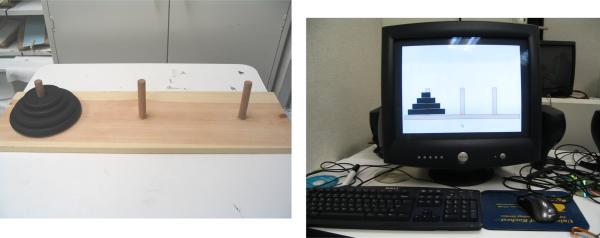
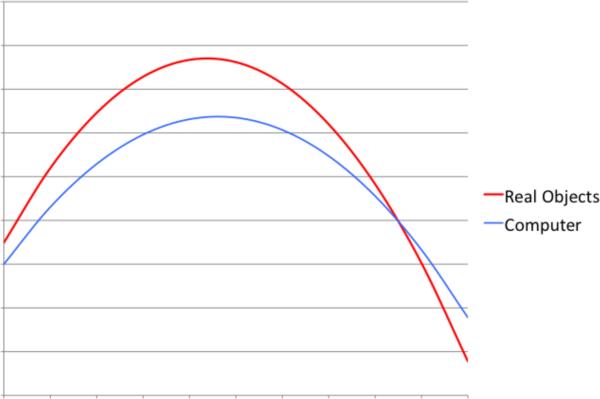
We explored how speakers and listeners use hand gestures as a source of perceptual-motor information during naturalistic communication. After solving the Tower of Hanoi task either with real objects or on a computer, speakers explained the task to listeners. Speakers' hand gestures, but not their speech, reflected properties of the particular objects and the actions that they had previously used to solve the task. Speakers who solved the problem with real objects used more grasping handshapes and produced more curved trajectories during the explanation. Listeners who observed explanations from speakers who had previously solved the problem with real objects subsequently treated computer objects more like real objects; their mouse trajectories revealed that they lifted the objects in conjunction with moving them sideways, and this behavior was related to the particular gestures that were observed. These findings demonstrate that hand gestures are a reliable source of perceptual-motor information during human communication.
我们探究了在自然交流过程中,说话者和倾听者如何将手势用作感知运动信息的来源。在使用真实物体或在电脑上解决完汉诺塔任务后,说话者向倾听者解释该任务。说话者的手势而非言语,反映了他们之前用于解决任务的特定物体的属性和动作。用真实物体解决问题的说话者在解释过程中使用了更多抓握的手部形状,并产生了更多弯曲的轨迹。那些观察了之前用真实物体解决问题的说话者所做解释的倾听者,随后在对待电脑物体时更像对待真实物体;他们的鼠标轨迹显示,他们在将物体向一侧移动的同时还会抬起物体,并且这种行为与所观察到的特定手势有关。这些发现表明,在人际交流中,手势是感知运动信息的可靠来源。