Malatesta M, Perdoni F, Muller S, Zancanaro C, Pellicciari C
Dipartimento di Scienze Morfologico-Biomediche, Sezione di Anatomia e Istologia, University of Verona, Italy.
Eur J Histochem. 2009 Apr-Jun;53(2):e12. doi: 10.4081/ejh.2009.e12.
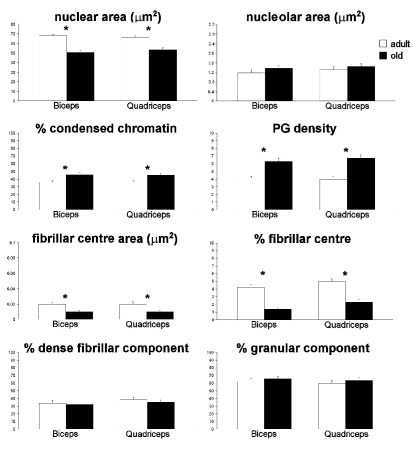
Advancing adult age is associated with a progressive decrease in skeletal muscle mass, strength and quality known as sarcopenia. The mechanisms underlying age-related skeletal muscle wasting and weakness are manifold and still remain to be fully elucidated. Despite the increasing evidence that the progress of muscle diseases leading to muscle atrophy/dystrophy may be related to defective RNA processing, no data on the morpho-functional features of skeletal muscle nuclei in sarcopenia are available at present. In this view, we have investigated, by combining morphometry and immunocytochemistry at light and electron microscopy, the fine structure of myonuclei as well as the distribution and amount of RNA processing factors in skeletal myofibres of biceps brachii and quadriceps femoris from adult and old rats. Results demonstrate that the myonuclei of aged type II fibres show an increased amount of condensed chromatin and lower amounts of phosphorylated polymerase II and DNA/RNA hybrid molecules, clearly indicating a decrease in pre-mRNA transcription rate compared to adult animals. In addition, myonuclei of aged fibres show decreased amounts of nucleoplasmic splicing factors and an accumulation of cleavage factors, polyadenilated RNA and perichromatin granules, suggesting a reduction in the processing and transport rate of premRNA. During ageing, it seems therefore that in rat myonuclei the entire production chain of mRNA, from synthesis to cytoplasmic export, is less efficient. This failure likely contributes to the reduced responsiveness of muscle cells to anabolic stimuli in the elderly.
随着成年年龄的增长,骨骼肌质量、力量和质量会逐渐下降,这被称为肌肉减少症。与年龄相关的骨骼肌萎缩和无力的潜在机制是多方面的,仍有待充分阐明。尽管越来越多的证据表明导致肌肉萎缩/营养不良的肌肉疾病进展可能与RNA加工缺陷有关,但目前尚无关于肌肉减少症中骨骼肌细胞核形态功能特征的数据。鉴于此,我们通过在光学和电子显微镜下结合形态计量学和免疫细胞化学,研究了成年和老年大鼠肱二头肌和股四头肌骨骼肌纤维中肌细胞核的精细结构以及RNA加工因子的分布和数量。结果表明,老年II型纤维的肌细胞核中浓缩染色质数量增加,磷酸化聚合酶II和DNA/RNA杂交分子数量减少,这清楚地表明与成年动物相比,前体mRNA转录率降低。此外,老年纤维的肌细胞核中核质剪接因子数量减少,切割因子、多聚腺苷酸化RNA和染色质周围颗粒积累,表明前体mRNA的加工和运输速率降低。因此,在衰老过程中,大鼠肌细胞核中从合成到细胞质输出的整个mRNA生产链似乎效率较低。这种缺陷可能导致老年人肌肉细胞对合成代谢刺激的反应性降低。