Morris Zoe, Whiteley William N, Longstreth W T, Weber Frank, Lee Yi-Chung, Tsushima Yoshito, Alphs Hannah, Ladd Susanne C, Warlow Charles, Wardlaw Joanna M, Al-Shahi Salman Rustam
Division of Clinical Neurosciences, Western General Hospital, Edinburgh.
BMJ. 2009 Aug 17;339:b3016. doi: 10.1136/bmj.b3016.
To quantify the prevalence of incidental findings on magnetic resonance imaging (MRI) of the brain.
Systematic review and meta-analysis of observational studies.
Ovid Medline (1950 to May 2008), Embase (1980 to May 2008), and bibliographies of relevant articles. Review methods Two reviewers sought and assessed studies of people without neurological symptoms who underwent MRI of the brain with or without intravenous contrast for research purposes or for occupational, clinical, or commercial screening.
Overall disease specific and age specific prevalence of incidental brain findings, calculated by meta-analysis of pooled proportions using DerSimonian-Laird weights in a random effects model.
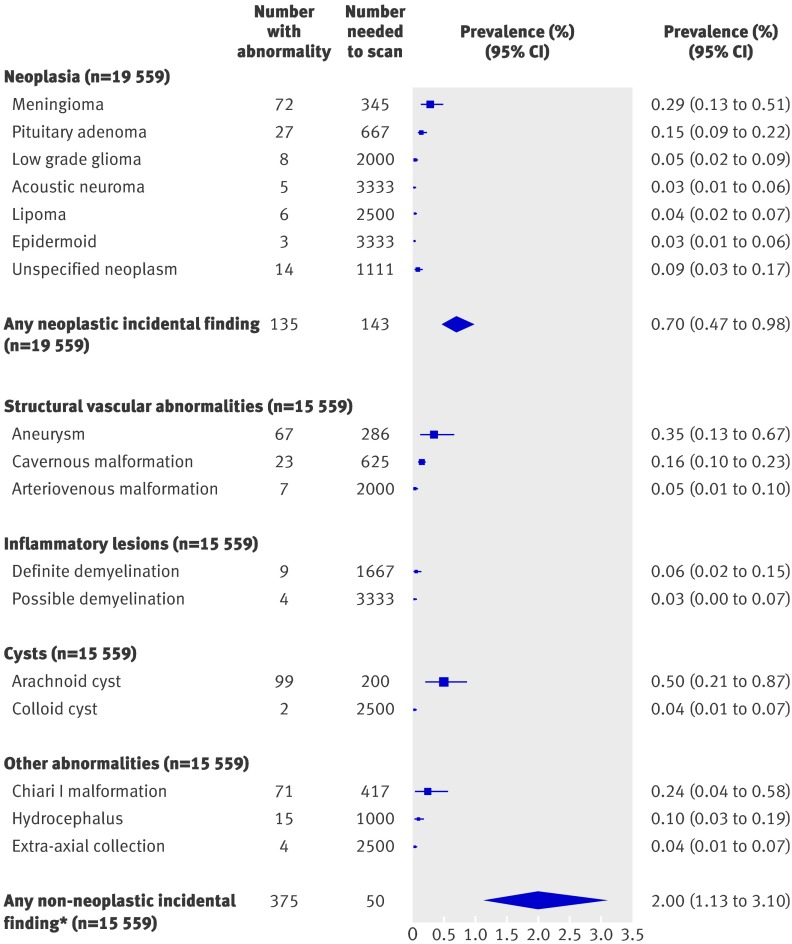
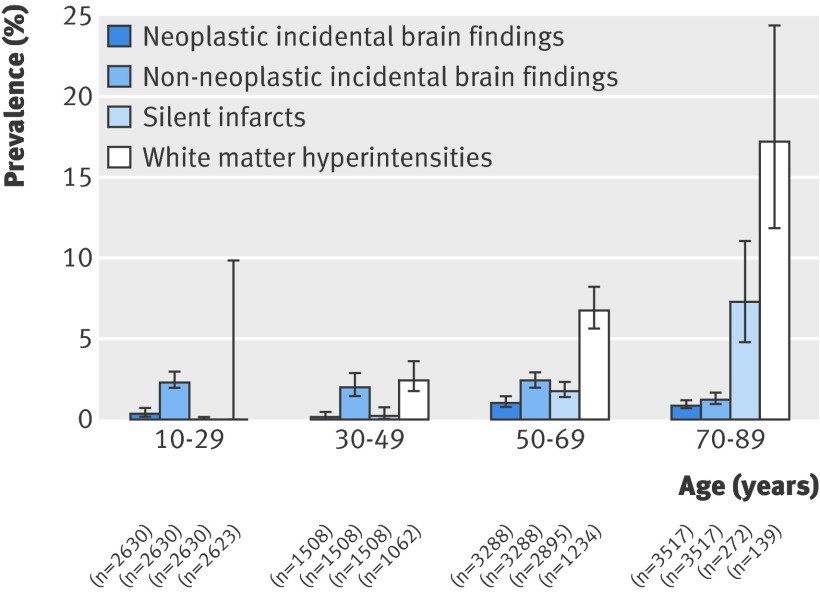
In 16 studies, 135 of 19 559 people had neoplastic incidental brain findings (prevalence 0.70%, 95% confidence interval 0.47% to 0.98%), and prevalence increased with age (chi(2) for linear trend, P=0.003). In 15 studies, 375 of 15 559 people had non-neoplastic incidental brain findings (prevalence 2.0%, 1.1% to 3.1%, excluding white matter hyperintensities, silent infarcts, and microbleeds). The number of asymptomatic people needed to scan to detect any incidental brain finding was 37. The prevalence of incidental brain findings was higher in studies using high resolution MRI sequences than in those using standard resolution sequences (4.3% v 1.7%, P<0.001). The prevalence of neoplastic incidental brain findings increased with age.
Incidental findings on brain MRI are common, prevalence increases with age, and detection is more likely using high resolution MRI sequences than standard resolution sequences. These findings deserve to be mentioned when obtaining informed consent for brain MRI in research and clinical practice but are not sufficient to justify screening healthy asymptomatic people.
量化脑部磁共振成像(MRI)中偶然发现的发生率。
对观察性研究进行系统评价和荟萃分析。
Ovid Medline(1950年至2008年5月)、Embase(1980年至2008年5月)以及相关文章的参考文献。综述方法:两名综述者检索并评估了针对无神经系统症状人群的研究,这些人群因研究目的或职业、临床或商业筛查接受了脑部MRI检查,检查时使用或未使用静脉造影剂。
通过随机效应模型中使用DerSimonian-Laird权重对合并比例进行荟萃分析,计算脑部偶然发现的总体疾病特异性和年龄特异性发生率。
在16项研究中,19559人中有135人有脑部肿瘤性偶然发现(发生率0.70%,95%置信区间0.47%至0.98%),且发生率随年龄增加(线性趋势的卡方检验,P = 0.003)。在15项研究中,15559人中有375人有脑部非肿瘤性偶然发现(发生率2.0%,1.1%至3.1%,不包括白质高信号、无症状梗死和微出血)。检测到任何脑部偶然发现所需扫描的无症状人数为37人。使用高分辨率MRI序列的研究中脑部偶然发现的发生率高于使用标准分辨率序列的研究(4.3%对1.7%,P<0.001)。脑部肿瘤性偶然发现的发生率随年龄增加。
脑部MRI的偶然发现很常见,发生率随年龄增加,使用高分辨率MRI序列比标准分辨率序列更易检测到。在研究和临床实践中获取脑部MRI知情同意时应提及这些发现,但不足以证明对健康无症状人群进行筛查是合理的。