Sathyamangalam Ramesh Ve, Paul Pradeep G, George Ronnie, Baskaran Mani, Hemamalini Arvind, Madan Raj V, Augustian J, Prema Raju, Lingam Vijaya
Glaucoma Project, Vision Research Foundation, Sankara Nethralaya, Chennai, India.
Indian J Ophthalmol. 2009 Sep-Oct;57(5):355-60. doi: 10.4103/0301-4738.55073.
To assess the awareness and knowledge levels about glaucoma and its determinants in an urban population of Chennai in south India.
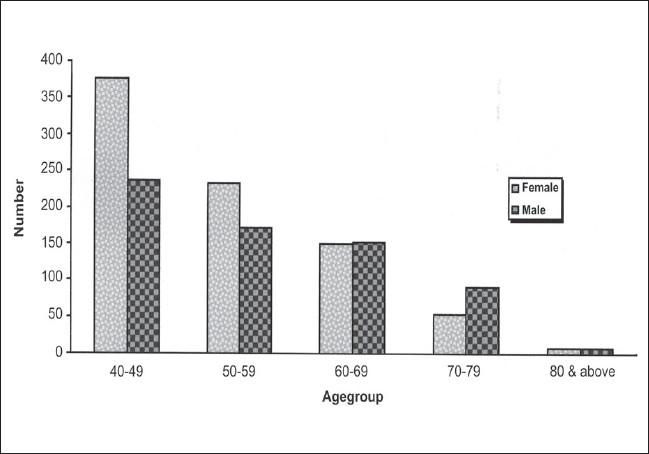
Chennai glaucoma study (CGS) was a population based prevalence study to estimate the prevalence of glaucoma in a rural and urban south Indian population. A total of 3850 subjects aged 40 years or above participated in the urban arm of CGS. A systematic random sample of 1926 (50.0%) subjects completed a questionnaire that assesses their awareness and knowledge level of glaucoma. Respondents "having heard of glaucoma" even before they were contacted/recruited for the study were defined as "aware" and respondents having some understanding of the eye disease were defined as "knowledgeable".
Overall 13.5% were aware of glaucoma, the age-gender adjusted rate for awareness was 13.3% (95% CI: 11.57 to 15.03). Two clinicians graded knowledge on glaucoma, based on the subject's knowledge of risk factors, definitions and treatment aspects of glaucoma. Overall 8.7% had some knowledge about glaucoma. Among those who had knowledge 0.5% had good knowledge about glaucoma, 4% had fair knowledge and 4.2% had poor knowledge. We observed a very good agreement between the clinicians in grading knowledge (k =0.92). Determinants of glaucoma awareness and knowledge were higher levels of education, females, age, religion and family history of glaucoma.
Awareness and knowledge about glaucoma was very low among the urban population of Chennai. We have found that younger subjects and men were less aware of glaucoma. Subjects with lower levels of education were less aware and knew less about glaucoma than their counterparts. The study findings stress the need for health education for effective prevention of blindness due to glaucoma.
评估印度南部钦奈城市人口对青光眼及其决定因素的知晓度和知识水平。
钦奈青光眼研究(CGS)是一项基于人群的患病率研究,旨在估计印度南部农村和城市人口中青光眼的患病率。共有3850名40岁及以上的受试者参与了CGS的城市部分研究。1926名(50.0%)受试者通过系统随机抽样完成了一份评估其青光眼知晓度和知识水平的问卷。在联系/招募参加研究之前“听说过青光眼”的受访者被定义为“知晓”,对该眼病有一定了解的受访者被定义为“有知识”。
总体上13.5%的人知晓青光眼,年龄和性别调整后的知晓率为13.3%(95%置信区间:11.57至15.03)。两名临床医生根据受试者对青光眼危险因素、定义和治疗方面的知识对青光眼知识进行分级。总体上8.7%的人对青光眼有一定了解。在有知识的人群中,0.5%的人对青光眼有良好的了解,4%的人有中等程度的了解,4.2%的人了解较少。我们观察到临床医生在知识分级方面有非常好的一致性(k = 0.92)。青光眼知晓度和知识的决定因素包括较高的教育水平、女性、年龄、宗教信仰和青光眼家族史。
钦奈城市人口中对青光眼的知晓度和知识水平非常低。我们发现年轻受试者和男性对青光眼的知晓度较低。教育水平较低的受试者比其同龄人对青光眼的知晓度更低且了解更少。研究结果强调了开展健康教育以有效预防青光眼致盲的必要性。