Department of Biological Sciences, University of Idaho, Moscow, Idaho, United States of America.
PLoS One. 2009 Aug 4;4(8):e6494. doi: 10.1371/journal.pone.0006494.
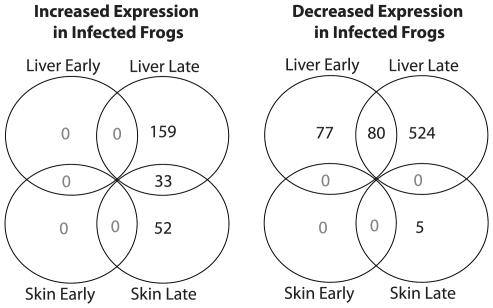
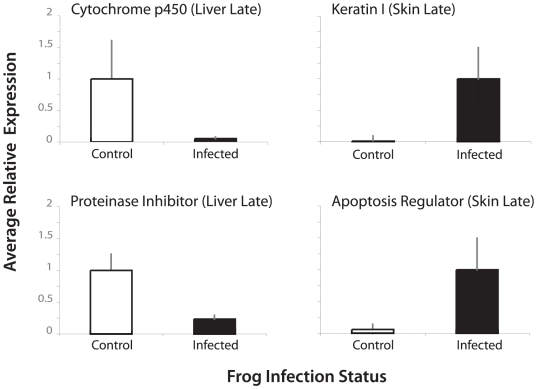
Emerging infectious diseases are of great concern for both wildlife and humans. Several highly virulent fungal pathogens have recently been discovered in natural populations, highlighting the need for a better understanding of fungal-vertebrate host-pathogen interactions. Because most fungal pathogens are not fatal in the absence of other predisposing conditions, host-pathogen dynamics for deadly fungal pathogens are of particular interest. The chytrid fungus Batrachochytrium dendrobatidis (hereafter Bd) infects hundreds of species of frogs in the wild. It is found worldwide and is a significant contributor to the current global amphibian decline. However, the mechanism by which Bd causes death in amphibians, and the response of the host to Bd infection, remain largely unknown. Here we use whole-genome microarrays to monitor the transcriptional responses to Bd infection in the model frog species, Silurana (Xenopus) tropicalis, which is susceptible to chytridiomycosis. To elucidate the immune response to Bd and evaluate the physiological effects of chytridiomycosis, we measured gene expression changes in several tissues (liver, skin, spleen) following exposure to Bd. We detected a strong transcriptional response for genes involved in physiological processes that can help explain some clinical symptoms of chytridiomycosis at the organismal level. However, we detected surprisingly little evidence of an immune response to Bd exposure, suggesting that this susceptible species may not be mounting efficient innate and adaptive immune responses against Bd. The weak immune response may be partially explained by the thermal conditions of the experiment, which were optimal for Bd growth. However, many immune genes exhibited decreased expression in Bd-exposed frogs compared to control frogs, suggesting a more complex effect of Bd on the immune system than simple temperature-mediated immune suppression. This study generates important baseline data for ongoing efforts to understand differences in response to Bd between susceptible and resistant frog species and the effects of chytridiomycosis in natural populations.
新发传染病对野生动物和人类都有很大的关注。最近在自然种群中发现了几种高毒力的真菌病原体,这凸显了更好地理解真菌-脊椎动物宿主-病原体相互作用的必要性。由于大多数真菌病原体在没有其他易患条件的情况下并不致命,因此致命真菌病原体的宿主-病原体动态特别有趣。两栖动物壶菌(Batrachochytrium dendrobatidis,简称 Bd)感染了野外数百种青蛙。它在世界范围内都有发现,是当前全球两栖动物减少的主要原因之一。然而,Bd 如何导致两栖动物死亡以及宿主对 Bd 感染的反应,在很大程度上仍不清楚。在这里,我们使用全基因组微阵列来监测模型蛙种 Silurana(Xenopus)tropicalis 对 Bd 感染的转录反应,该蛙种易患壶菌病。为了阐明对 Bd 的免疫反应并评估壶菌病的生理影响,我们测量了暴露于 Bd 后几种组织(肝脏、皮肤、脾脏)的基因表达变化。我们检测到与生理过程相关的基因的强烈转录反应,这有助于解释在机体水平上一些壶菌病的临床症状。然而,我们几乎没有发现对 Bd 暴露的免疫反应的证据,这表明这种易感物种可能没有针对 Bd 产生有效的先天和适应性免疫反应。弱免疫反应可能部分解释了实验的热条件,这些条件对 Bd 的生长最有利。然而,与对照蛙相比,Bd 暴露的蛙中许多免疫基因的表达降低,这表明 Bd 对免疫系统的影响比简单的温度介导的免疫抑制更为复杂。这项研究为正在进行的努力提供了重要的基线数据,以了解易感和抗性蛙种对 Bd 的反应差异以及壶菌病在自然种群中的影响。