Department of Molecular Biology and NCCR Frontiers in Genetics, Sciences III, University of Geneva, Geneva, Switzerland.
PLoS Biol. 2009 Sep;7(9):e1000181. doi: 10.1371/journal.pbio.1000181. Epub 2009 Sep 1.
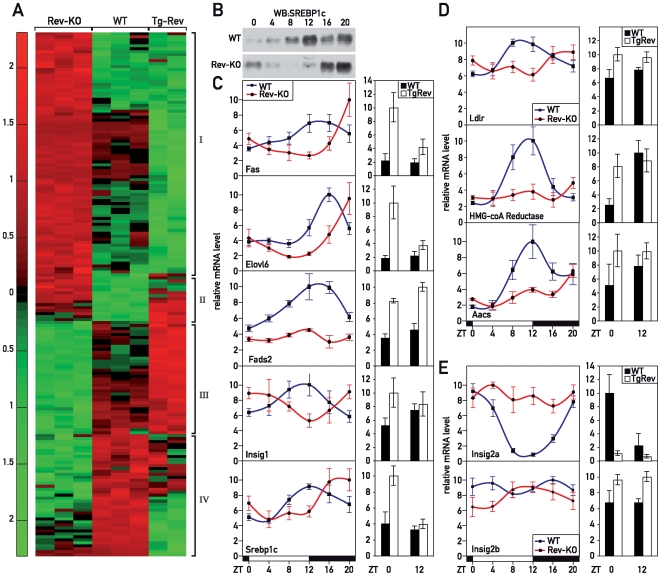
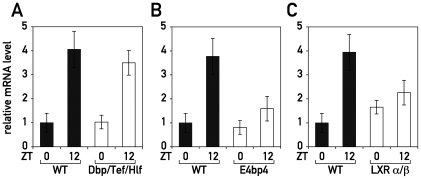
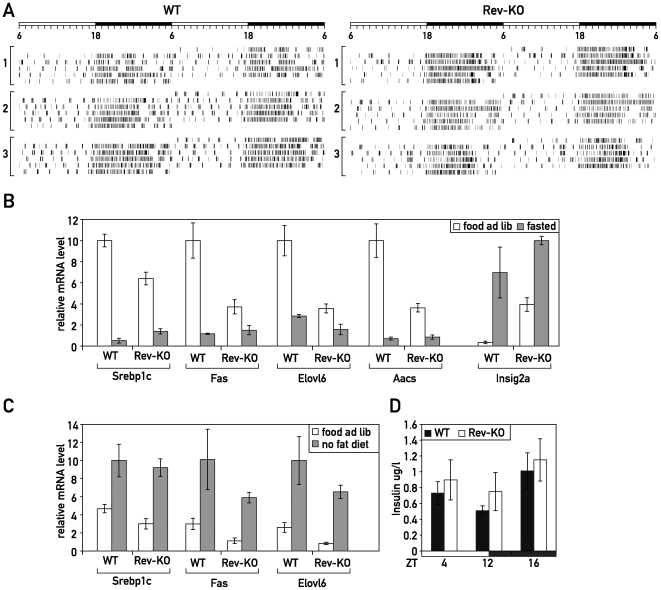
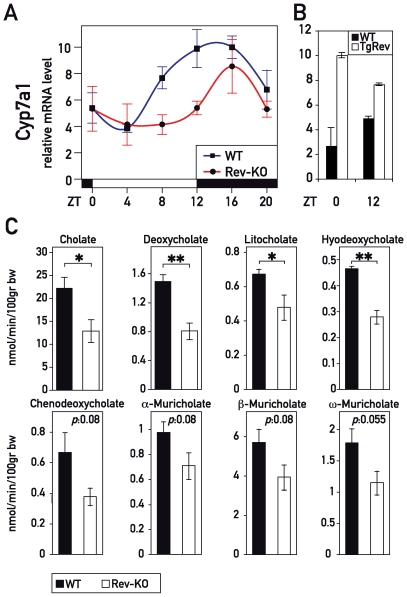
In mammals, many aspects of behavior and physiology, and in particular cellular metabolism, are coordinated by the circadian timing system. Molecular clocks are thought to rely on negative feedback loops in clock gene expression that engender oscillations in the accumulation of transcriptional regulatory proteins, such as the orphan receptor REV-ERBalpha. Circadian transcription factors then drive daily rhythms in the expression of clock-controlled output genes, for example genes encoding enzymes and regulators of cellular metabolism. To gain insight into clock output functions of REV-ERBalpha, we carried out genome-wide transcriptome profiling experiments with liver RNA from wild-type mice, Rev-erbalpha knock-out mice, or REV-ERBalpha overexpressing mice. On the basis of these genetic loss- and gain-of-function experiments, we concluded that REV-ERBalpha participates in the circadian modulation of sterol regulatory element-binding protein (SREBP) activity, and thereby in the daily expression of SREBP target genes involved in cholesterol and lipid metabolism. This control is exerted via the cyclic transcription of Insig2, encoding a trans-membrane protein that sequesters SREBP proteins to the endoplasmic reticulum membranes and thereby interferes with the proteolytic activation of SREBPs in Golgi membranes. REV-ERBalpha also participates in the cyclic expression of cholesterol-7alpha-hydroxylase (CYP7A1), the rate-limiting enzyme in converting cholesterol to bile acids. Our findings suggest that this control acts via the stimulation of LXR nuclear receptors by cyclically produced oxysterols. In conclusion, our study suggests that rhythmic cholesterol and bile acid metabolism is not just driven by alternating feeding-fasting cycles, but also by REV-ERBalpha, a component of the circadian clockwork circuitry.
在哺乳动物中,行为和生理的许多方面,尤其是细胞代谢,都受到生物钟系统的协调。分子钟被认为依赖于时钟基因表达的负反馈环,这些负反馈环产生转录调节蛋白(如孤儿受体 REV-ERBalpha)的积累振荡。生物钟转录因子然后驱动时钟控制输出基因的日常节律表达,例如编码细胞代谢酶和调节剂的基因。为了深入了解 REV-ERBalpha 的时钟输出功能,我们对野生型小鼠、Rev-erbalpha 敲除小鼠或 REV-ERBalpha 过表达小鼠的肝 RNA 进行了全基因组转录组谱分析实验。基于这些遗传功能获得和丧失实验,我们得出结论,REV-ERBalpha 参与固醇调节元件结合蛋白(SREBP)活性的昼夜调节,从而参与胆固醇和脂质代谢相关的 SREBP 靶基因的日常表达。这种控制是通过 Insig2 的循环转录来实现的,Insig2 编码一种跨膜蛋白,将 SREBP 蛋白隔离在内质网膜上,从而干扰高尔基膜中 SREBPs 的蛋白水解激活。REV-ERBalpha 还参与胆固醇-7alpha-羟化酶(CYP7A1)的循环表达,CYP7A1 是将胆固醇转化为胆汁酸的限速酶。我们的研究结果表明,这种控制作用是通过循环产生的氧化固醇刺激 LXR 核受体来实现的。总之,我们的研究表明,节律性胆固醇和胆汁酸代谢不仅由交替的进食-禁食周期驱动,还由生物钟电路的组成部分 REV-ERBalpha 驱动。