Kim Dong Wook, Rho Myung Ho, Kim Ki Nam
Department of Radiology, Busan Paik Hospital, Inje University College of Medicine, Pusan, Korea.
Korean J Radiol. 2009 Sep-Oct;10(5):441-6. doi: 10.3348/kjr.2009.10.5.441. Epub 2009 Aug 25.
This study was designed to evaluate the difference in the degree of patient pain for an ultrasound-guided fine-needle aspiration biopsy (USFNAB) of a thyroid nodule with one needle puncture with and without local anesthesia.
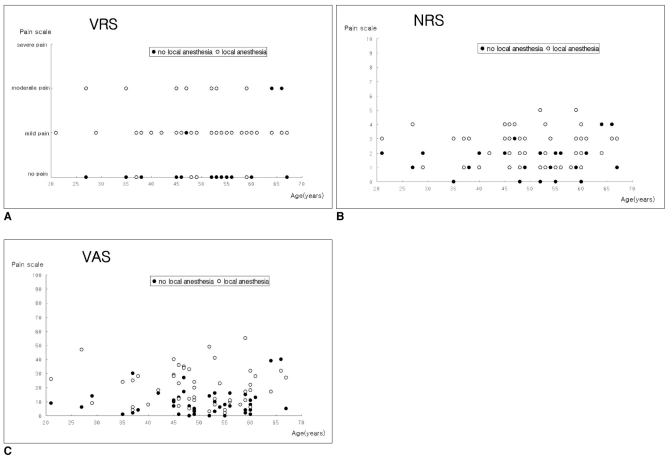
A total of 50 patients participated in the study. We examined prospective patients who would undergo US-FNABs of two thyroid nodules (larger than 10 mm maximum diameter), which were located in separate thyroid lobes. For one of these thyroid nodules, US-FNAB was performed following the administration of local anesthesia; for the other nodule, no anesthesia was administered. The application of anesthesia was alternatively administered between patients (either prior to the first US-FNAB procedure or prior to the second procedure). For all patients, the degree of pain during and after each US-guided FNAB was evaluated according to a 4-category verbal rating scale (VRS), an 11-point numeric rating scale (NRS) and a 100-mm visual analogue scale (VAS).
The mean maximum diameters of thyroid nodules examined by US-FNAB with the use of local anesthesia and with no local anesthesia were 13.6 mm and 13.0 mm, respectively. There was no significant difference in nodule size (p > 0.05) between two groups. For the VRS, there were 27 patients with a higher pain score when local anesthesia was used and four patients with a higher pain score when no local anesthesia was administered. Nineteen patients had equivalent pain score for both treatments. This finding was statistically significant (p < 0.001). For the NRS, there were 33 patients with a higher pain score when local anesthesia was used and 10 patients with a higher pain score when no local anesthesia was administered. Seven patients had an equivalent pain score for each treatment. This finding was statistically significant (p < 0.001). For the VAS, there were 35 patients with a higher pain score when local anesthesia was used and 11 patients with a higher pain score where no local anesthesia was administered. Four patients had an equivalent pain score for both treatments. This finding was also statistically significant (p = 0.001).
In our study, patient pain scales were significantly lower when no local anesthesia was used prior to US-FNABs of thyroid nodules as compared to when local anesthesia was administered. Therefore, we believe that when one needle puncture is used, US-FNAB should be performed without administering local anesthesia.
本研究旨在评估在超声引导下对甲状腺结节进行单针穿刺细针抽吸活检(USFNAB)时,局部麻醉与不进行局部麻醉情况下患者疼痛程度的差异。
共有50名患者参与本研究。我们对预期要接受两个甲状腺结节(最大直径大于10mm)的US-FNAB检查的患者进行了研究,这两个结节位于不同的甲状腺叶。对于其中一个甲状腺结节,在给予局部麻醉后进行US-FNAB;对于另一个结节,则不给予麻醉。麻醉的应用在患者之间交替进行(在第一次US-FNAB操作之前或第二次操作之前)。对于所有患者,根据4级语言评定量表(VRS)、11点数字评定量表(NRS)和100mm视觉模拟量表(VAS)评估每次超声引导下细针抽吸活检期间及之后的疼痛程度。
使用局部麻醉和未使用局部麻醉进行US-FNAB检查的甲状腺结节平均最大直径分别为13.6mm和13.0mm。两组结节大小无显著差异(p>0.05)。对于VRS,使用局部麻醉时有27例患者疼痛评分较高,未使用局部麻醉时有4例患者疼痛评分较高。19例患者两种治疗的疼痛评分相当。这一发现具有统计学意义(p<0.001)。对于NRS,使用局部麻醉时有33例患者疼痛评分较高,未使用局部麻醉时有10例患者疼痛评分较高。7例患者每种治疗的疼痛评分相当。这一发现具有统计学意义(p<0.001)。对于VAS,使用局部麻醉时有35例患者疼痛评分较高,未使用局部麻醉时有11例患者疼痛评分较高。4例患者两种治疗的疼痛评分相当。这一发现也具有统计学意义(p = 0.001)。
在我们的研究中,与给予局部麻醉相比,在对甲状腺结节进行US-FNAB之前不使用局部麻醉时患者的疼痛量表评分显著更低。因此,我们认为当采用单针穿刺时,US-FNAB应在不给予局部麻醉的情况下进行。