Department of Anatomy, School of Medical Sciences, University of Bristol, Bristol, UK.
J Neuroendocrinol. 2009 Nov;21(11):888-97. doi: 10.1111/j.1365-2826.2009.01912.x. Epub 2009 Sep 1.
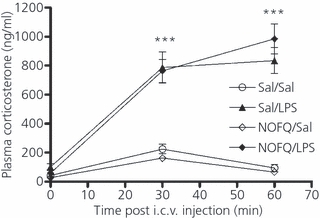
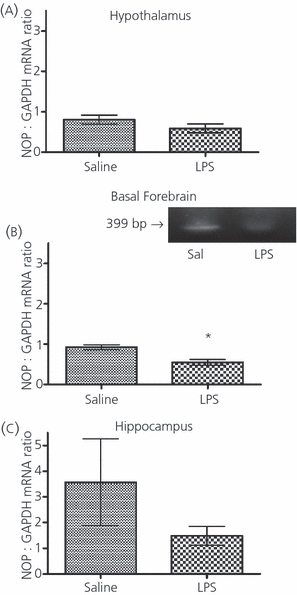
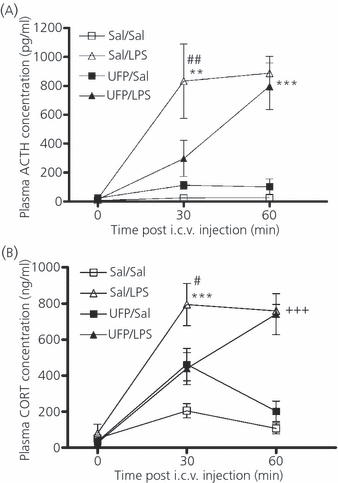
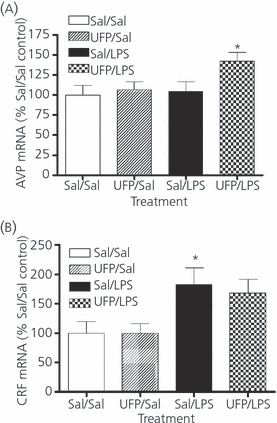
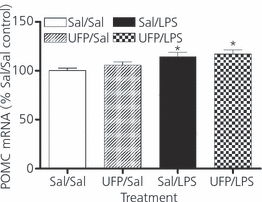
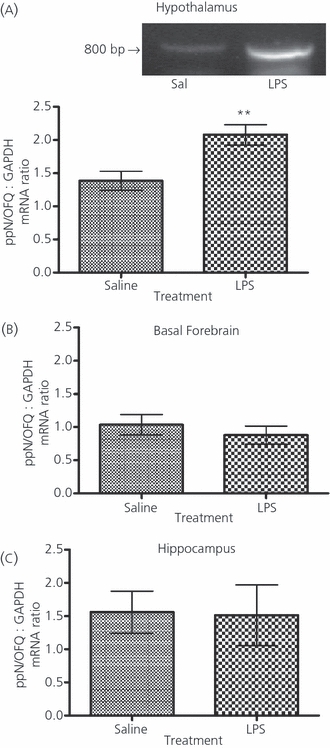
Nociceptin/orphanin FQ (N/OFQ) peptide and its receptor (NOP) function in the neuromodulation of anxiety, stress and hypothalamic-pituitary-adrenal (HPA) axis activity. We investigated the endogenous NOP system using the selective NOP antagonist, UFP-101, during the HPA axis response to bacterial endotoxin, lipopolysaccharide (LPS). Although i.c.v. N/OFQ (1 microg/rat) had no significant effect on LPS-induced (250 microg/rat i.p) plasma corticosterone release at 30 or 60 min post-i.c.v. injection, i.c.v. UFP-101 (1 microg/rat)/LPS significantly attenuated plasma adrenocorticotrophic hormone and corticosterone at the 30-min time-point compared to i.c.v saline (0.9%)/LPS. Parvocellular paraventricular nucleus (PVN) corticotrophin-releasing factor (CRF) and corticotrophic pro-opiomelanocortin (POMC), but not parvocellular PVN arginine vasopressin (AVP), mRNA expression was significantly increased by LPS compared to non-LPS control. Intracerebroventricular UFP-101/LPS treatment was associated with increased POMC mRNA expression 4 h after injection and a clear trend towards increased parvocellular CRF mRNA. Furthermore, i.c.v. UFP-101 was selectively associated with an LPS-induced increase in parvocellular AVP mRNA, an effect that was absent in the i.c.v saline/LPS group. To determine whether LPS challenge was associated with compensatory changes in N/OFQ precursor or NOP receptor mRNAs, in a separate study, we undertook reverse transcriptase-polymerase chain reaction analysis of preproN/OFQ and NOP transcripts. In support of an endogenous role for central N/OFQ in inflammatory stress, we found that LPS significantly increased preproN/OFQ transcript expression in the hypothalamus 4 h after injection compared to the saline control. No changes in preproN/OFQ mRNA level in the hippocampus or basal forebrain (including bed nucleus of stria terminalis) were seen, albeit at 4 h. LPS was associated with a significant attenuation of NOP mRNA in the basal forebrain at 4 h, possibly as a compensatory response to increased N/OFQ release. Although the exact mechanisms require elucidation, the findings obtained in the present study provide evidence indicating that the endogenous NOP system is involved in the acute HPA axis response to immune challenge.
孤啡肽/孤儿啡肽(N/OFQ)肽及其受体(NOP)在焦虑、应激和下丘脑-垂体-肾上腺(HPA)轴活动的神经调节中发挥作用。我们使用选择性 NOP 拮抗剂 UFP-101 研究了内源性 NOP 系统在 HPA 轴对细菌内毒素脂多糖(LPS)的反应中的作用。尽管脑室注射 N/OFQ(1μg/大鼠)在脑室注射后 30 或 60 分钟对 LPS 诱导的(250μg/大鼠腹腔内)血浆皮质酮释放没有显著影响,但脑室注射 UFP-101(1μg/大鼠)/LPS 与脑室注射生理盐水(0.9%)/LPS 相比,在 30 分钟时显著减弱了血浆促肾上腺皮质激素和皮质酮。室旁核(PVN)促肾上腺皮质释放因子(CRF)和促皮质素原(POMC)的小细胞,但不是 PVN 精氨酸加压素(AVP)的小细胞,mRNA 表达明显高于非 LPS 对照组。与 LPS 相比,脑室注射 UFP-101/LPS 治疗 4 小时后 POMC mRNA 表达增加,小细胞 CRF mRNA 表达增加趋势明显。此外,脑室注射 UFP-101 与 LPS 诱导的小细胞 AVP mRNA 增加有关,而在脑室注射生理盐水/LPS 组中则没有这种作用。为了确定 LPS 挑战是否与中枢 N/OFQ 前体或 NOP 受体 mRNAs 的代偿性变化有关,在另一项研究中,我们对 preproN/OFQ 和 NOP 转录物进行了逆转录聚合酶链反应分析。支持中枢 N/OFQ 在炎症应激中的内源性作用,我们发现 LPS 注射后 4 小时与生理盐水对照组相比,下丘脑 preproN/OFQ 转录物表达显著增加。在海马体或基底前脑(包括终纹床核)中未观察到 preproN/OFQ mRNA 水平的变化,尽管在 4 小时时观察到了变化。LPS 与 4 小时时基底前脑 NOP mRNA 的显著衰减有关,这可能是对 N/OFQ 释放增加的代偿反应。尽管确切的机制需要阐明,但本研究获得的结果提供了证据,表明内源性 NOP 系统参与了急性 HPA 轴对免疫挑战的反应。