Haidar Jemal A, Pobocik Rebecca S
School of Public Health, Addis Ababa University, P,O, Box: 27285/1000, Addis Ababa, Ethiopia.
BMC Blood Disord. 2009 Sep 7;9:7. doi: 10.1186/1471-2326-9-7.
In Ethiopia, the existence of iron deficiency anemia is controversial despite the fact that Ethiopia is one of the least developed in Africa with a high burden of nutrient deficiencies.
The first large nutrition study of a representative sample of women in Ethiopia was conducted from June to July 2005 and a systematically selected sub-sample of 970 of these subjects, 15 to 49 years old, were used in this analysis of nutritional anemia. Hemoglobin was measured from capillary blood using a portable HemoCue photometer. For serum ferritin, venous blood from antecubital veins was measured by an automated Elecsys 1020 using commercial kits. Diets were assessed via simplified food frequency questionnaire. The association of anemia to demographic and health variables was tested by chi-square and a stepwise backward logistic regression model was applied to test the significant associations observed in chi square tests.
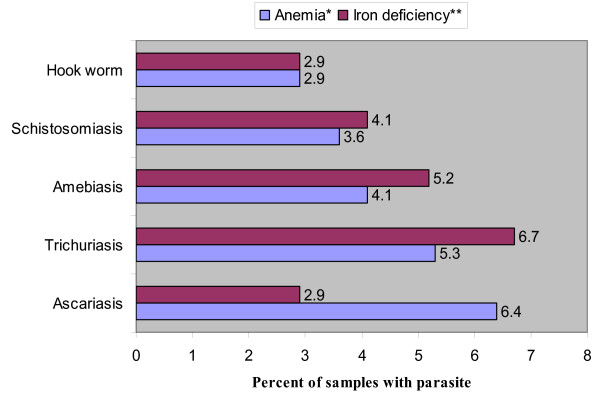
Mean hemoglobin +/- SD was 11.5 +/- 2.1 g/dL with a 29.4% prevalence of anemia. Mean serum ferritin was 58 +/- 41.1 ug/L with a 32.1% prevalence of iron deficiency. The overall prevalence rate of iron deficiency anemia was 18.0%. Prevalence of anemia, iron deficiency, and iron deficiency anemia was highest among those 31-49 years old (p < 0.05). Intake of vegetables less than once a day and meat less than once a week was common and was associated with increased anemia (p = 0.001). Although the prevalence of anemia was slightly higher among women with parasitic infestation the difference was not significant (p = 0.9). Nonetheless, anemia was significantly higher in women with history of illness and the association was retained even when the variable was adjusted for its confounding effect in the logistic regression models (AOR = 0.3; 95%CI = 0.17 to 0.5) signifying that the most probable causes of anemia is nutrition related and to some extent chronic illnesses.
Moderate nutritional anemia in the form of iron deficiency anemia is a problem in Ethiopia and therefore, the need for improved supplementation to vulnerable groups is warranted to achieve the United Nation's Millennium Development Goals. Chronic illnesses are another important cause of anemia.
尽管埃塞俄比亚是非洲最不发达且营养缺乏负担沉重的国家之一,但缺铁性贫血的存在情况仍存在争议。
2005年6月至7月对埃塞俄比亚有代表性的女性样本进行了首次大型营养研究,在这些受试者中系统选取了970名年龄在15至49岁的子样本用于本次营养性贫血分析。使用便携式HemoCue光度计从毛细血管血中测量血红蛋白。对于血清铁蛋白,使用商用试剂盒通过自动Elecsys 1020测定来自肘前静脉的静脉血。通过简化食物频率问卷评估饮食情况。通过卡方检验贫血与人口统计学和健康变量之间的关联,并应用逐步向后逻辑回归模型来检验在卡方检验中观察到的显著关联。
血红蛋白均值±标准差为11.5±2.1 g/dL,贫血患病率为29.4%。血清铁蛋白均值为58±41.1 μg/L,缺铁患病率为32.1%。缺铁性贫血的总体患病率为18.0%。贫血、缺铁和缺铁性贫血的患病率在31至49岁人群中最高(p<0.05)。每天蔬菜摄入量少于一次且每周肉类摄入量少于一次的情况很常见,且与贫血增加相关(p = 0.001)。尽管寄生虫感染女性的贫血患病率略高,但差异不显著(p = 0.9)。然而,有疾病史的女性贫血患病率显著更高,即使在逻辑回归模型中对该变量的混杂效应进行调整后,这种关联仍然存在(调整后比值比 = 0.3;95%置信区间 = 0.17至0.5),这表明贫血最可能的原因与营养相关,在一定程度上也与慢性病有关。
以缺铁性贫血形式存在的中度营养性贫血在埃塞俄比亚是一个问题,因此,为实现联合国千年发展目标,有必要对弱势群体加强补充。慢性病是贫血的另一个重要原因。