Kreuzer Wolfgang, Majdak Piotr, Chen Zhengsheng
Acoustics Research Institute, Austrian Academy of Sciences, Wohllebengasse 12-14, Vienna, Austria.
J Acoust Soc Am. 2009 Sep;126(3):1280-90. doi: 10.1121/1.3177264.
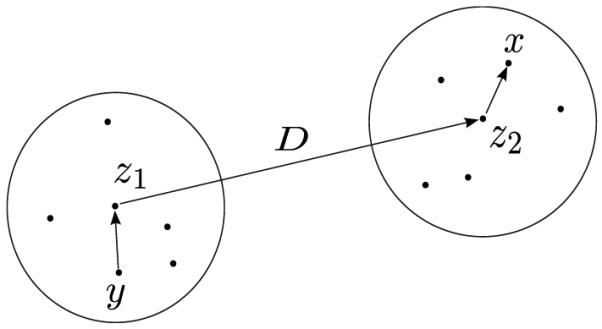
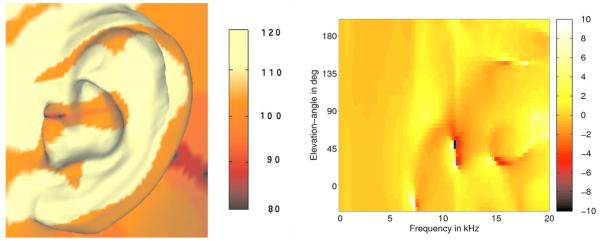
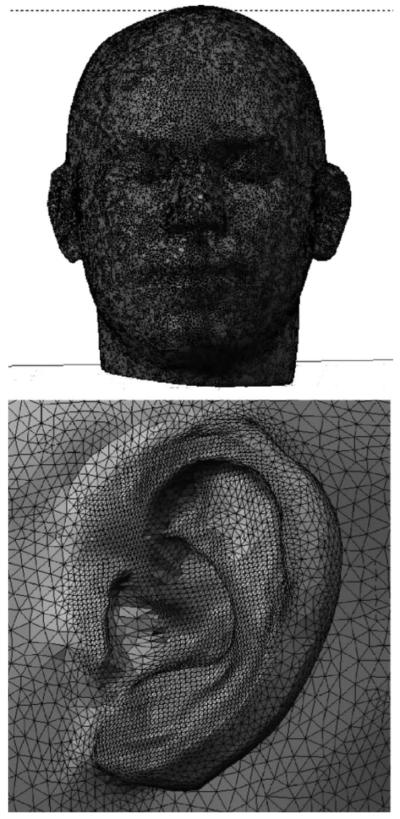
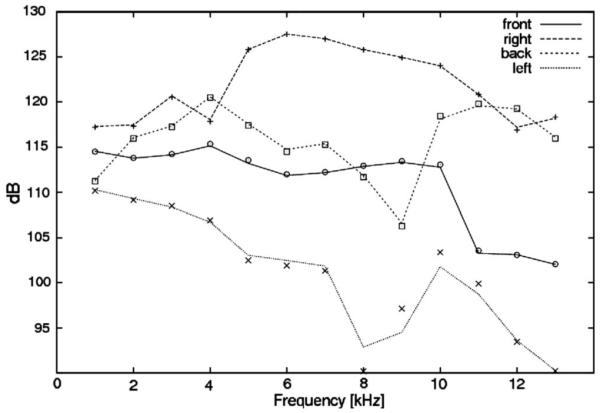
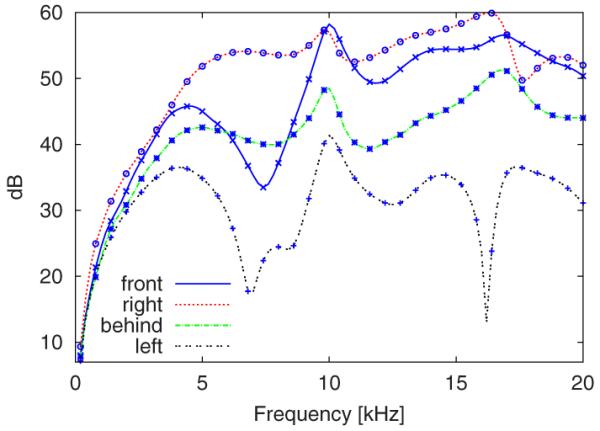
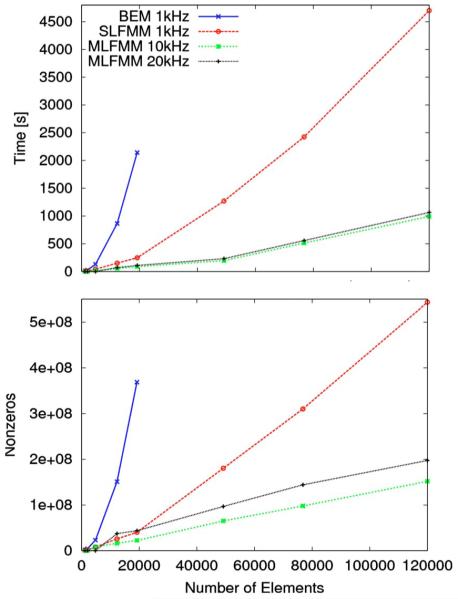
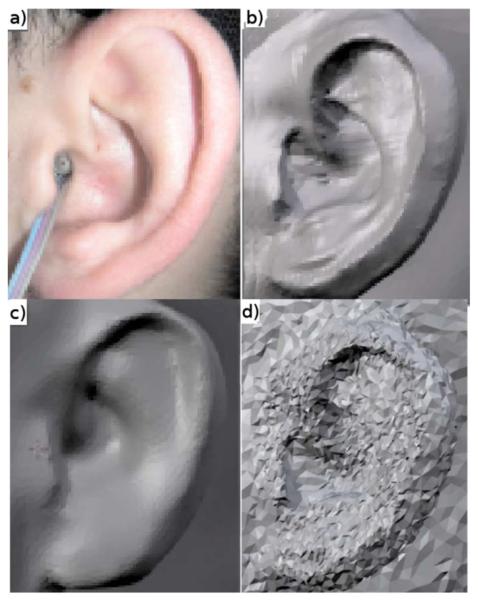
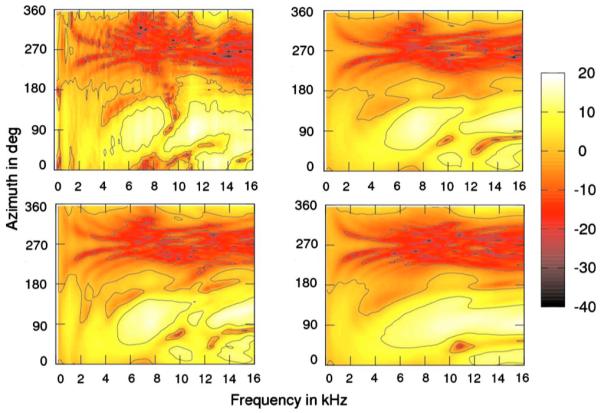
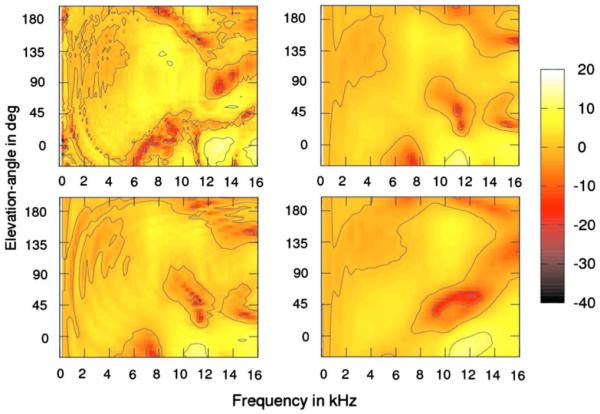
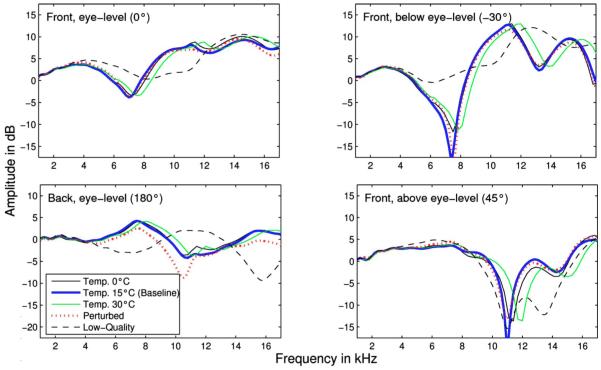
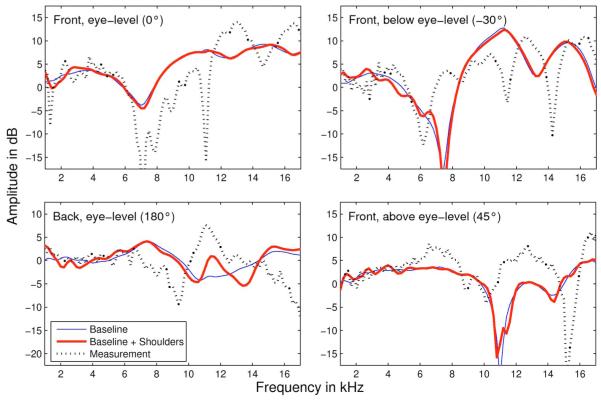
Head-related transfer functions (HRTFs) play an important role in spatial sound localization. The boundary element method (BEM) can be applied to calculate HRTFs from non-contact visual scans. Because of high computational complexity, HRTF simulations with BEM for the whole head and pinnae have only been performed for frequencies below 10 kHz. In this study, the fast multipole method (FMM) is coupled with BEM to simulate HRTFs for a wide frequency range. The basic approach of the FMM and its implementation are described. A mesh with over 70 000 elements was used to calculate HRTFs for one subject. With this mesh, the method allowed to calculate HRTFs for frequencies up to 35 kHz. Comparison to acoustically-measured HRTFs has been performed for frequencies up to 16 kHz, showing a good congruence below 7 kHz. Simulations with an additional shoulder mesh improved the congruence in the vertical direction. Reduction in the mesh size by 5% resulted in a substantially-worse representation of spectral cues. The effects of temperature and mesh perturbation were negligible. The FMM appears to be a promising approach for HRTF simulations. Further limitations and potential advantages of the FMM-coupled BEM are discussed.
头部相关传递函数(HRTFs)在空间声音定位中起着重要作用。边界元法(BEM)可用于从非接触式视觉扫描中计算HRTFs。由于计算复杂度高,仅对低于10 kHz的频率进行了使用BEM对整个头部和耳廓进行的HRTF模拟。在本研究中,快速多极子方法(FMM)与BEM相结合,以在宽频率范围内模拟HRTFs。描述了FMM的基本方法及其实现。使用具有超过70000个单元的网格为一名受试者计算HRTFs。使用该网格,该方法能够计算高达35 kHz频率的HRTFs。已对高达16 kHz的频率进行了与声学测量的HRTFs的比较,结果表明在7 kHz以下具有良好的一致性。使用额外的肩部网格进行模拟改善了垂直方向上的一致性。网格尺寸减小5%会导致频谱线索的表示明显变差。温度和网格扰动的影响可忽略不计。FMM似乎是一种用于HRTF模拟的有前途的方法。讨论了FMM耦合BEM的进一步局限性和潜在优势。