Donovan Jesse, Copeland Paul R
Department of Molecular Genetics, Microbiology, and Immunology, Graduate School of Biomedical Sciences, University of Medicine and Dentistry of New Jersey - Robert Wood Johnson Medical School, Piscataway, NJ, USA.
BMC Evol Biol. 2009 Sep 10;9:229. doi: 10.1186/1471-2148-9-229.
The co-translational incorporation of selenocysteine into nascent polypeptides by recoding the UGA stop codon occurs in all domains of life. In eukaryotes, this event requires at least three specific factors: SECIS binding protein 2 (SBP2), a specific translation elongation factor (eEFSec), selenocysteinyl tRNA, and a cis-acting selenocysteine insertion sequence (SECIS) element in selenoprotein mRNAs. While the phylogenetic relationships of selenoprotein families and the evolution of selenocysteine usage are well documented, the evolutionary history of SECIS binding proteins has not been explored.
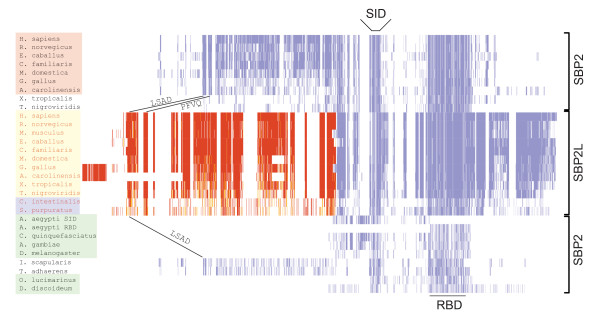
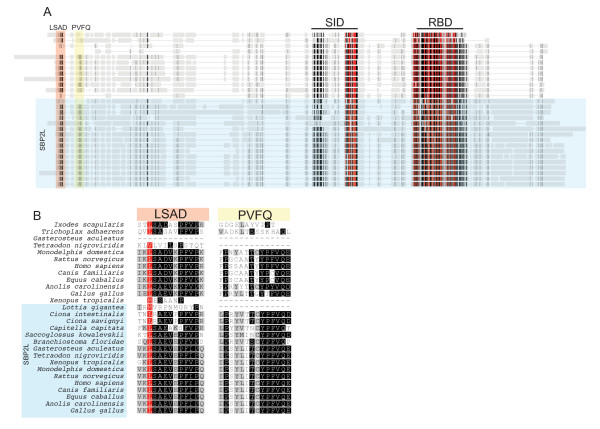
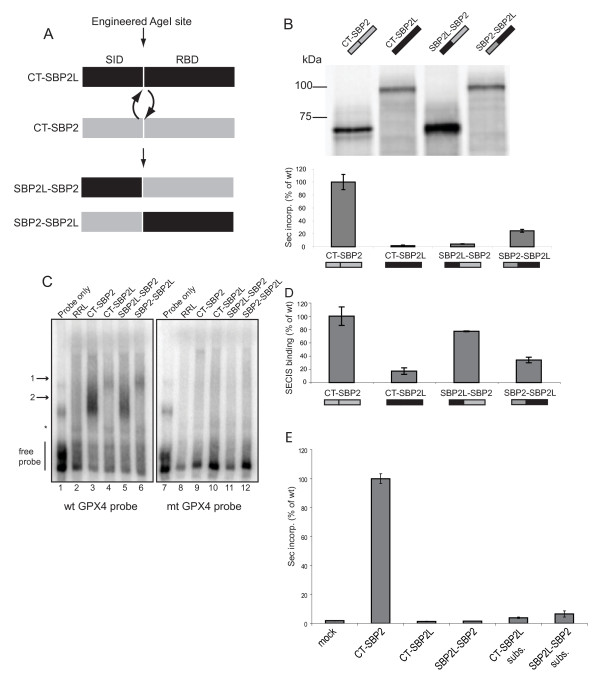
In this report we present a phylogeny of the eukaryotic SECIS binding protein family which includes SBP2 and a related protein we herein term SBP2L. Here we show that SBP2L is an SBP2 paralogue in vertebrates and is the only form of SECIS binding protein in invertebrate deuterostomes, suggesting a key role in Sec incorporation in these organisms, but an SBP2/SBP2L fusion protein is unable to support Sec incorporation in vitro. An in-depth phylogenetic analysis of the conserved L7Ae RNA binding domain suggests an ancestral relationship with ribosomal protein L30. In addition, we describe the emergence of a motif upstream of the SBP2 RNA binding domain that shares significant similarity with a motif within the pseudouridine synthase Cbf5.
Our analysis suggests that SECIS binding proteins arose once in evolution but diverged significantly in multiple lineages. In addition, likely due to a gene duplication event in the early vertebrate lineage, SBP2 and SBP2L are paralogous in vertebrates.
通过对UGA终止密码子进行重编码,将硒代半胱氨酸共翻译掺入新生多肽的过程发生在生命的所有领域。在真核生物中,这一过程至少需要三个特定因子:SECIS结合蛋白2(SBP2)、特定的翻译延伸因子(eEFSec)、硒代半胱氨酰tRNA以及硒蛋白mRNA中的顺式作用硒代半胱氨酸插入序列(SECIS)元件。虽然硒蛋白家族的系统发育关系和硒代半胱氨酸使用的进化已有充分记录,但SECIS结合蛋白的进化历史尚未得到探索。
在本报告中,我们展示了真核生物SECIS结合蛋白家族的系统发育,该家族包括SBP2和我们在此称为SBP2L的相关蛋白。我们在此表明,SBP2L是脊椎动物中的SBP2旁系同源物,并且是无脊椎后口动物中SECIS结合蛋白的唯一形式,这表明其在这些生物体中硒代半胱氨酸掺入过程中起关键作用,但SBP2/SBP2L融合蛋白在体外无法支持硒代半胱氨酸的掺入。对保守的L7Ae RNA结合结构域的深入系统发育分析表明,它与核糖体蛋白L30存在祖先关系。此外,我们描述了SBP2 RNA结合结构域上游一个基序的出现,该基序与假尿苷合酶Cbf5中的一个基序具有显著相似性。
我们的分析表明,SECIS结合蛋白在进化中只出现过一次,但在多个谱系中发生了显著分化。此外,可能由于早期脊椎动物谱系中的基因复制事件,SBP2和SBP2L在脊椎动物中是旁系同源物。