Division of HIV/AIDS at San Francisco General Hospital, 995 Potrero Avenue, Building 80, San Francisco, CA 94110, USA.
J Acquir Immune Defic Syndr. 2010 Mar;53(3):405-11. doi: 10.1097/QAI.0b013e3181b843f0.
Losses to follow-up after initiation of antiretroviral therapy (ART) are common in Africa and are a considerable obstacle to understanding the effectiveness of nascent treatment programs. We sought to characterize, through a sampling-based approach, reasons for and outcomes of patients who become lost to follow-up.
Cohort study.
We searched for and interviewed a representative sample of lost patients or close informants in the community to determine reasons for and outcomes among lost patients.
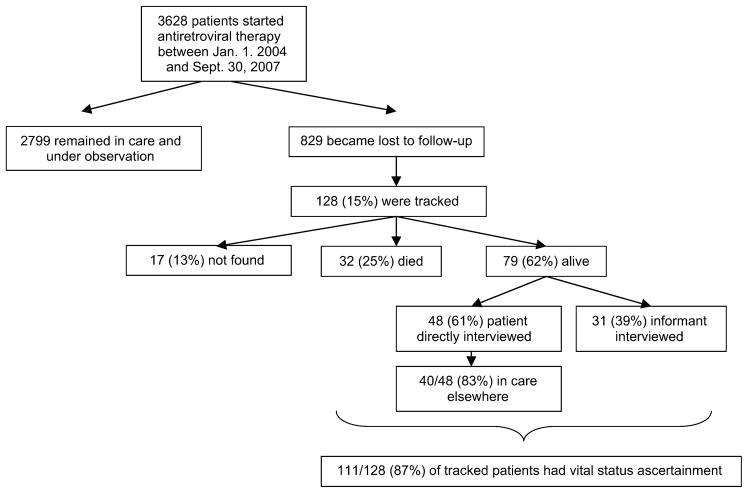
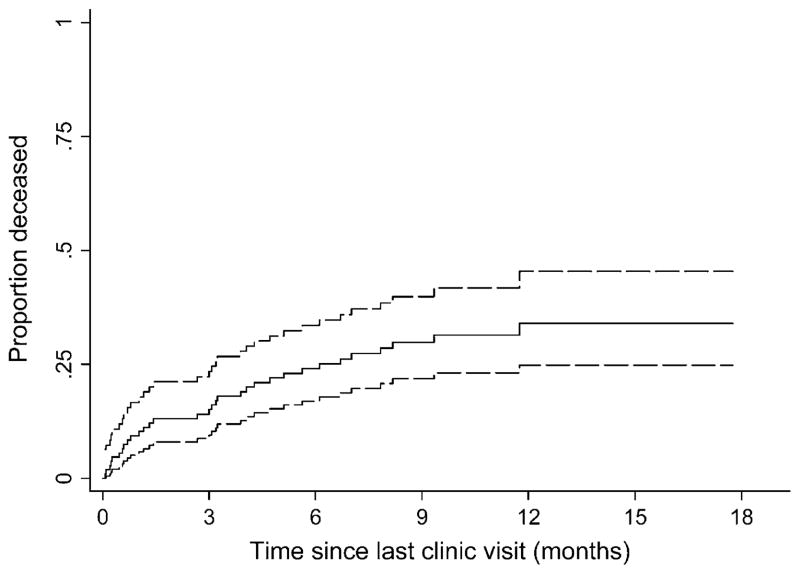
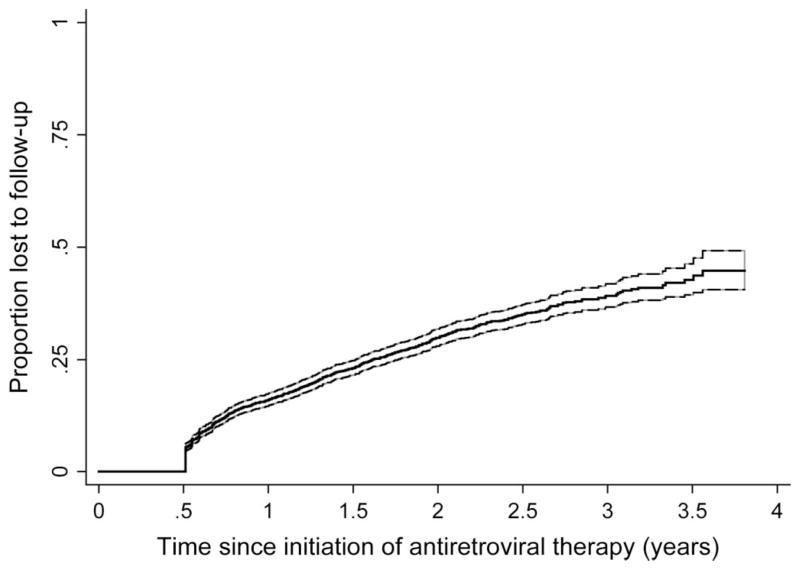
Three thousand six hundred twenty-eight HIV-infected adults initiated ART between January 1, 2004 and September 30, 2007 in Mbarara, Uganda. Eight hundred twenty-nine became lost to follow-up (cumulative incidence at 1, 2, and 3 years of 16%, 30%, and 39%). We sought a representative sample of 128 lost patients in the community and ascertained vital status in 111 (87%). Top reasons for loss included lack of transportation or money and work/child care responsibilities. Among the 111 lost patients who had their vital status ascertained through tracking, 32 deaths occurred (cumulative 1-year incidence 36%); mortality was highest shortly after the last clinic visit. Lower pre-ART CD4 T-cell count, older age, low blood pressure, and a central nervous system syndrome at the last clinic visit predicted deaths. Of patients directly interviewed, 83% were in care at another clinic and 71% were still using ART.
Sociostructural factors are the primary reasons for loss to follow-up. Outcomes among the lost are heterogeneous: both deaths and transfers to other clinics were common. Tracking a sample of lost patients is an efficient means for programs to understand site-specific reasons for and outcomes among patients lost to follow-up.
在开始抗逆转录病毒疗法(ART)后,患者失访的情况在非洲很常见,这对了解新生治疗方案的效果构成了相当大的障碍。我们试图通过抽样方法来描述失访患者的原因和结局。
队列研究。
我们搜索并采访了社区中具有代表性的失访患者或其密切知情人,以确定失访患者的原因和结局。
2004 年 1 月 1 日至 2007 年 9 月 30 日期间,乌干达姆巴拉拉有 3628 名 HIV 感染成年人开始接受 ART。829 人失访(1、2、3 年的累积发生率为 16%、30%和 39%)。我们在社区中寻求了一个有代表性的 128 名失访患者样本,并在 111 名(87%)中确定了他们的生死状况。失访的主要原因包括交通或资金不足,以及工作/儿童保育责任。在通过追踪确定生死状况的 111 名失访患者中,有 32 人死亡(1 年累积发生率为 36%);死亡率在最后一次就诊后不久最高。较低的 ART 前 CD4 T 细胞计数、年龄较大、血压较低和上次就诊时出现的中枢神经系统综合征预测了死亡。在直接接受采访的患者中,83%在另一家诊所接受治疗,71%仍在使用 ART。
社会结构因素是导致失访的主要原因。失访患者的结局存在异质性:死亡和转至其他诊所都很常见。跟踪失访患者样本是了解特定地点失访患者的原因和结局的有效方法。