Rowe Meredith L, Ozçalişkan Seyda, Goldin-Meadow Susan
University of Chicago.
First Lang. 2008 Jan 1;28(2):182-199. doi: 10.1177/0142723707088310.
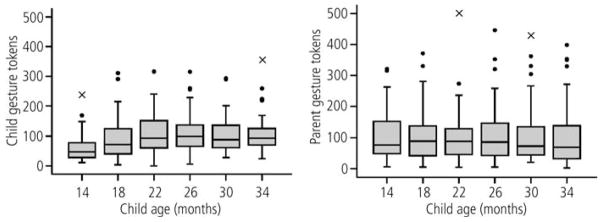
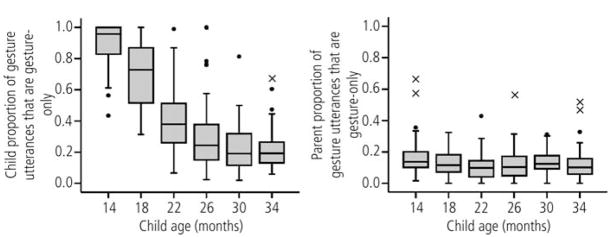
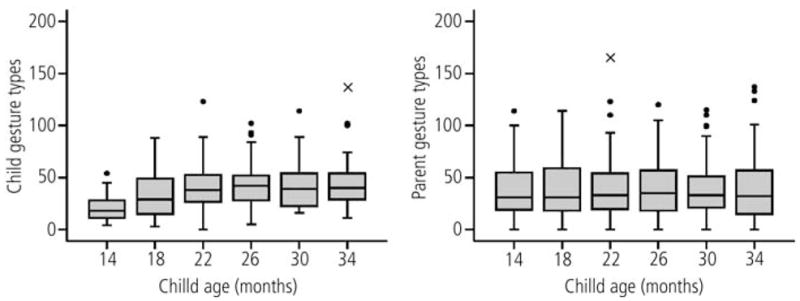
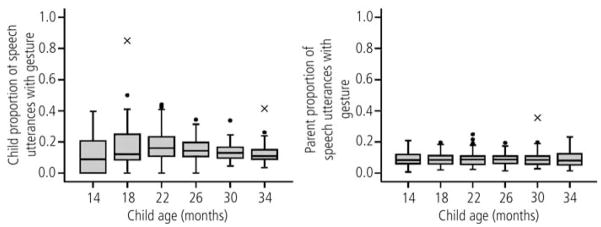
Children vary widely in how quickly their vocabularies grow. Can looking at early gesture use in children and parents help us predict this variability? We videotaped 53 English-speaking parent-child dyads in their homes during their daily activities for 90-minutes every four months between child age 14 and 34 months. At 42 months, children were given the Peabody Picture Vocabulary Test (PPVT). We found that child gesture use at 14 months was a significant predictor of vocabulary size at 42 months, above and beyond the effects of parent and child word use at 14 months. Parent gesture use at 14 months was not directly related to vocabulary development, but did relate to child gesture use at 14 months which, in turn, predicted child vocabulary. These relations hold even when background factors such as socio-economic status are controlled. The findings underscore the importance of examining early gesture when predicting child vocabulary development.
儿童词汇量增长的速度差异很大。观察儿童及其父母早期的手势运用能否帮助我们预测这种差异呢?我们对53个说英语的亲子对进行了录像,在孩子14个月至34个月大期间,每四个月一次,每次90分钟,记录他们在家中的日常活动。在孩子42个月大时,对他们进行了皮博迪图片词汇测试(PPVT)。我们发现,14个月大时孩子的手势运用是42个月大时词汇量大小的一个重要预测指标,这一指标超出了14个月大时父母和孩子词汇运用的影响。14个月大时父母的手势运用与词汇发展没有直接关系,但与14个月大时孩子的手势运用有关,而孩子的手势运用反过来又能预测孩子的词汇量。即使控制了社会经济地位等背景因素,这些关系依然成立。研究结果强调了在预测儿童词汇发展时考察早期手势的重要性。