XXscience, Koningsdam 1, Rotterdam, The Netherlands.
BMC Health Serv Res. 2009 Sep 26;9:175. doi: 10.1186/1472-6963-9-175.
Collaborative approaches in quality improvement have been promoted since the introduction of the Breakthrough method. The effectiveness of this method is inconclusive and further independent evaluation of the method has been called for. For any evaluation to succeed, data collection on interventions performed within the collaborative and outcomes of those interventions is crucial. Getting enough data from Quality Improvement Collaboratives (QICs) for evaluation purposes, however, has proved to be difficult. This paper provides a retrospective analysis on the process of data management in a Dutch Quality Improvement Collaborative. From this analysis general failure and success factors are identified.
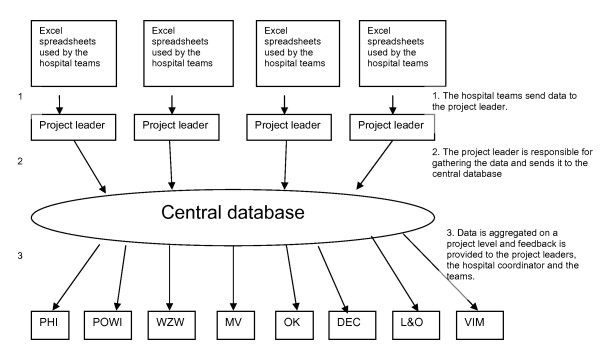
This paper discusses complications and dilemma's observed in the set-up of data management for QICs. An overview is presented of signals that were picked up by the data management team. These signals were used to improve the strategies for data management during the program and have, as far as possible, been translated into practical solutions that have been successfully implemented.The recommendations coming from this study are: From our experience it is clear that quality improvement programs deviate from experimental research in many ways. It is not only impossible, but also undesirable to control processes and standardize data streams. QIC's need to be clear of data protocols that do not allow for change. It is therefore minimally important that when quantitative results are gathered, these results are accompanied by qualitative results that can be used to correctly interpret them.Monitoring and data acquisition interfere with routine. This makes a database collecting data in a QIC an intervention in itself. It is very important to be aware of this in reporting the results. Using existing databases when possible can overcome some of these problems but is often not possible given the change objective of QICs. Introducing a standardized spreadsheet to the teams is a very practical and helpful tool in collecting standardized data within a QIC. It is vital that the spreadsheets are handed out before baseline measurements start.
突破性方法引入以来,一直提倡采用协作方法进行质量改进。该方法的有效性尚无定论,因此需要进一步进行独立评估。任何评估要想成功,关键是要收集协作过程中实施的干预措施以及这些干预措施的结果的数据。然而,要从质量改进合作组织(QIC)获得足够的数据用于评估,事实证明是困难的。本文对荷兰一个质量改进合作组织的数据管理过程进行了回顾性分析。从该分析中确定了一般的失败和成功因素。
本文讨论了在为 QIC 建立数据管理时观察到的并发症和困境。介绍了数据管理团队收到的信号概览。这些信号被用于改进项目期间的数据管理策略,并尽可能转化为成功实施的实用解决方案。本研究提出的建议是:根据我们的经验,质量改进计划在许多方面与实验研究不同。不仅不可能,而且也不希望控制过程和标准化数据流。QIC 需要明确不允许更改的数据协议。因此,当收集定量结果时,重要的是要伴随定性结果,以便正确解释这些结果。监测和数据采集会干扰常规工作。这使得在 QIC 中收集数据的数据库本身就是一种干预。在报告结果时,必须意识到这一点。在可能的情况下使用现有的数据库可以克服其中的一些问题,但由于 QIC 的变化目标,通常是不可能的。向团队介绍标准化电子表格是在 QIC 中收集标准化数据的非常实用且有帮助的工具。至关重要的是,在开始基线测量之前分发电子表格。