Division of Endocrinology and Metabolism, Department of Medicine, University of California San Diego, La Jolla, California, United States of America.
PLoS One. 2009 Sep 29;4(9):e7250. doi: 10.1371/journal.pone.0007250.
Recent understanding that insulin resistance is an inflammatory condition necessitates searching for genes that regulate inflammation in insulin sensitive tissues. 12/15-lipoxygenase (12/15LO) regulates the expression of proinflammatory cytokines and chemokines and is implicated in the early development of diet-induced atherosclerosis. Thus, we tested the hypothesis that 12/15LO is involved in the onset of high fat diet (HFD)-induced insulin resistance.
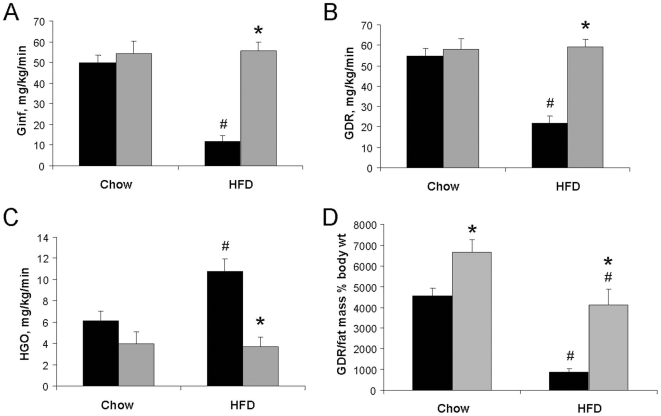
METHODOLOGY/PRINCIPAL FINDINGS: Cells over-expressing 12/15LO secreted two potent chemokines, MCP-1 and osteopontin, implicated in the development of insulin resistance. We assessed adipose tissue inflammation and whole body insulin resistance in wild type (WT) and 12/15LO knockout (KO) mice after 2-4 weeks on HFD. In adipose tissue from WT mice, HFD resulted in recruitment of CD11b(+), F4/80(+) macrophages and elevated protein levels of the inflammatory markers IL-1beta, IL-6, IL-10, IL-12, IFNgamma, Cxcl1 and TNFalpha. Remarkably, adipose tissue from HFD-fed 12/15LO KO mice was not infiltrated by macrophages and did not display any increase in the inflammatory markers compared to adipose tissue from normal chow-fed mice. WT mice developed severe whole body (hepatic and skeletal muscle) insulin resistance after HFD, as measured by hyperinsulinemic euglycemic clamp. In contrast, 12/15LO KO mice exhibited no HFD-induced change in insulin-stimulated glucose disposal rate or hepatic glucose output during clamp studies. Insulin-stimulated Akt phosphorylation in muscle tissue from HFD-fed mice was significantly greater in 12/15LO KO mice than in WT mice.
These results demonstrate that 12/15LO mediates early stages of adipose tissue inflammation and whole body insulin resistance induced by high fat feeding.
最近人们认识到胰岛素抵抗是一种炎症状态,这就需要寻找调节胰岛素敏感组织炎症的基因。12/15-脂氧合酶(12/15LO)调节前炎症细胞因子和趋化因子的表达,并且与饮食诱导的动脉粥样硬化的早期发展有关。因此,我们测试了这样一个假设,即 12/15LO 参与高脂肪饮食(HFD)诱导的胰岛素抵抗的发生。
方法/主要发现:过表达 12/15LO 的细胞分泌两种强效趋化因子,MCP-1 和骨桥蛋白,这两种趋化因子与胰岛素抵抗的发展有关。我们在高脂肪饮食喂养 2-4 周后,评估了 WT 和 12/15LO 敲除(KO)小鼠的脂肪组织炎症和全身胰岛素抵抗。在 WT 小鼠的脂肪组织中,HFD 导致 CD11b(+)、F4/80(+)巨噬细胞的募集,并导致炎症标志物 IL-1beta、IL-6、IL-10、IL-12、IFNgamma、Cxcl1 和 TNFalpha 的蛋白水平升高。值得注意的是,与正常饲料喂养的小鼠相比,高脂肪饮食喂养的 12/15LO KO 小鼠的脂肪组织没有被巨噬细胞浸润,并且没有任何炎症标志物的增加。WT 小鼠在高脂肪饮食后发展为严重的全身(肝和骨骼肌)胰岛素抵抗,如高胰岛素正葡萄糖钳夹所测量的。相比之下,12/15LO KO 小鼠在钳夹研究中没有表现出高脂肪饮食诱导的胰岛素刺激葡萄糖摄取率或肝葡萄糖输出的变化。高脂肪饮食喂养的小鼠肌肉组织中胰岛素刺激的 Akt 磷酸化在 12/15LO KO 小鼠中明显高于 WT 小鼠。
这些结果表明,12/15LO 介导了高脂肪喂养诱导的脂肪组织炎症和全身胰岛素抵抗的早期阶段。