Mathé Ewy A, Nguyen Giang Huong, Bowman Elise D, Zhao Yiqiang, Budhu Anuradha, Schetter Aaron J, Braun Rosemary, Reimers Mark, Kumamoto Kensuke, Hughes Duncan, Altorki Nasser K, Casson Alan G, Liu Chang-Gong, Wang Xin Wei, Yanaihara Nozomu, Hagiwara Nobutoshi, Dannenberg Andrew J, Miyashita Masao, Croce Carlo M, Harris Curtis C
Laboratory of Human Carcinogenesis, National Cancer Institute/NIH, Bethesda, Maryland 20892, USA.
Clin Cancer Res. 2009 Oct 1;15(19):6192-200. doi: 10.1158/1078-0432.CCR-09-1467. Epub 2009 Sep 29.
The dismal outcome of esophageal cancer patients highlights the need for novel prognostic biomarkers, such as microRNAs (miRNA). Although recent studies have established the role of miRNAs in esophageal carcinoma, a comprehensive multicenter study investigating different histologic types, including squamous cell carcinoma (SCC) and adenocarcinoma with or without Barrett's, is still lacking.
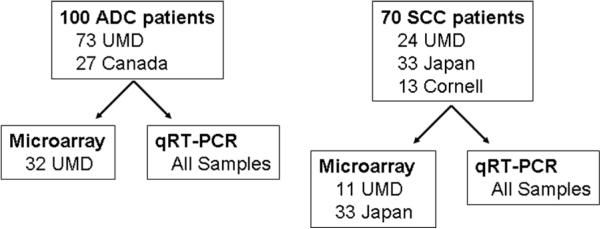
miRNA expression was measured in cancerous and adjacent noncancerous tissue pairs collected from 100 adenocarcinoma and 70 SCC patients enrolled at four clinical centers from the United States, Canada, and Japan. Microarray-based expression was measured in a subset of samples in two cohorts and was validated in all available samples.
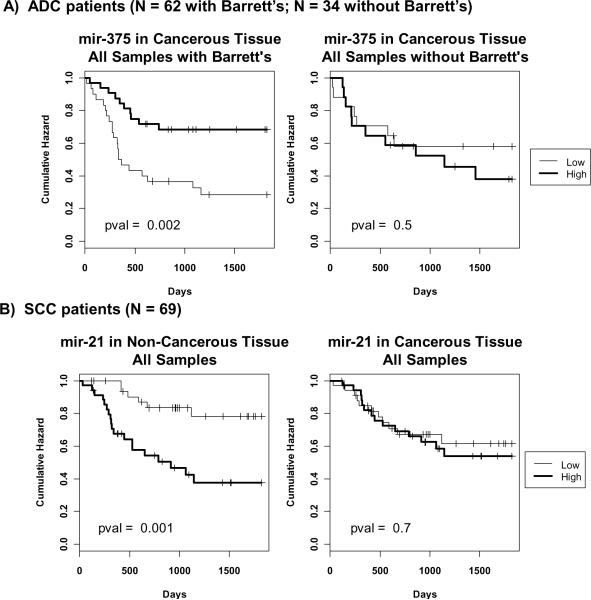
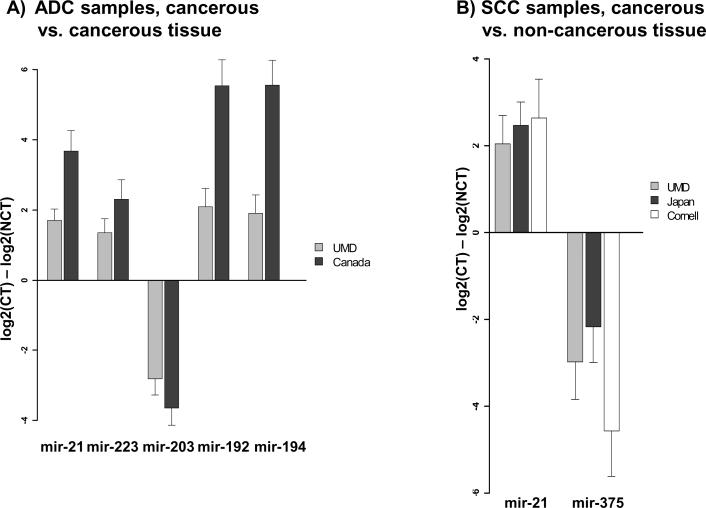
In adenocarcinoma patients, miR-21, miR-223, miR-192, and miR-194 expression was elevated, whereas miR-203 expression was reduced in cancerous compared with noncancerous tissue. In SCC patients, we found elevated miR-21 and reduced miR-375 expression levels in cancerous compared with noncancerous tissue. When comparing cancerous tissue expression between adenocarcinoma and SCC patients, miR-194 and miR-375 were elevated in adenocarcinoma patients. Significantly, elevated miR-21 expression in noncancerous tissue of SCC patients and reduced levels of miR-375 in cancerous tissue of adenocarcinoma patients with Barrett's were strongly associated with worse prognosis. Associations with prognosis were independent of tumor stage or nodal status, cohort type, and chemoradiation therapy.
Our multicenter-based results highlight miRNAs involved in major histologic types of esophageal carcinoma and uncover significant associations with prognosis. Elucidating miRNAs relevant to esophageal carcinogenesis is potentially clinically useful for developing prognostic biomarkers and identifying novel drug targets and therapies.
食管癌患者的预后不佳凸显了对新型预后生物标志物(如微小RNA(miRNA))的需求。尽管最近的研究已确定miRNA在食管癌中的作用,但仍缺乏一项全面的多中心研究来调查不同组织学类型,包括鳞状细胞癌(SCC)以及伴有或不伴有巴雷特食管化生的腺癌。
对从美国、加拿大和日本四个临床中心招募的100例腺癌患者和70例SCC患者的癌组织和相邻非癌组织样本对进行miRNA表达检测。在两个队列的一部分样本中基于微阵列检测表达,并在所有可用样本中进行验证。
在腺癌患者中,与非癌组织相比,癌组织中miR-21、miR-223、miR-192和miR-194表达升高,而miR-203表达降低。在SCC患者中,与非癌组织相比,癌组织中miR-21表达升高,miR-375表达降低。比较腺癌和SCC患者的癌组织表达时,腺癌患者中miR-194和miR-375升高。值得注意的是,SCC患者非癌组织中miR-21表达升高以及伴有巴雷特食管化生的腺癌患者癌组织中miR-375水平降低与较差的预后密切相关。与预后的关联独立于肿瘤分期或淋巴结状态、队列类型以及放化疗。
我们基于多中心的结果突出了参与食管癌主要组织学类型的miRNA,并揭示了与预后的显著关联。阐明与食管癌发生相关的miRNA可能在临床上有助于开发预后生物标志物以及识别新的药物靶点和治疗方法。