Landberg Jonas
Centre for Social Research on Alcohol and Drugs (SoRAD), Stockholm University, Stockholm, Sweden.
Suicide Life Threat Behav. 2009 Aug;39(4):452-9. doi: 10.1521/suli.2009.39.4.452.
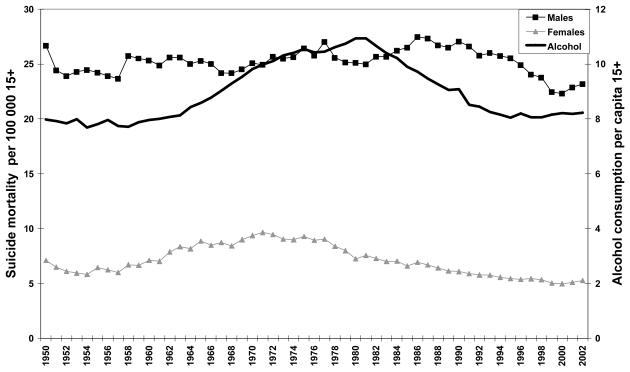
The aim of this paper was to estimate how suicide rates in the United States are affected by changes in per capita consumption during the postwar period. The analysis included Annual suicide rates and per capita alcohol consumption data (total and beverage specific) for the period 1950-2002. Gender- and age-specific models were estimated using the Box-Jenkins technique for time series analysis. No significant estimate was found for males. For females the total alcohol estimate (0.059) was significant at the 10% level whereas the spirits estimate was significant with an effect of 0.152. The results imply that a change in U.S. per capita consumption would result in a change in female suicide rates, whereas the male rates would not be affected.
本文的目的是估计战后时期美国人均消费的变化如何影响自杀率。分析包括1950 - 2002年期间的年度自杀率和人均酒精消费数据(总量及特定饮料的消费数据)。使用Box-Jenkins时间序列分析技术估计了按性别和年龄分类的模型。未发现男性有显著的估计结果。对于女性,酒精消费总量的估计值(0.059)在10%的水平上具有显著性,而烈酒消费的估计值具有显著性,影响为0.152。结果表明,美国人均消费的变化会导致女性自杀率的变化,而男性自杀率不会受到影响。