Laboratoire de Biotechnologies et Pharmacologie génétique Appliquée (LBPA), UMR 8113 CNRS, Ecole Normale Supérieure de Cachan, 61 Avenue du Président Wilson, 94235 Cachan Cedex, France.
Nucleic Acids Res. 2009 Dec;37(22):7691-700. doi: 10.1093/nar/gkp824.
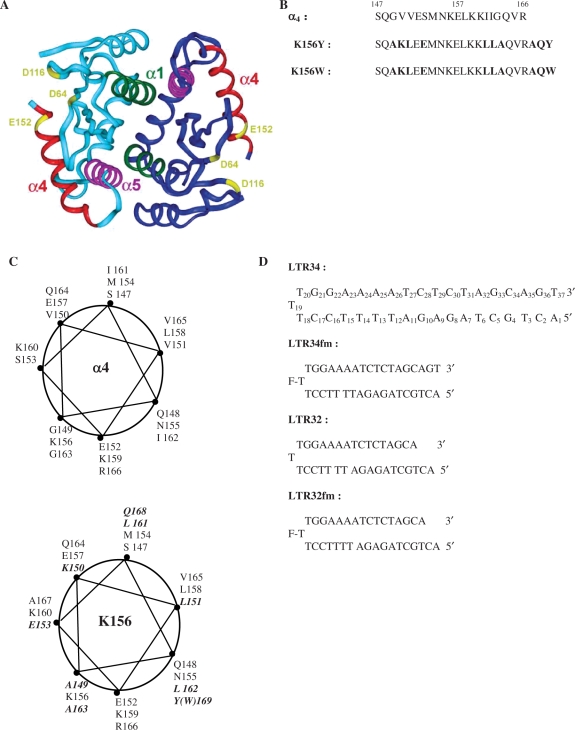
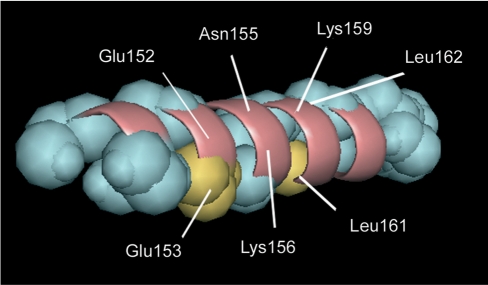
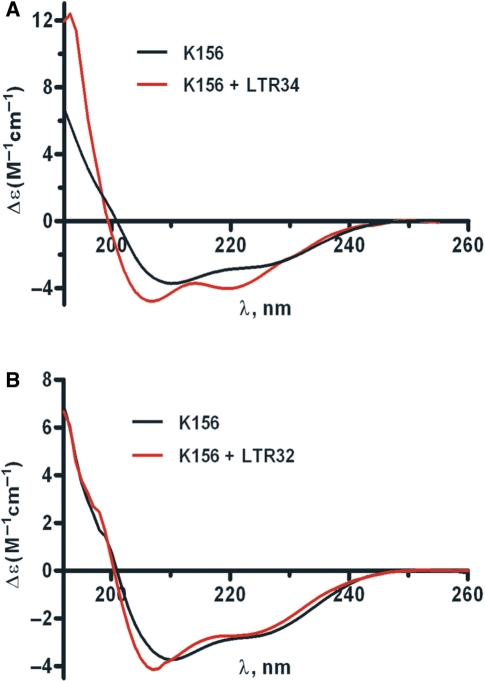
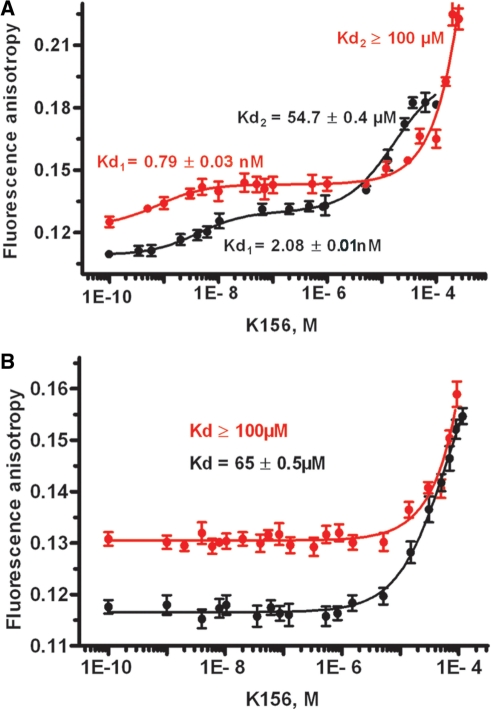
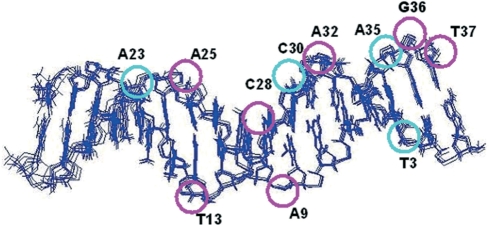
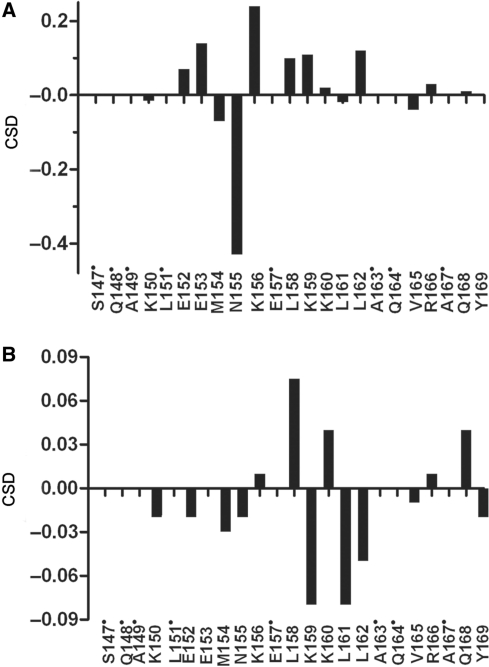
HIV-1 integrase integrates retroviral DNA through 3'-processing and strand transfer reactions in the presence of a divalent cation (Mg(2+) or Mn(2+)). The alpha4 helix exposed at the catalytic core surface is essential to the specific recognition of viral DNA. To define group determinants of recognition, we used a model composed of a peptide analogue of the alpha4 helix, oligonucleotides mimicking processed and unprocessed U5 LTR end and 5 mM Mg(2+). Circular dichroism, fluorescence and NMR experiments confirmed the implication of the alpha4 helix polar/charged face in specific and non-specific bindings to LTR ends. The specific binding requires unprocessed LTR ends-i.e. an unaltered 3'-processing site CA downward arrowGT3'-and is reinforced by Mg(2+) (K(d) decreases from 2 to 0.8 nM). The latter likely interacts with the ApG and GpT3' steps of the 3'-processing site. With deletion of GT3', only persists non-specific binding (K(d) of 100 microM). Proton chemical shift deviations showed that specific binding need conserved amino acids in the alpha4 helix and conserved nucleotide bases and backbone groups at LTR ends. We suggest a conserved recognition mechanism based on both direct and indirect readout and which is subject to evolutionary pressure.
HIV-1 整合酶在二价阳离子(Mg(2+)或 Mn(2+))存在的情况下,通过 3'-加工和链转移反应将逆转录病毒 DNA 整合。暴露在催化核心表面的α4 螺旋对于病毒 DNA 的特异性识别至关重要。为了定义识别的群体决定因素,我们使用了一种由α4 螺旋肽类似物、模拟加工和未加工 U5 LTR 末端的寡核苷酸以及 5mM Mg(2+)组成的模型。圆二色性、荧光和 NMR 实验证实了α4 螺旋极性/带电面在与 LTR 末端的特异性和非特异性结合中的作用。特异性结合需要未加工的 LTR 末端,即未改变的 3'-加工位点 CA 箭头 GT3'-,并且由 Mg(2+)增强(K(d)从 2 降至 0.8 nM)。后者可能与 3'-加工位点的 ApG 和 GpT3'步骤相互作用。删除 GT3'后,仅存在非特异性结合(K(d)为 100μM)。质子化学位移偏差表明,特异性结合需要α4 螺旋中的保守氨基酸以及 LTR 末端的保守核苷酸碱基和骨架基团。我们提出了一种基于直接和间接读取的保守识别机制,该机制受到进化压力的影响。