Department of Family Medicine, David Geffen School of Medicine, University of California-Los Angeles, 10880 Wilshire Blvd., Suite 1800, Los Angeles, CA 90024, USA.
J Gen Intern Med. 2009 Dec;24(12):1296-302. doi: 10.1007/s11606-009-1132-4. Epub 2009 Oct 8.
Medication reviews are recommended annually for older patients. A medication review is a discussion of a patient's complete set of medications, but the actual content of a review is not well specified. The medical literature suggests that it is an exhaustive evaluation, but what physicians actually ask about their patients' medication regimens has been little studied.
To describe what physicians do when they review medications in the office setting.
Qualitative content analysis of audio-taped encounters between 100 patients aged 65 and older and 28 primary care physicians in two health care systems in Sacramento, California.
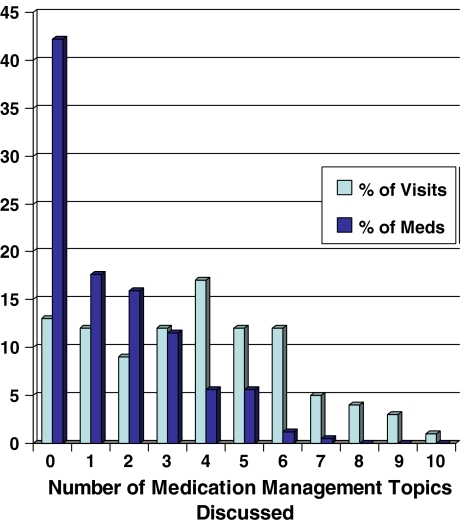
Physicians use a combination of non-mutually exclusive strategies when reviewing chronic medications that include: (1) efforts to obtain a complete list of patient medications (36% of visits), (2) discussion of a topic related to the management of each of a patient's chronic medications (47% of visits), and (3) sequential discussion of the majority of a patient's medications without intervening discussion (45% of visits). Of 10 medication management topics that were discussed in medication reviews, a mean of 1.5 topics (SD = 1.7, range 0-7) were mentioned for each medication, with efficacy and directions being most common. Physicians conducted a sequential discussion that included discussion of each of a patient's medications in only 32% of visits.
Comprehensive discussions about chronic medications are uncommon in routine practice. Practical conceptualization of what constitutes a physician-conducted medication review is needed.
建议为老年患者每年进行一次药物审查。药物审查是对患者所有药物的讨论,但审查的实际内容并没有明确规定。医学文献表明,这是一次详尽的评估,但医生实际上询问患者的药物治疗方案的内容却很少被研究。
描述医生在办公室环境中审查药物时的具体做法。
对加利福尼亚州萨克拉门托的两个医疗系统中 100 名 65 岁及以上患者和 28 名初级保健医生进行的音频记录的医患互动进行定性内容分析。
医生在审查慢性病药物时采用了多种非互斥策略,包括:(1)努力获取患者药物的完整清单(36%的就诊),(2)讨论与患者每一种慢性病药物管理相关的话题(47%的就诊),以及(3)连续讨论患者大部分药物而不穿插讨论(45%的就诊)。在药物审查中讨论的 10 个药物管理主题中,每个药物平均讨论了 1.5 个主题(SD=1.7,范围 0-7),以疗效和用法最常见。医生仅在 32%的就诊中进行了包括讨论患者每种药物的连续讨论。
在常规实践中,对慢性病药物的全面讨论并不常见。需要对医生进行药物审查的具体内容进行实际的概念化。