Dugas Marylène, Dubé Eric, Kouyaté Bocar, Sanou Aboubakary, Bibeau Gilles
Dalhousie University, Bioethic department, Halifax, Canada.
BMC Int Health Hum Rights. 2009 Oct 14;9 Suppl 1(Suppl 1):S9. doi: 10.1186/1472-698X-9-S1-S9.
The global recognition of vaccination is strongly related to the fact that it has proved in the past able to dramatically reduce the incidence of certain diseases. Nevertheless, reactions regarding the practice of vaccination still vary among communities, affecting the worldwide vaccination coverage. Numerous studies, conducted from varying perspectives, have focused on explaining this active refusal or resistance to vaccination. Although in some cases low immunization coverage has been well explained by active refusal or resistance to vaccination, little is known about the reasons for low coverage where those reactions are absent or play a minor role, especially outside an epidemic context. This study attempts to explain this situation, which is found in the health district of Nouna in Burkina Faso.
An in-depth ethnographic study was undertaken in the health district of Nouna in an effort to understand, from an anthropological point of view, the logic behind the parental decision-making process regarding the vaccination or non-vaccination of children, in a context where rejection of, and reservations concerning vaccination are not major obstacles.
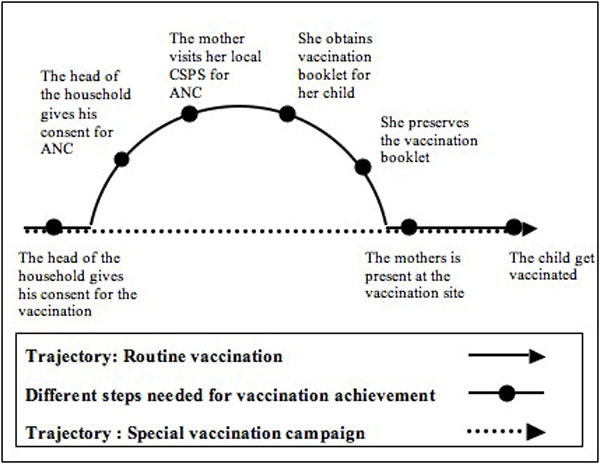
Three elements emerged from the analysis: the empirical conceptions of childhood diseases, the perceived efficacy of vaccine and the knowledge of appropriate age for vaccination uptake; the gap between the decision-making process and the actual achievement of vaccination; and the vaccination procedure leading to vaccination uptake in the particular context of the health district of Nouna.
The procedures parents must follow in order to obtain vaccination for their children appear complex and constraining, and on certain points discord with the traditional systems of meaning and idioms of distress related to pregnancy, the prevention of childhood diseases and with the cultural matrix shaping decision-making and behaviour. Attention needs to be directed at certain promotional, logistical and structural elements, and at the procedure that must currently be followed to obtain vaccination for a child during routine vaccination sessions, which are currently limiting the active demand for vaccination. ABSTRACT IN FRENCH : See the full article online for a translation of this abstract in French.
疫苗接种在全球范围内得到认可,这与过去已证明其能够显著降低某些疾病的发病率密切相关。然而,不同社区对疫苗接种做法的反应仍然存在差异,影响了全球疫苗接种覆盖率。众多从不同角度开展的研究致力于解释这种对疫苗接种的主动拒绝或抵制现象。尽管在某些情况下,疫苗接种覆盖率低已被主动拒绝或抵制疫苗接种很好地解释,但对于在没有这些反应或这些反应起次要作用的情况下(尤其是在非疫情背景下)覆盖率低的原因却知之甚少。本研究试图解释在布基纳法索努纳卫生区发现的这种情况。
在努纳卫生区开展了一项深入的人种学研究,旨在从人类学角度理解在拒绝和质疑疫苗接种并非主要障碍的背景下,父母关于儿童是否接种疫苗的决策过程背后的逻辑。
分析得出三个要素:对儿童疾病的经验性认知、对疫苗效力的认知以及对适合接种疫苗年龄的了解;决策过程与实际疫苗接种完成情况之间的差距;以及在努纳卫生区特定背景下导致疫苗接种的接种程序。
父母为孩子获得疫苗接种必须遵循的程序似乎复杂且具有限制性,在某些方面与与怀孕、预防儿童疾病相关的传统意义系统和痛苦习语以及塑造决策和行为的文化基质不一致。需要关注某些宣传、后勤和结构要素,以及目前在常规疫苗接种期间为儿童获得疫苗接种必须遵循的程序,这些目前正在限制对疫苗接种的积极需求。法语摘要:见在线全文获取此摘要的法语翻译。