Bicaba Abel, Haddad Slim, Kabore Moussa, Taminy Emile, Feletto Marta, Fournier Pierre
Société d'Etudes et de Recherche en Santé Publique (SERSAP), Ouagadougou, Burkina Faso.
BMC Int Health Hum Rights. 2009 Oct 14;9 Suppl 1(Suppl 1):S12. doi: 10.1186/1472-698X-9-S1-S12.
The greatest challenge facing expanded programs on immunization in general, and in Burkina Faso in particular, lies in their capacity to achieve and sustain levels of immunization coverage that will ensure effective protection of children. This article aims to demonstrate that full immunization coverage of children, which is the primary indicator for monitoring national immunization programs, is sufficient neither to evaluate their performance adequately, nor to help identify the broad strategies that must be implemented to improve their performance. Other dimensions of performance, notably adherence to the vaccination schedule and the efficacy of the approaches used to reach all the children (targeting) must also be considered.
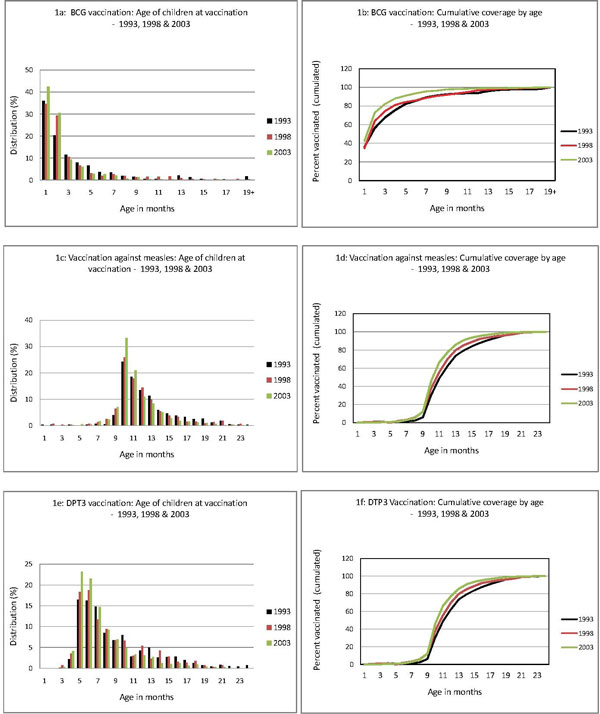
The study was carried out using data from surveys carried out in Burkina Faso: the 1993, 1998 and 2003 Demographic and Health Surveys and the 2003 national Survey of Immunization Coverage. Essentially, we described levels of immunization coverage and their trends according to the indicators considered. Performance differences are illustrated by amplitudes and maximum/minimum ratios.
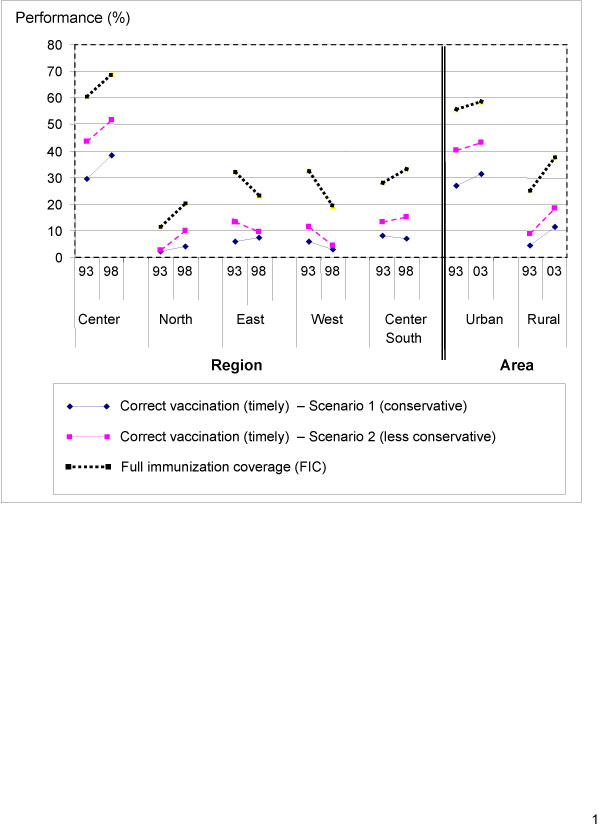
The health regions' performances vary according to whether they are evaluated on the basis of full immunization coverage or vaccination status of children who have not completed their vaccinations. The health regions encompass a variety of realities, and efforts of substantially different intensity would be required to reach all the target populations.
Decision-making can be improved by integrating a tripartite view of performance that includes full immunization coverage, adherence to the vaccination schedule (timely coverage), and the status of children who are not fully vaccinated. With such an approach, interventions can be better targeted. It provides information on the quality and timeliness of vaccination and identifies the efforts required to meet the objectives of full immunization coverage. ABSTRACT IN FRENCH: See the full article online for a translation of this abstract in French.
总体而言,扩大免疫规划面临的最大挑战,尤其是布基纳法索面临的挑战,在于其实现并维持免疫接种覆盖率水平的能力,而这一水平将确保对儿童的有效保护。本文旨在表明,作为监测国家免疫规划的主要指标,儿童全程免疫覆盖率既不足以充分评估其绩效,也无助于确定为改善其绩效而必须实施的广泛战略。还必须考虑绩效的其他方面,特别是对疫苗接种时间表的依从性以及用于覆盖所有儿童(目标设定)的方法的有效性。
该研究使用了布基纳法索进行的调查数据:1993年、1998年和2003年的人口与健康调查以及2003年全国免疫接种覆盖率调查。本质上,我们根据所考虑的指标描述了免疫接种覆盖率水平及其趋势。绩效差异通过幅度和最大/最小比率来说明。
根据对儿童全程免疫覆盖率还是未完成疫苗接种儿童的疫苗接种状况进行评估,各卫生区域的绩效有所不同。各卫生区域情况各异,要覆盖所有目标人群需要付出强度大不相同的努力。
通过纳入包括全程免疫覆盖率、对疫苗接种时间表的依从性(及时覆盖率)以及未全程接种疫苗儿童状况在内的三方绩效观,可以改进决策。采用这种方法,干预措施可以更有针对性。它提供了有关疫苗接种质量和及时性的信息,并确定了实现全程免疫覆盖率目标所需的努力。法文摘要:见在线全文,获取此摘要的法文译文。