Institute of Biotechnology, University of Cambridge, Tennis Court Road, Cambridge, UK.
BMC Bioinformatics. 2009 Oct 15;10 Suppl 12(Suppl 12):S6. doi: 10.1186/1471-2105-10-S12-S6.
In the diagnosis of complex diseases such as neurological pathologies, a wealth of clinical and molecular information is often available to help the interpretation. Yet, the pieces of information are usually considered in isolation and rarely integrated due to the lack of a sound statistical framework. This lack of integration results in the loss of valuable information about how disease associated factors act synergistically to cause the complex phenotype.
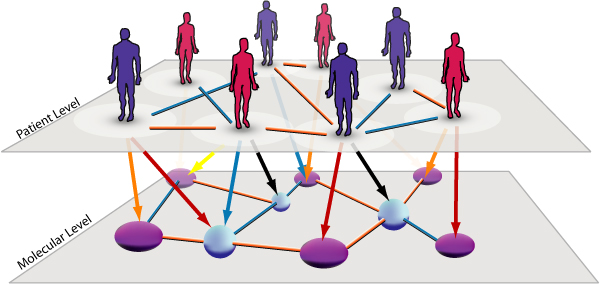
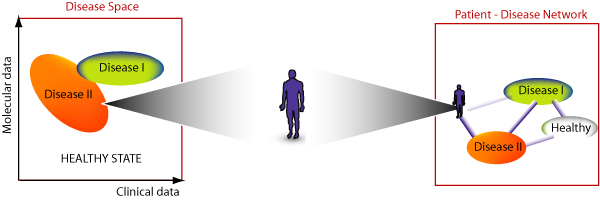
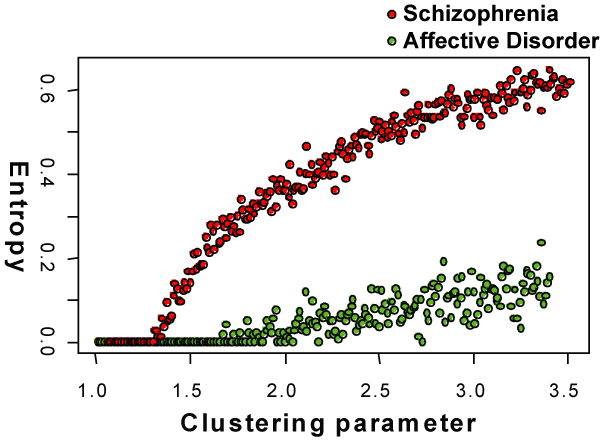
Here, we investigated complex psychiatric diseases as networks. The networks were used to integrate data originating from different profiling platforms. The weighted links in these networks capture the association between the analyzed factors and allow the quantification of their relevance for the pathology. The heterogeneity of the patient population was analyzed by clustering and graph theoretical procedures. We provided an estimate of the heterogeneity of the population of schizophrenia and detected a subgroup of patients featuring remarkable abnormalities in a network of serum primary fatty acid amides. We compared the stability of this molecular network in an extended dataset between schizophrenia and affective disorder patients and found more stable structures in the latter.
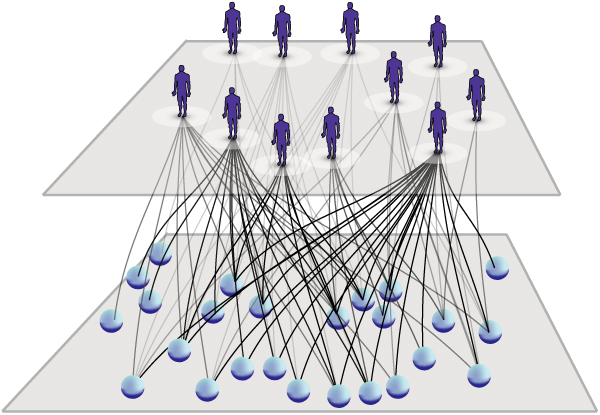
We quantified robust associations between analytes measured with different profiling platforms as networks. The methodology allows the quantitative evaluation of the complexity of the disease. The identified disease patterns can then be further investigated with regards to their diagnostic utility or help in the prediction of novel therapeutic targets. The applied framework is able to enhance the understanding of complex psychiatric diseases, and may give novel insights into drug development and personalized medicine approaches.
在诊断神经病理学等复杂疾病时,通常有大量的临床和分子信息可用于辅助解读。然而,由于缺乏健全的统计框架,这些信息通常是孤立考虑的,很少进行整合。这种信息缺失导致了对疾病相关因素如何协同作用导致复杂表型的宝贵信息的丢失。
在这里,我们将复杂的精神疾病视为网络进行研究。这些网络用于整合来自不同分析平台的数据。网络中的加权链接捕捉了分析因素之间的关联,并可量化它们对病理的相关性。通过聚类和图论程序分析了患者群体的异质性。我们估计了精神分裂症患者群体的异质性,并在血清初级脂肪酸酰胺网络中检测到一个具有显著异常的患者亚群。我们比较了精神分裂症和情感障碍患者扩展数据集之间该分子网络的稳定性,发现后者具有更稳定的结构。
我们将不同分析平台测量的分析物作为网络进行量化稳健关联。该方法允许对疾病的复杂性进行定量评估。然后,可以进一步研究所识别的疾病模式,以评估其诊断效用或帮助预测新的治疗靶点。所应用的框架能够增强对复杂精神疾病的理解,并可能为药物开发和个性化医疗方法提供新的见解。