Sahin Ned T, Pinker Steven, Cash Sydney S, Schomer Donald, Halgren Eric
Department of Radiology, University of California-San Diego, La Jolla, CA 92037, USA.
Science. 2009 Oct 16;326(5951):445-9. doi: 10.1126/science.1174481.
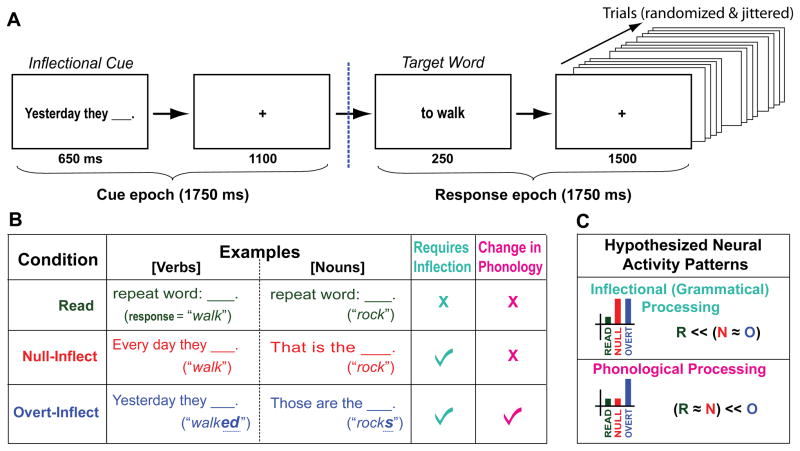
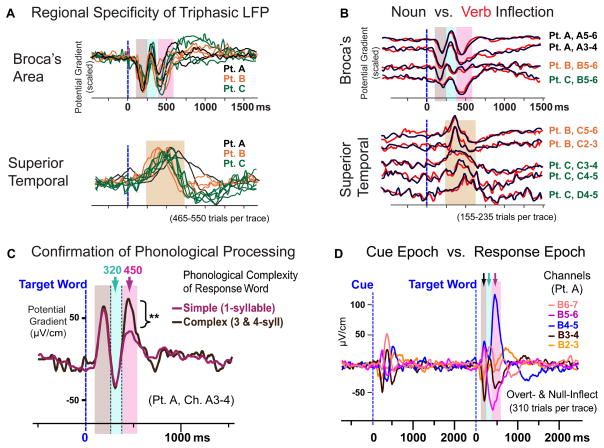
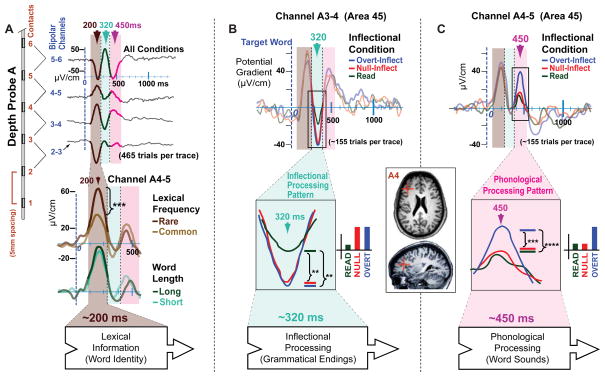
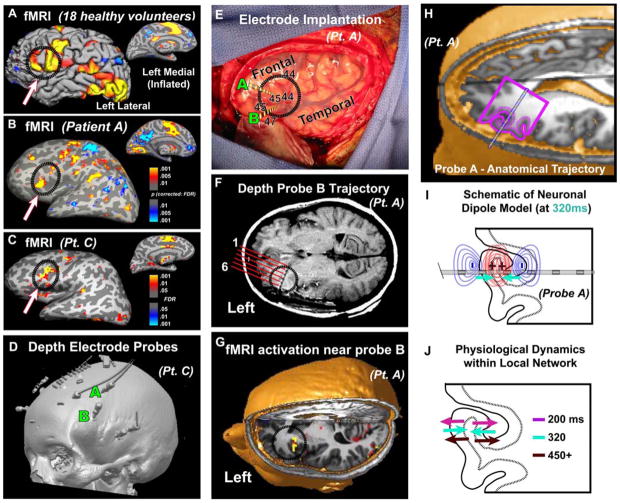
Words, grammar, and phonology are linguistically distinct, yet their neural substrates are difficult to distinguish in macroscopic brain regions. We investigated whether they can be separated in time and space at the circuit level using intracranial electrophysiology (ICE), namely by recording local field potentials from populations of neurons using electrodes implanted in language-related brain regions while people read words verbatim or grammatically inflected them (present/past or singular/plural). Neighboring probes within Broca's area revealed distinct neuronal activity for lexical (approximately 200 milliseconds), grammatical (approximately 320 milliseconds), and phonological (approximately 450 milliseconds) processing, identically for nouns and verbs, in a region activated in the same patients and task in functional magnetic resonance imaging. This suggests that a linguistic processing sequence predicted on computational grounds is implemented in the brain in fine-grained spatiotemporally patterned activity.
词汇、语法和语音在语言学上是不同的,但它们的神经基质在宏观脑区中却难以区分。我们研究了能否使用颅内电生理学(ICE)在回路水平上在时间和空间上对它们进行分离,即当人们逐字阅读单词或对其进行语法变形(现在时/过去时或单数/复数)时,通过植入与语言相关脑区的电极记录神经元群体的局部场电位。在功能磁共振成像中,同一患者在相同任务下激活的一个区域内,布罗卡区内相邻的探针显示出词汇(约200毫秒)、语法(约320毫秒)和语音(约450毫秒)处理的不同神经元活动,名词和动词的情况相同。这表明基于计算得出的语言处理序列在大脑中以精细的时空模式活动得以实现。