Rong Libin, Perelson Alan S
Theoretical Biology and Biophysics, Los Alamos National Laboratory, Los Alamos, New Mexico, United States of America.
PLoS Comput Biol. 2009 Oct;5(10):e1000533. doi: 10.1371/journal.pcbi.1000533. Epub 2009 Oct 16.
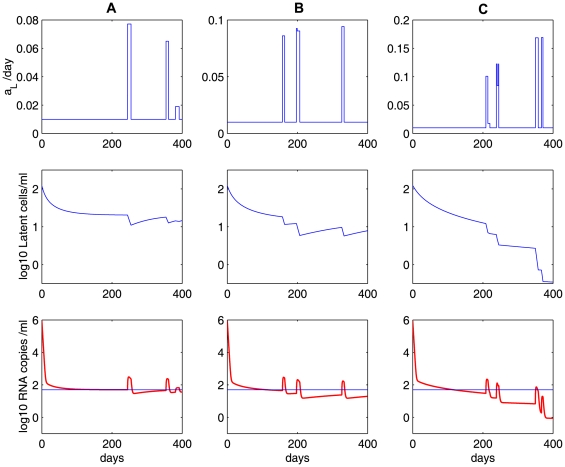
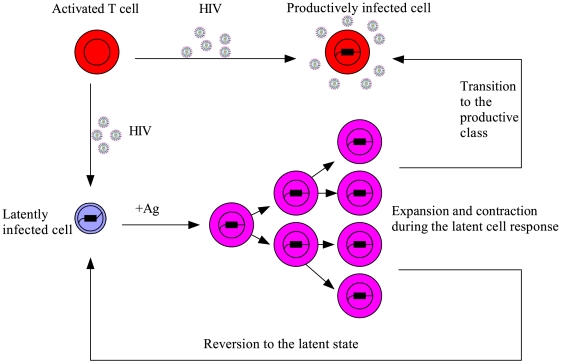
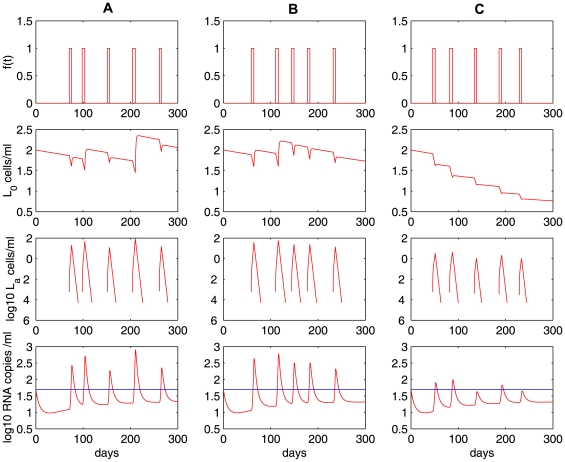
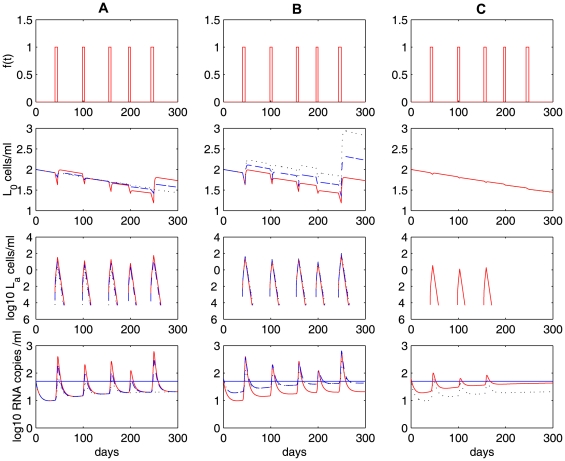
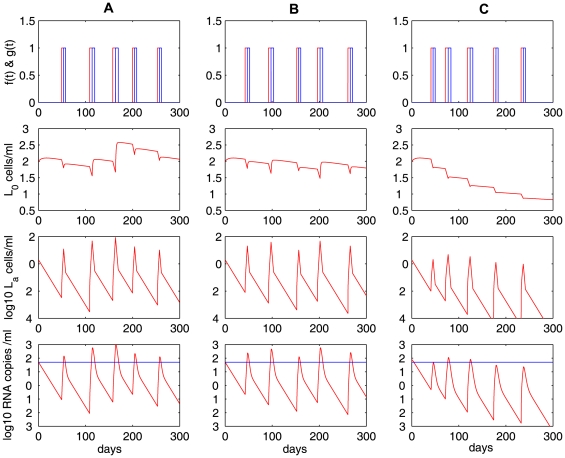
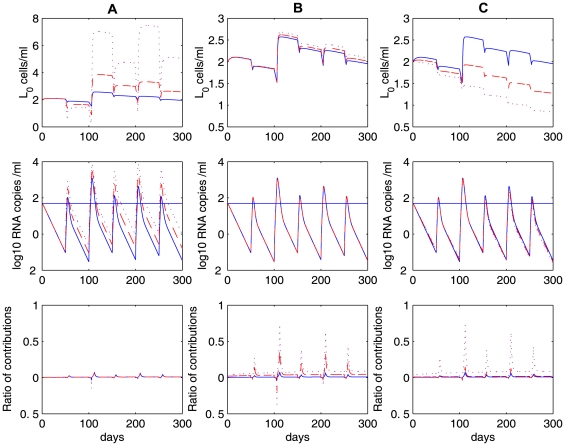
Although potent combination therapy is usually able to suppress plasma viral loads in HIV-1 patients to below the detection limit of conventional clinical assays, a low level of viremia frequently can be detected in plasma by more sensitive assays. Additionally, many patients experience transient episodes of viremia above the detection limit, termed viral blips, even after being on highly suppressive therapy for many years. An obstacle to viral eradication is the persistence of a latent reservoir for HIV-1 in resting memory CD4(+) T cells. The mechanisms underlying low viral load persistence, slow decay of the latent reservoir, and intermittent viral blips are not fully characterized. The quantitative contributions of residual viral replication to viral and the latent reservoir persistence remain unclear. In this paper, we probe these issues by developing a mathematical model that considers latently infected cell activation in response to stochastic antigenic stimulation. We demonstrate that programmed expansion and contraction of latently infected cells upon immune activation can generate both low-level persistent viremia and intermittent viral blips. Also, a small fraction of activated T cells revert to latency, providing a potential to replenish the latent reservoir. By this means, occasional activation of latently infected cells can explain the variable decay characteristics of the latent reservoir observed in different clinical studies. Finally, we propose a phenomenological model that includes a logistic term representing homeostatic proliferation of latently infected cells. The model is simple but can robustly generate the multiphasic viral decline seen after initiation of therapy, as well as low-level persistent viremia and intermittent HIV-1 blips. Using these models, we provide a quantitative and integrated prospective into the long-term dynamics of HIV-1 and the latent reservoir in the setting of potent antiretroviral therapy.
尽管强效联合疗法通常能够将HIV-1患者的血浆病毒载量抑制到常规临床检测方法的检测限以下,但通过更灵敏的检测方法经常能在血浆中检测到低水平的病毒血症。此外,许多患者即使在接受多年高效抑制性治疗后,仍会经历病毒血症高于检测限的短暂发作,即所谓的病毒波动。病毒根除的一个障碍是静止记忆CD4(+) T细胞中存在HIV-1潜伏库。低病毒载量持续存在、潜伏库缓慢衰减以及间歇性病毒波动的潜在机制尚未完全明确。残余病毒复制对病毒和潜伏库持续存在的定量贡献仍不清楚。在本文中,我们通过建立一个考虑潜伏感染细胞对随机抗原刺激作出反应而激活的数学模型来探究这些问题。我们证明,免疫激活时潜伏感染细胞的程序性扩增和收缩可产生低水平持续性病毒血症和间歇性病毒波动。此外,一小部分活化的T细胞会恢复到潜伏状态,为补充潜伏库提供了可能。通过这种方式,潜伏感染细胞的偶尔激活可以解释在不同临床研究中观察到的潜伏库可变的衰减特征。最后,我们提出了一个现象学模型,其中包括一个代表潜伏感染细胞稳态增殖的逻辑项。该模型简单,但能有力地产生治疗开始后出现的多相病毒下降,以及低水平持续性病毒血症和间歇性HIV-1波动。利用这些模型,我们对强效抗逆转录病毒治疗背景下HIV-1和潜伏库的长期动态变化提供了定量的综合展望。