Department of Microbiology, University of Texas Southwestern Medical Center, Dallas, TX 75390, USA.
Department of Genetics and Genomic Sciences, Department of Microbiology, Icahn School of Medicine at Mount Sinai, New York, NY 10029, USA.
Viruses. 2023 Oct 19;15(10):2119. doi: 10.3390/v15102119.
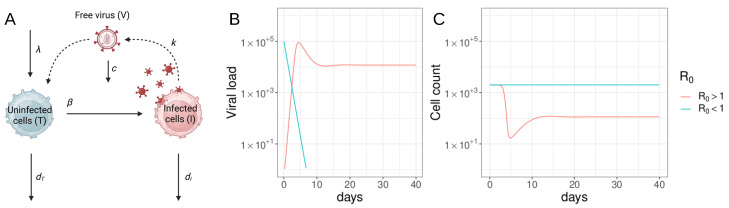
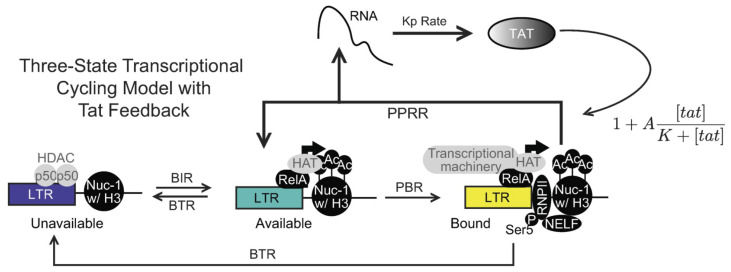
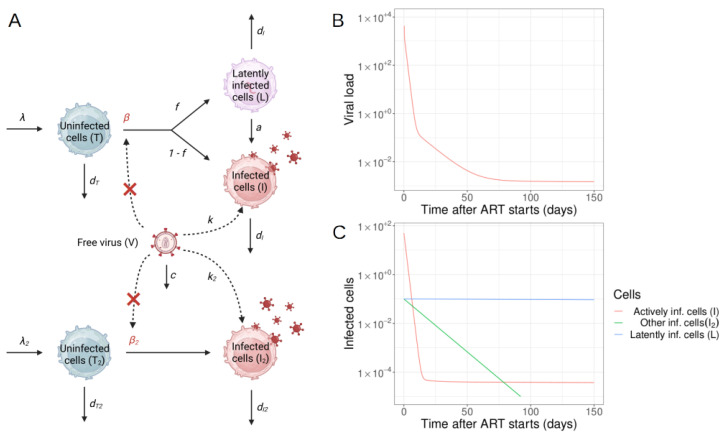
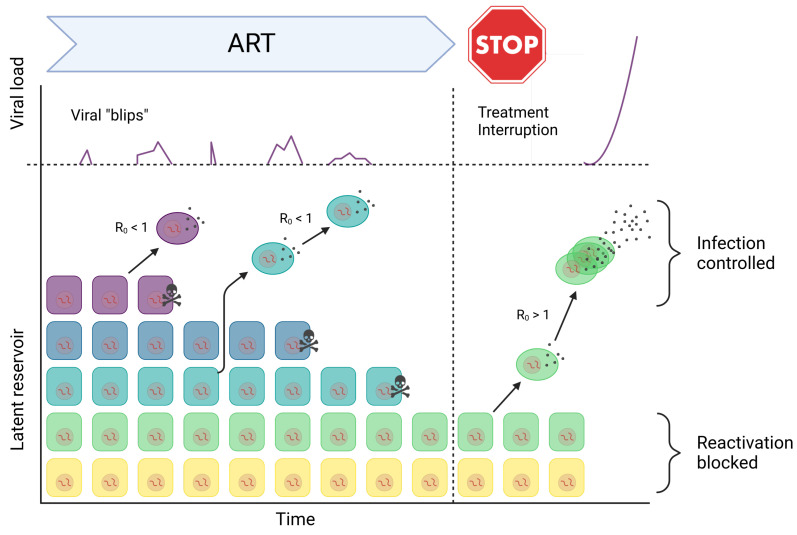
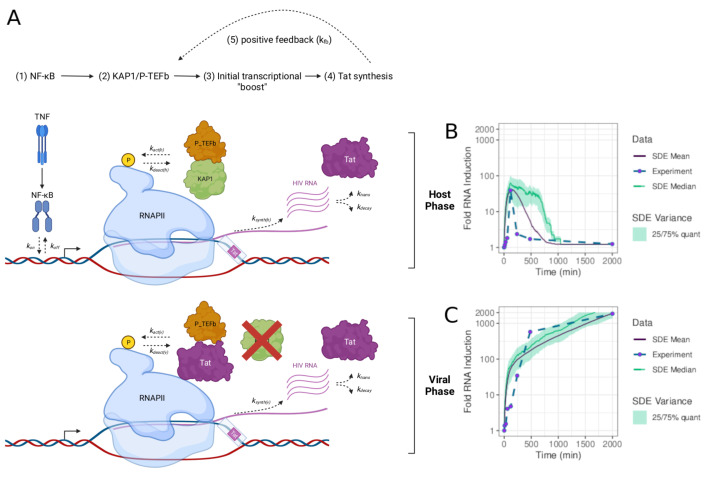
HIV-1 latency is a major barrier to curing infections with antiretroviral therapy and, consequently, to eliminating the disease globally. The establishment, maintenance, and potential clearance of latent infection are complex dynamic processes and can be best described with the help of mathematical models followed by experimental validation. Here, we review the use of viral dynamics models for HIV-1, with a focus on applications to the latent reservoir. Such models have been used to explain the multi-phasic decay of viral load during antiretroviral therapy, the early seeding of the latent reservoir during acute infection and the limited inflow during treatment, the dynamics of viral blips, and the phenomenon of post-treatment control. Finally, we discuss that mathematical models have been used to predict the efficacy of potential HIV-1 cure strategies, such as latency-reversing agents, early treatment initiation, or gene therapies, and to provide guidance for designing trials of these novel interventions.
HIV-1 潜伏期是用抗逆转录病毒疗法治愈感染的主要障碍,因此也是在全球消除该疾病的主要障碍。潜伏感染的建立、维持和潜在清除是复杂的动态过程,最好通过数学模型来描述,并通过实验验证加以支持。在这里,我们回顾了 HIV-1 病毒动力学模型的应用,重点介绍了其在潜伏库中的应用。这些模型被用于解释抗逆转录病毒治疗期间病毒载量的多相衰减、急性感染期间潜伏库的早期建立以及治疗期间有限的流入、病毒激增的动力学以及治疗后控制现象。最后,我们讨论了数学模型已被用于预测潜在的 HIV-1 治愈策略的疗效,例如逆转录病毒潜伏期药物、早期治疗开始或基因治疗,并为这些新干预措施的试验设计提供指导。