• 文献检索
  • 文档翻译
  • 深度研究
  • 学术资讯
  • Suppr Zotero 插件Zotero 插件
  • 邀请有礼
  • 套餐&价格
  • 历史记录
应用&插件
Suppr Zotero 插件Zotero 插件浏览器插件Mac 客户端Windows 客户端微信小程序
定价
高级版会员购买积分包购买API积分包
服务
文献检索文档翻译深度研究API 文档MCP 服务
关于我们
关于 Suppr公司介绍联系我们用户协议隐私条款
关注我们

Suppr 超能文献

核心技术专利:CN118964589B侵权必究
粤ICP备2023148730 号-1Suppr @ 2026

文献检索

告别复杂PubMed语法,用中文像聊天一样搜索,搜遍4000万医学文献。AI智能推荐,让科研检索更轻松。

立即免费搜索

文件翻译

保留排版,准确专业,支持PDF/Word/PPT等文件格式,支持 12+语言互译。

免费翻译文档

深度研究

AI帮你快速写综述,25分钟生成高质量综述,智能提取关键信息,辅助科研写作。

立即免费体验

利用神经网络从蛋白质序列预测无规卷曲残基的二面角概率分布。

Predicting dihedral angle probability distributions for protein coil residues from primary sequence using neural networks.

机构信息

University of Copenhagen, Department of Computer Science, Universitetsparken 1, 2100 Copenhagen, Denmark.

出版信息

BMC Bioinformatics. 2009 Oct 16;10:338. doi: 10.1186/1471-2105-10-338.

DOI:10.1186/1471-2105-10-338
PMID:19835576
原文链接:https://pmc.ncbi.nlm.nih.gov/articles/PMC2771020/
Abstract

BACKGROUND

Predicting the three-dimensional structure of a protein from its amino acid sequence is currently one of the most challenging problems in bioinformatics. The internal structure of helices and sheets is highly recurrent and help reduce the search space significantly. However, random coil segments make up nearly 40% of proteins and they do not have any apparent recurrent patterns, which complicates overall prediction accuracy of protein structure prediction methods. Luckily, previous work has indicated that coil segments are in fact not completely random in structure and flanking residues do seem to have a significant influence on the dihedral angles adopted by the individual amino acids in coil segments. In this work we attempt to predict a probability distribution of these dihedral angles based on the flanking residues. While attempts to predict dihedral angles of coil segments have been done previously, none have, to our knowledge, presented comparable results for the probability distribution of dihedral angles.

RESULTS

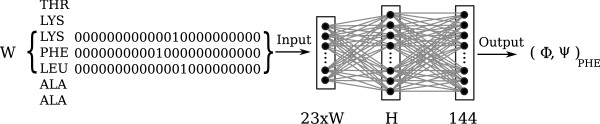
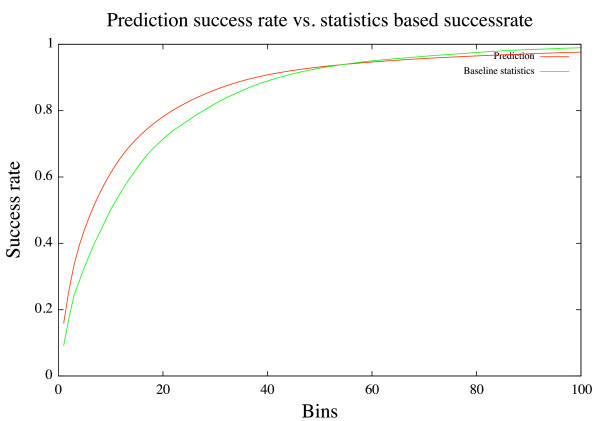
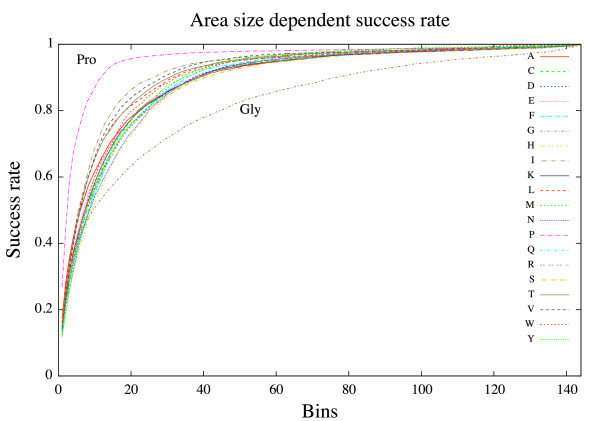
In this paper we develop an artificial neural network that uses an input-window of amino acids to predict a dihedral angle probability distribution for the middle residue in the input-window. The trained neural network shows a significant improvement (4-68%) in predicting the most probable bin (covering a 30 degrees x 30 degrees area of the dihedral angle space) for all amino acids in the data set compared to baseline statistics. An accuracy comparable to that of secondary structure prediction ( approximately 80%) is achieved by observing the 20 bins with highest output values.

CONCLUSION

Many different protein structure prediction methods exist and each uses different tools and auxiliary predictions to help determine the native structure. In this work the sequence is used to predict local context dependent dihedral angle propensities in coil-regions. This predicted distribution can potentially improve tertiary structure prediction methods that are based on sampling the backbone dihedral angles of individual amino acids. The predicted distribution may also help predict local structure fragments used in fragment assembly methods.

摘要

背景

从氨基酸序列预测蛋白质的三维结构是目前生物信息学中最具挑战性的问题之一。螺旋和片层的内部结构高度重复,这有助于显著缩小搜索空间。然而,无规卷曲片段约占蛋白质的 40%,它们没有任何明显的重复模式,这使得蛋白质结构预测方法的整体预测准确性变得复杂。幸运的是,以前的工作表明,卷曲片段实际上在结构上并不是完全随机的,并且侧翼残基似乎对卷曲片段中各个氨基酸所采用的二面角有显著影响。在这项工作中,我们试图根据侧翼残基预测这些二面角的概率分布。虽然以前已经尝试预测卷曲片段的二面角,但据我们所知,没有一个方法能够为二面角的概率分布提供可比的结果。

结果

在本文中,我们开发了一个人工神经网络,该网络使用氨基酸输入窗口来预测输入窗口中间残基的二面角概率分布。与基线统计相比,训练有素的神经网络在预测数据集所有氨基酸的最可能-bin(覆盖二面角空间的 30 度 x 30 度区域)方面显示出显著的改进(4-68%)。通过观察输出值最高的 20 个-bin,可以达到与二级结构预测相当的精度(约 80%)。

结论

存在许多不同的蛋白质结构预测方法,每种方法都使用不同的工具和辅助预测来帮助确定天然结构。在这项工作中,序列用于预测卷曲区域中局部上下文相关的二面角倾向。这种预测的分布可能有助于改进基于采样单个氨基酸的骨架二面角的三级结构预测方法。预测的分布也可能有助于预测用于片段组装方法的局部结构片段。
https://cdn.ncbi.nlm.nih.gov/pmc/blobs/b66e/2771020/f55fdc6ceedb/1471-2105-10-338-4.jpg
https://cdn.ncbi.nlm.nih.gov/pmc/blobs/b66e/2771020/42ee89a9236a/1471-2105-10-338-1.jpg
https://cdn.ncbi.nlm.nih.gov/pmc/blobs/b66e/2771020/c52b9ec67907/1471-2105-10-338-2.jpg
https://cdn.ncbi.nlm.nih.gov/pmc/blobs/b66e/2771020/d4c54ff74860/1471-2105-10-338-3.jpg
https://cdn.ncbi.nlm.nih.gov/pmc/blobs/b66e/2771020/f55fdc6ceedb/1471-2105-10-338-4.jpg
https://cdn.ncbi.nlm.nih.gov/pmc/blobs/b66e/2771020/42ee89a9236a/1471-2105-10-338-1.jpg
https://cdn.ncbi.nlm.nih.gov/pmc/blobs/b66e/2771020/c52b9ec67907/1471-2105-10-338-2.jpg
https://cdn.ncbi.nlm.nih.gov/pmc/blobs/b66e/2771020/d4c54ff74860/1471-2105-10-338-3.jpg
https://cdn.ncbi.nlm.nih.gov/pmc/blobs/b66e/2771020/f55fdc6ceedb/1471-2105-10-338-4.jpg

相似文献

1
Predicting dihedral angle probability distributions for protein coil residues from primary sequence using neural networks.利用神经网络从蛋白质序列预测无规卷曲残基的二面角概率分布。
BMC Bioinformatics. 2009 Oct 16;10:338. doi: 10.1186/1471-2105-10-338.
2
Naive Prediction of Protein Backbone Phi and Psi Dihedral Angles Using Deep Learning.使用深度学习进行蛋白质主链 φ 和 ψ 二面角的朴素预测。
Molecules. 2023 Oct 12;28(20):7046. doi: 10.3390/molecules28207046.
3
Deep learning methods for protein torsion angle prediction.用于蛋白质扭转角预测的深度学习方法。
BMC Bioinformatics. 2017 Sep 18;18(1):417. doi: 10.1186/s12859-017-1834-2.
4
Backbone Dihedral Angle Prediction.主链二面角预测
Methods Mol Biol. 2017;1484:65-82. doi: 10.1007/978-1-4939-6406-2_7.
5
Prediction of backbone dihedral angles and protein secondary structure using support vector machines.利用支持向量机预测骨架二面角和蛋白质二级结构。
BMC Bioinformatics. 2009 Dec 22;10:437. doi: 10.1186/1471-2105-10-437.
6
Local propensities and statistical potentials of backbone dihedral angles in proteins.蛋白质中主链二面角的局部倾向和统计势
J Mol Biol. 2004 Sep 10;342(2):635-49. doi: 10.1016/j.jmb.2004.06.091.
7
RNA Backbone Torsion and Pseudotorsion Angle Prediction Using Dilated Convolutional Neural Networks.使用扩张卷积神经网络预测 RNA 骨架扭转和伪扭转角。
J Chem Inf Model. 2021 Jun 28;61(6):2610-2622. doi: 10.1021/acs.jcim.1c00153. Epub 2021 May 26.
8
Capturing non-local interactions by long short-term memory bidirectional recurrent neural networks for improving prediction of protein secondary structure, backbone angles, contact numbers and solvent accessibility.利用长短期记忆双向递归神经网络捕捉非局部相互作用,提高蛋白质二级结构、主链角度、接触数和溶剂可及性的预测能力。
Bioinformatics. 2017 Sep 15;33(18):2842-2849. doi: 10.1093/bioinformatics/btx218.
9
Predicting three-dimensional structure of protein fragments from dihedral angle propensities and molecular dynamics.基于二面角倾向和分子动力学预测蛋白质片段的三维结构。
Int J Comput Biol Drug Des. 2010;3(2):146-63. doi: 10.1504/IJCBDD.2010.035240. Epub 2010 Sep 16.
10
Comparison between the phi distribution of the amino acids in the protein database and NMR data indicates that amino acids have various phi propensities in the random coil conformation.蛋白质数据库中氨基酸的φ分布与核磁共振数据之间的比较表明,氨基酸在无规卷曲构象中具有各种φ倾向。
J Mol Biol. 1995 Nov 24;254(2):322-33. doi: 10.1006/jmbi.1995.0619.

引用本文的文献

1
SARS-CoV-2 Spike Protein Interaction Space.SARS-CoV-2 刺突蛋白互作空间。
Int J Mol Sci. 2023 Jul 27;24(15):12058. doi: 10.3390/ijms241512058.
2
Computational analysis and low-scale constitutive expression of laccases synthetic genes GlLCC1 from Ganoderma lucidum and POXA 1B from Pleurotus ostreatus in Pichia pastoris.灵芝漆酶合成基因GlLCC1和平菇POXA 1B在毕赤酵母中的计算分析及低水平组成型表达
PLoS One. 2015 Jan 22;10(1):e0116524. doi: 10.1371/journal.pone.0116524. eCollection 2015.
3
From local structure to a global framework: recognition of protein folds.

本文引用的文献

1
Assessment of CASP8 structure predictions for template free targets.无模板靶标中 CASP8 结构预测的评估。
Proteins. 2009;77 Suppl 9:50-65. doi: 10.1002/prot.22591.
2
PREDICT-2ND: a tool for generalized protein local structure prediction.PREDICT - 2ND:一种用于广义蛋白质局部结构预测的工具。
Bioinformatics. 2008 Nov 1;24(21):2453-9. doi: 10.1093/bioinformatics/btn438. Epub 2008 Aug 30.
3
A generative, probabilistic model of local protein structure.一种局部蛋白质结构的生成式概率模型。
从局部结构到全局框架:蛋白质折叠的识别
J R Soc Interface. 2014 Apr 16;11(95):20131147. doi: 10.1098/rsif.2013.1147. Print 2014 Jun 6.
4
TANGLE: two-level support vector regression approach for protein backbone torsion angle prediction from primary sequences.TANGLE:一种两级支持向量回归方法,用于从蛋白质一级序列预测蛋白质主链扭转角。
PLoS One. 2012;7(2):e30361. doi: 10.1371/journal.pone.0030361. Epub 2012 Feb 2.
Proc Natl Acad Sci U S A. 2008 Jul 1;105(26):8932-7. doi: 10.1073/pnas.0801715105. Epub 2008 Jun 25.
4
Structures, basins, and energies: a deconstruction of the Protein Coil Library.结构、结构域与能量:蛋白质卷曲文库解构
Protein Sci. 2008 Jul;17(7):1151-61. doi: 10.1110/ps.035055.108. Epub 2008 Apr 23.
5
Ab initio modeling of small proteins by iterative TASSER simulations.通过迭代TASSER模拟对小蛋白质进行从头建模。
BMC Biol. 2007 May 8;5:17. doi: 10.1186/1741-7007-5-17.
6
Support vector machines for prediction of dihedral angle regions.用于预测二面角区域的支持向量机
Bioinformatics. 2006 Dec 15;22(24):3009-15. doi: 10.1093/bioinformatics/btl489. Epub 2006 Sep 27.
7
A supersecondary structure library and search algorithm for modeling loops in protein structures.一种用于构建蛋白质结构中环的超二级结构库及搜索算法。
Nucleic Acids Res. 2006 Apr 14;34(7):2085-97. doi: 10.1093/nar/gkl156. Print 2006.
8
Local protein structure prediction using discriminative models.使用判别模型进行局部蛋白质结构预测。
BMC Bioinformatics. 2006 Jan 11;7:14. doi: 10.1186/1471-2105-7-14.
9
A structural alphabet for local protein structures: improved prediction methods.一种用于局部蛋白质结构的结构字母表:改进的预测方法。
Proteins. 2005 Jun 1;59(4):810-27. doi: 10.1002/prot.20458.
10
Relationships between amino acid sequence and backbone torsion angle preferences.氨基酸序列与主链扭转角偏好之间的关系。
Proteins. 2004 Jun 1;55(4):992-8. doi: 10.1002/prot.20100.