Department of Structural and Cellular Biology, School of Medicine, Tulane Cancer Center and Tulane Center for Aging, Tulane University, SL-49 1430 Tulane Ave, New Orleans, LA 70112, USA.
Genome Med. 2009 Oct 27;1(10):97. doi: 10.1186/gm97.
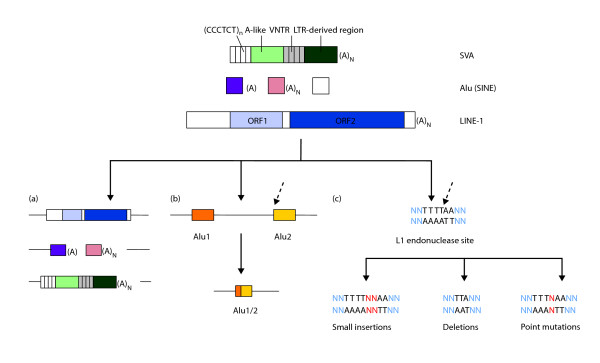
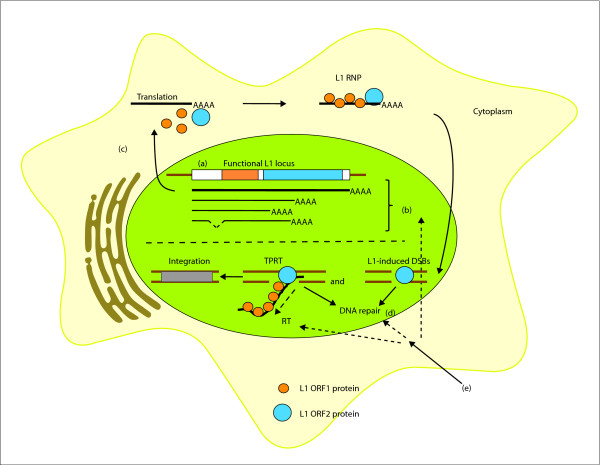
Transposable elements (TEs) have been consistently underestimated in their contribution to genetic instability and human disease. TEs can cause human disease by creating insertional mutations in genes, and also contributing to genetic instability through non-allelic homologous recombination and introduction of sequences that evolve into various cis-acting signals that alter gene expression. Other outcomes of TE activity, such as their potential to cause DNA double-strand breaks or to modulate the epigenetic state of chromosomes, are less fully characterized. The currently active human transposable elements are members of the non-LTR retroelement families, LINE-1, Alu (SINE), and SVA. The impact of germline insertional mutagenesis by TEs is well established, whereas the rate of post-insertional TE-mediated germline mutations and all forms of somatic mutations remain less well quantified. The number of human diseases discovered to be associated with non-allelic homologous recombination between TEs, and particularly between Alu elements, is growing at an unprecedented rate. Improvement in the technology for detection of such events, as well as the mounting interest in the research and medical communities in resolving the underlying causes of the human diseases with unknown etiology, explain this increase. Here, we focus on the most recent advances in understanding of the impact of the active human TEs on the stability of the human genome and its relevance to human disease.
转座元件 (TEs) 在遗传不稳定性和人类疾病中的作用一直被低估。TEs 可以通过在基因中产生插入突变导致人类疾病,也可以通过非等位基因同源重组和引入进化为各种顺式作用信号的序列来导致遗传不稳定性,从而改变基因表达。TE 活性的其他结果,例如它们潜在的引起 DNA 双链断裂或调节染色体的表观遗传状态的能力,尚未得到充分描述。目前活跃的人类转座元件是非 LTR 反转录元件家族、LINE-1、Alu(SINE)和 SVA 的成员。TE 引起的种系插入诱变的影响已得到充分证实,而种系突变和所有形式的体细胞突变的 TE 介导的后插入率仍未得到充分量化。由于 TEs 之间,特别是 Alu 元件之间的非等位基因同源重组而与人类疾病相关的数量正在以前所未有的速度增长。检测此类事件的技术不断改进,以及研究和医学界对解决病因不明的人类疾病的根本原因的兴趣不断增加,解释了这种增长。在这里,我们重点介绍了关于活跃的人类 TEs 对人类基因组稳定性的影响及其与人类疾病相关性的最新进展。