Biologie I, Universität Regensburg, 93040 Regensburg, Germany.
Front Zool. 2009 Oct 28;6:27. doi: 10.1186/1742-9994-6-27.
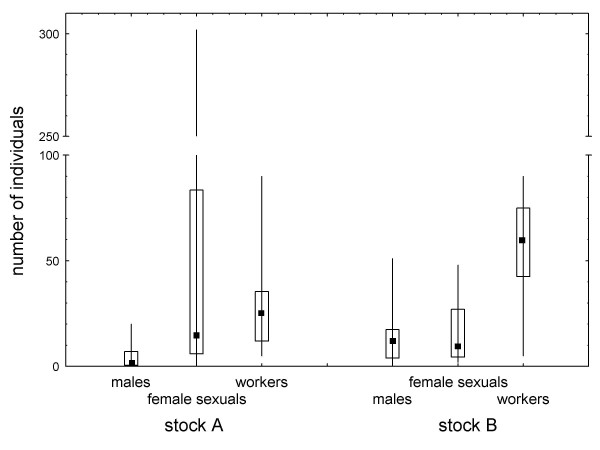
Studies on sex ratios in social insects provide among the most compelling evidence for the importance of kin selection in social evolution. The elegant synthesis of Fisher's sex ratio principle and Hamilton's inclusive fitness theory predicts that colony-level sex ratios vary with the colonies' social and genetic structures. Numerous empirical studies in ants, bees, and wasps have corroborated these predictions. However, the evolutionary optimization of sex ratios requires genetic variation, but one fundamental determinant of sex ratios - the propensity of female larvae to develop into young queens or workers ("queen bias") - is thought to be largely controlled by the environment. Evidence for a genetic influence on sex ratio and queen bias is as yet restricted to a few taxa, in particular hybrids.Because of the very short lifetime of their queens, ants of the genus Cardiocondyla are ideal model systems for the study of complete lifetime reproductive success, queen bias, and sex ratios. We found that lifetime sex ratios of the ant Cardiocondyla kagutsuchi have a heritable component. In experimental single-queen colonies, 22 queens from a genetic lineage with a highly female-biased sex ratio produced significantly more female-biased offspring sex ratios than 16 queens from a lineage with a more male-biased sex ratio (median 91.5% vs. 58.5% female sexuals). Sex ratio variation resulted from different likelihood of female larvae developing into sexuals (median 50% vs. 22.6% female sexuals) even when uniformly nursed by workers from another colony.Consistent differences in lifetime sex ratios and queen bias among queens of C. kagutsuchi suggest that heritable, genetic or maternal effects strongly affect caste determination. Such variation might provide the basis for adaptive evolution of queen and worker strategies, though it momentarily constrains the power of workers and queens to optimize caste ratios.
社会性昆虫的性别比例研究为亲属选择在社会进化中的重要性提供了最有说服力的证据之一。Fisher 的性别比例原理和 Hamilton 的适合度综合理论的优雅综合预测,群体水平的性别比例随群体的社会和遗传结构而变化。蚂蚁、蜜蜂和黄蜂的大量实证研究证实了这些预测。然而,性比的进化优化需要遗传变异,但性比的一个基本决定因素——雌性幼虫发育成年轻女王或工蜂的倾向(“女王偏见”)——被认为主要受环境控制。性比和女王偏见的遗传影响的证据迄今为止仅限于少数分类群,特别是杂种。由于它们女王的寿命非常短,Cardiocondyla 属的蚂蚁是研究完整生命周期生殖成功、女王偏见和性别比例的理想模式系统。我们发现,Cardiocondyla kagutsuchi 蚂蚁的终生性别比具有遗传成分。在实验性的单女王群体中,来自性别比高度偏向雌性的遗传谱系的 22 只女王比来自性别比偏向雄性的谱系的 16 只女王产生了明显更多的偏向雌性的后代性别比(中位数为 91.5%对 58.5%的雌性生殖体)。性别比的变化是由于雌性幼虫发育成生殖体的可能性不同(中位数为 50%对 22.6%的雌性生殖体),即使由来自另一个群体的工蜂统一哺育。Cardiocondyla kagutsuchi 的女王终生性别比和女王偏见的一致差异表明,可遗传的、遗传或母性效应强烈影响着级型的决定。这种变异可能为女王和工蜂策略的适应性进化提供基础,尽管它暂时限制了工蜂和女王优化级型比例的能力。