Department of Pediatrics, Klinikum rechts der Isar, Technische Universität München, Kölner Platz 1, Munich, Germany.
J Transl Med. 2011 May 27;9:79. doi: 10.1186/1479-5876-9-79.
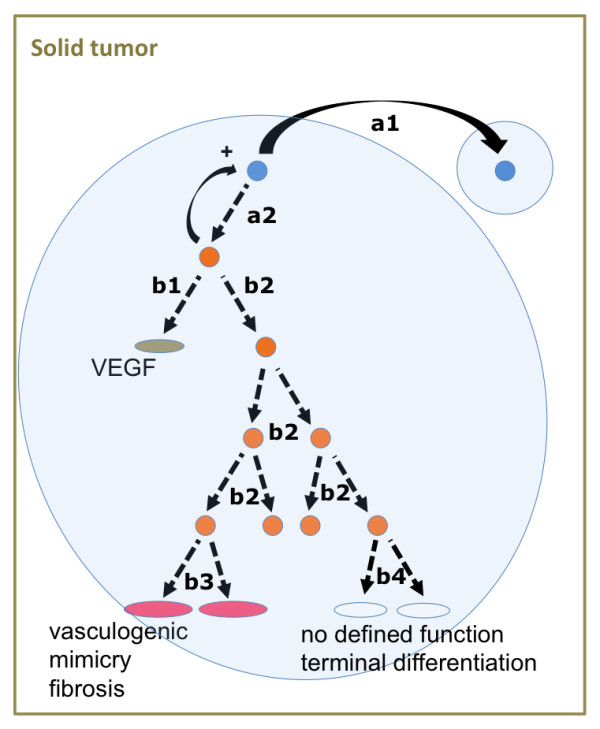
Compelling evidence broadens our understanding of tumors as highly heterogeneous populations derived from one common progenitor. In this review we portray various stages of tumorigenesis, tumor progression, self-seeding and metastasis in analogy to the superorganisms of insect societies to exemplify the highly complex architecture of a neoplasm as a system of functional "castes."Accordingly, we propose a model in which clonal expansion and cumulative acquisition of genetic alterations produce tumor compartments each equipped with distinct traits and thus distinct functions that cooperate to establish clinically apparent tumors. This functional compartment model also suggests mechanisms for the self-construction of tumor stem cell niches. Thus, thinking of a tumor as a superorganism will provide systemic insight into its functional compartmentalization and may even have clinical implications.
强有力的证据拓宽了我们对肿瘤的认识,肿瘤是由一个共同祖先进化而来的高度异质性群体。在这篇综述中,我们将肿瘤发生、肿瘤进展、自播种和转移的各个阶段类比为昆虫社会的超个体,以说明作为功能“等级”系统的肿瘤的高度复杂结构。相应地,我们提出了一个模型,其中克隆扩张和遗传改变的累积获得产生了每个肿瘤隔间,每个隔间都具有独特的特征,从而具有不同的功能,共同建立临床上明显的肿瘤。这个功能隔间模型还为肿瘤干细胞生态位的自我构建提供了机制。因此,将肿瘤视为一个超个体将为其功能分区提供系统的见解,甚至可能具有临床意义。