State Key Laboratory of Bioreactor Engineering, East China University of Science and Technology, Shanghai, People's Republic of China.
PLoS One. 2009 Oct 29;4(10):e7646. doi: 10.1371/journal.pone.0007646.
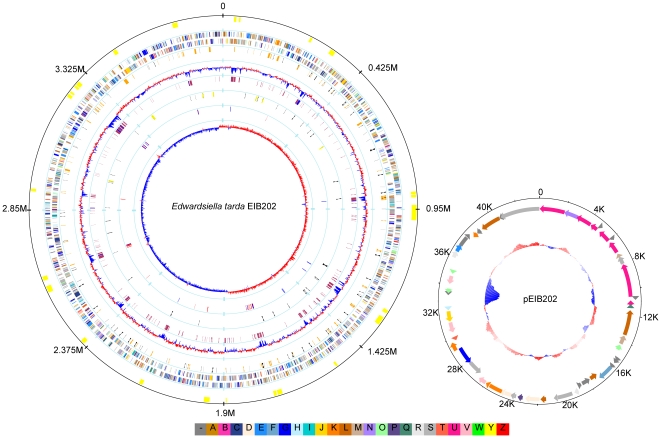
Edwardsiella tarda is the etiologic agent of edwardsiellosis, a devastating fish disease prevailing in worldwide aquaculture industries. Here we describe the complete genome of E. tarda, EIB202, a highly virulent and multi-drug resistant isolate in China.
METHODOLOGY/PRINCIPAL FINDINGS: E. tarda EIB202 possesses a single chromosome of 3,760,463 base pairs containing 3,486 predicted protein coding sequences, 8 ribosomal rRNA operons, and 95 tRNA genes, and a 43,703 bp conjugative plasmid harboring multi-drug resistant determinants and encoding type IV A secretion system components. We identified a full spectrum of genetic properties related to its genome plasticity such as repeated sequences, insertion sequences, phage-like proteins, integrases, recombinases and genomic islands. In addition, analysis also indicated that a substantial proportion of the E. tarda genome might be devoted to the growth and survival under diverse conditions including intracellular niches, with a large number of aerobic or anaerobic respiration-associated proteins, signal transduction proteins as well as proteins involved in various stress adaptations. A pool of genes for secretion systems, pili formation, nonfimbrial adhesions, invasions and hemagglutinins, chondroitinases, hemolysins, iron scavenging systems as well as the incomplete flagellar biogenesis might feature its surface structures and pathogenesis in a fish body.
CONCLUSION/SIGNIFICANCE: Genomic analysis of the bacterium offered insights into the phylogeny, metabolism, drug-resistance, stress adaptation, and virulence characteristics of this versatile pathogen, which constitutes an important first step in understanding the pathogenesis of E. tarda to facilitate construction of a practical effective vaccine used for combating fish edwardsiellosis.
迟缓爱德华氏菌是爱德华氏菌病的病原体,这是一种在世界水产养殖业中流行的毁灭性鱼类疾病。在这里,我们描述了中国高度毒力和多药耐药分离株 E. tarda EIB202 的完整基因组。
方法/主要发现:E. tarda EIB202 拥有一条 3760463 碱基对的单染色体,包含 3486 个预测蛋白编码序列、8 个核糖体 rRNA 操纵子和 95 个 tRNA 基因,以及一个 43703 碱基对的可接合质粒,其中包含多药耐药决定因素,并编码 IV 型 A 分泌系统组件。我们发现了一系列与基因组可塑性相关的遗传特性,如重复序列、插入序列、噬菌体样蛋白、整合酶、重组酶和基因组岛。此外,分析还表明,E. tarda 基因组的很大一部分可能致力于在各种条件下的生长和存活,包括细胞内小生境,具有大量需氧或厌氧呼吸相关蛋白、信号转导蛋白以及参与各种应激适应的蛋白。一个分泌系统、菌毛形成、非纤毛黏附、入侵和血凝素、软骨素酶、溶血性、铁摄取系统以及不完全鞭毛生物发生的基因池可能是其在鱼类体内的表面结构和发病机制的特征。
结论/意义:对该细菌的基因组分析提供了对该多功能病原体的系统发育、代谢、耐药性、应激适应和毒力特征的深入了解,这是理解 E. tarda 发病机制以促进用于对抗鱼类爱德华氏菌病的实用有效疫苗的构建的重要第一步。