Kelso J A Scott
The Human Brain and Behavior Laboratory Center for Complex Systems and Brain Sciences Florida Atlantic University.
Ecol Psychol. 2008 Apr 1;20(2):180-208. doi: 10.1080/10407410801949297.
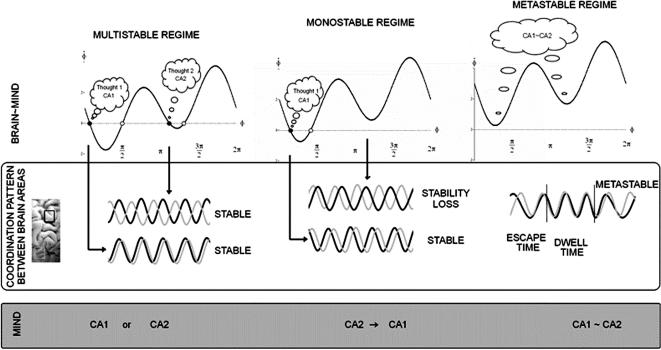
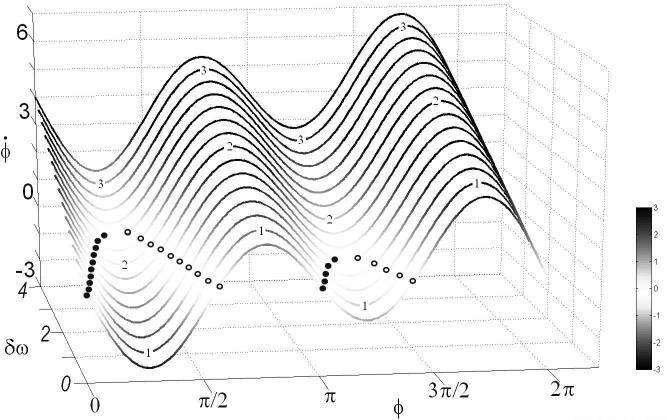
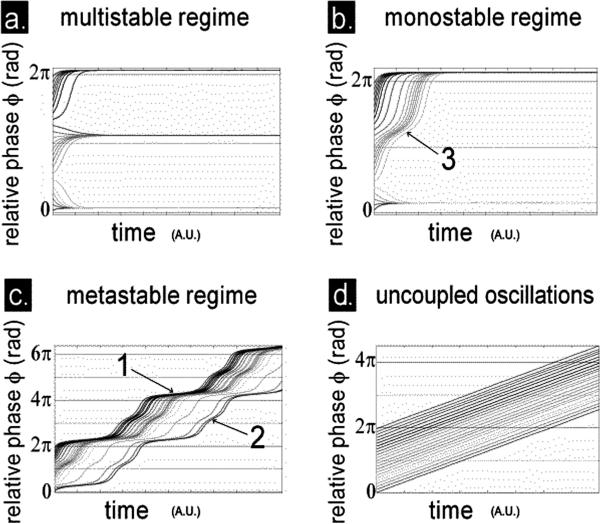
Several conjectures by A. S. Iberall on life and mind are used as a backdrop to sketch a theory of mental activity that respects both the contents of thought and the dynamics of thinking. The dynamics, in this case, refers fundamentally to animated, meaningfully coupled self-organizing processes (coordination dynamics) and exhibit multistability, switching, and, because of symmetry breaking, metastability. The interplay of 2 simultaneously acting forces underlies the metastable mind: the tendency for the coordinating elements to couple together (integration) and the tendency for the elements to express their individual autonomy (segregation). Metrics for metastability are introduced that enable these cooperative and competitive tendencies to be quantified. Whereas bistability is the basis for polarized, either/or thinking, the metastable régime-which contains neither stable nor unstable states, no states at all, in fact-gives rise to a far more fluid, complementary mode of operation in which it is possible for apparent contraries to coexist in the mind at the same time.
A. S. 伊贝拉尔关于生命与心智的若干猜想被用作背景,以勾勒一种尊重思想内容与思维动态的心理活动理论。在此情形下,动态性从根本上指的是有活力的、意义耦合的自组织过程(协调动力学),并呈现出多重稳定性、切换,以及由于对称性破缺而产生的亚稳定性。亚稳定心智的基础是两种同时起作用的力量的相互作用:协调元素耦合在一起的倾向(整合)以及元素表达其个体自主性的倾向(分离)。引入了亚稳定性的度量标准,使这些合作与竞争倾向得以量化。双稳性是两极化的非此即彼思维的基础,而亚稳定状态——实际上既不包含稳定状态也不包含不稳定状态,根本不存在任何状态——产生了一种更为灵活、互补的运作模式,在这种模式下,明显的对立面有可能在心智中同时共存。