Centre for Infections, Health Protection Agency, London, United Kingdom.
PLoS One. 2009 Oct 30;4(10):e7671. doi: 10.1371/journal.pone.0007671.
In the northern hemisphere winter of 2003-04 antigenic variant strains (A/Fujian/411/02 -like) of influenza A H3N2 emerged. Circulation of these strains in the UK was accompanied by an unusually high number of laboratory confirmed influenza associated fatalities in children. This study was carried out to better understand risk factors associated with fatal cases of influenza in children.
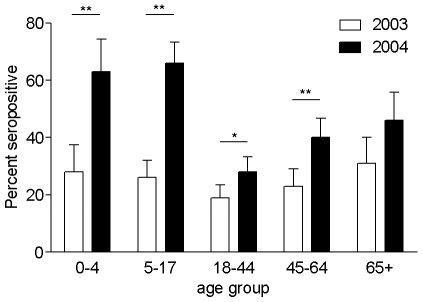
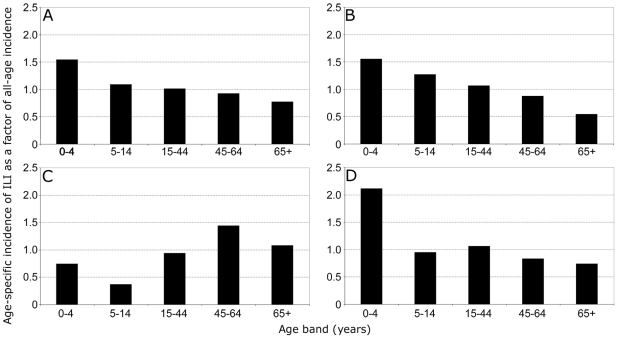
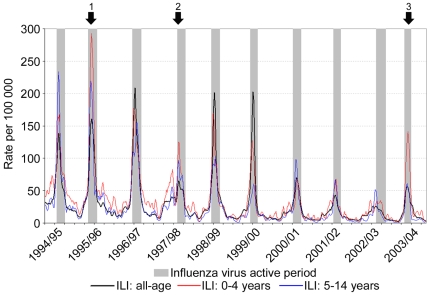
METHODOLOGY/PRINCIPAL FINDINGS: Case histories, autopsy reports and death registration certificates for seventeen fatal cases of laboratory confirmed influenza in children were analyzed. None had a recognized pre-existing risk factor for severe influenza and none had been vaccinated. Three cases had evidence of significant bacterial co-infection. Influenza strains recovered from fatal cases were antigenically similar to those circulating in the community. A comparison of protective antibody titres in age stratified cohort sera taken before and after winter 2003-04 showed that young children had the highest attack rate during this season (21% difference, 95% confidence interval from 0.09 to 0.33, p = 0.0009). Clinical incidences of influenza-like illness (ILI) in young age groups were shown to be highest only in the years when novel antigenic drift variants emerged.
CONCLUSIONS/SIGNIFICANCE: This work presents a rare insight into fatal influenza H3N2 in healthy children. It confirms that circulating seasonal influenza A H3N2 strains can cause severe disease and death in children in the apparent absence of associated bacterial infection or predisposing risk factors. This adds to the body of evidence demonstrating the burden of severe illness due to seasonal influenza A in childhood.
2003-04 年北半球冬季出现了甲型 H3N2 流感的抗原变异株(类似 A/Fujian/411/02)。这些变异株在英国流行的同时,儿童中实验室确诊的与流感相关的死亡人数异常高。本研究旨在更好地了解与儿童流感致死病例相关的危险因素。
方法/主要发现:对 17 例实验室确诊的儿童流感致死病例的病史、尸检报告和死亡登记证明进行了分析。这些患儿均无严重流感的已知既往危险因素,也均未接种疫苗。3 例有明显细菌合并感染的证据。从致死病例中分离出的流感株与社区中流行的株具有相似的抗原性。对 2003-04 年冬季前后分层年龄队列血清中保护性抗体滴度的比较显示,在这个季节,幼儿的发病率最高(差异 21%,95%置信区间为 0.09 至 0.33,p=0.0009)。在年轻年龄组中,流感样疾病(ILI)的临床发病率仅在出现新型抗原漂移变异株的年份最高。
结论/意义:本研究罕见地深入了解了健康儿童的致死性 H3N2 流感。它证实了流行的季节性甲型 H3N2 流感株可在无相关细菌感染或易患危险因素的情况下导致儿童发生严重疾病和死亡。这增加了因季节性甲型流感而导致儿童严重疾病的证据。