Mammary Biology and Tumorigenesis Laboratory, Center for Cancer Research, National Cancer Institute, National Institutes of Health, 37 Convent Drive, Building 37, Room 1106, Bethesda, Maryland 20892-4254, USA.
Breast Cancer Res. 2009;11(6):R82. doi: 10.1186/bcr2449. Epub 2009 Nov 11.
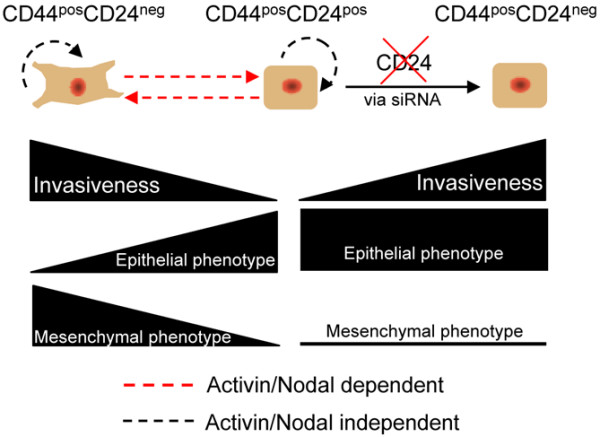
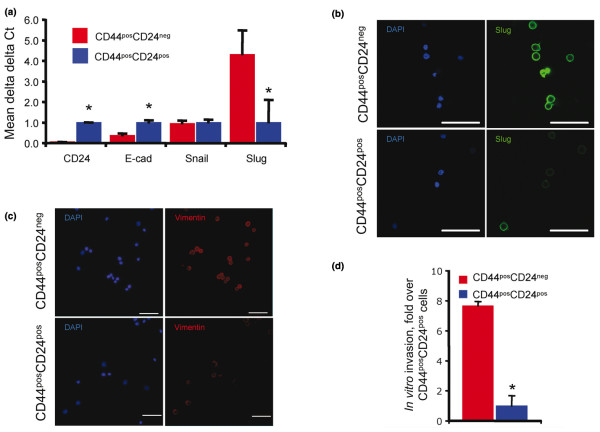
The invasive, mesenchymal phenotype of CD44posCD24neg breast cancer cells has made them a promising target for eliminating the metastatic capacity of primary tumors. It has been previously demonstrated that CD44neg/lowCD24pos breast cancer cells lack the ability to give rise to their invasive CD44posCD24neg counterpart. Here we demonstrate that noninvasive, epithelial-like CD44posCD24pos cells readily give rise to invasive, mesenchymal CD44posCD24neg progeny in vivo and in vitro. This interconversion was found to be dependent upon Activin/Nodal signaling.
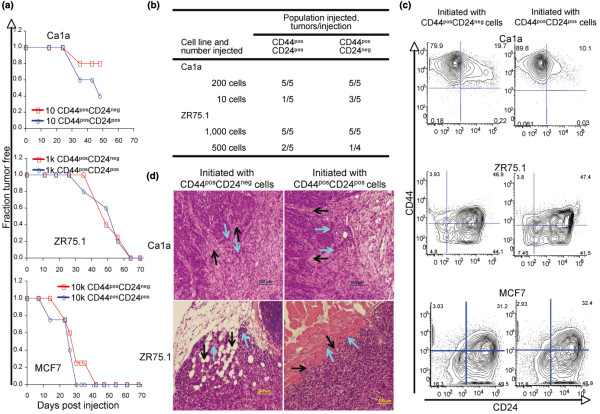
Breast cancer cell lines were sorted into CD44posCD24pos and CD44posCD24neg populations to evaluate their progeny for the expression of CD44, CD24, and markers of a mesenchymal phenotype. The populations, separated by fluorescence activated cell sorting (FACS) were injected into immunocompromised mice to evaluate their tumorigenicity and invasiveness of the resulting xenografts.
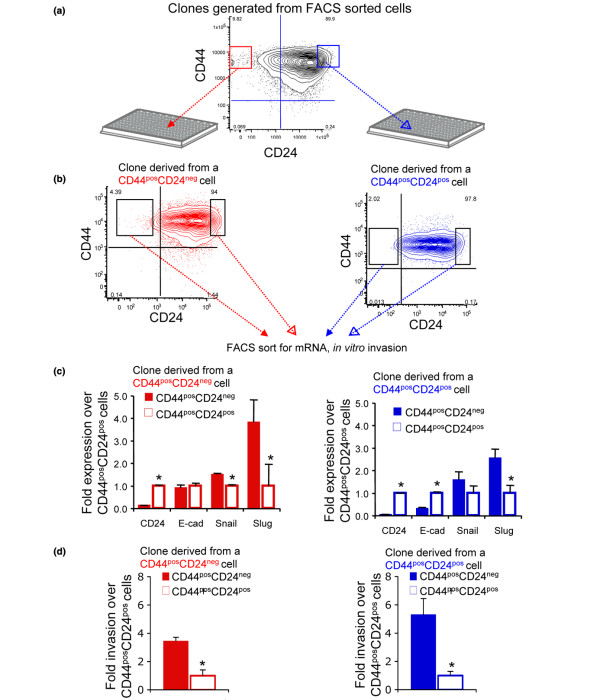
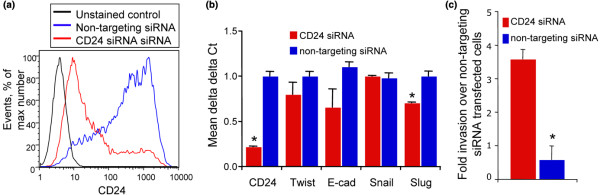
CD24 expression was dynamically regulated in vitro in all evaluated breast cancer cell lines. Furthermore, a single noninvasive, epithelial-like CD44posCD24pos cell had the ability to give rise to invasive, mesenchymal CD44posCD24neg progeny. Importantly, this interconversion occurred in vivo as CD44posCD24pos cells gave rise to xenografts with locally invasive borders as seen in xenografts initiated with CD44posCD24neg cells. Lastly, the ability of CD44posCD24pos cells to give rise to mesenchymal progeny, and vice versa, was blocked upon ablation of Activin/Nodal signaling.
Our data demonstrate that the invasive, mesenchymal CD44posCD24neg phenotype is under dynamic control in breast cancer cell lines both in vitro and in vivo. Furthermore, our observations suggest that therapies targeting CD44posCD24neg tumor cells may have limited success in preventing primary tumor metastasis unless Activin/Nodal signaling is arrested.
CD44posCD24neg 乳腺癌细胞的侵袭性间质表型使其成为消除原发性肿瘤转移能力的有希望的靶点。先前已经证明,CD44neg/lowCD24pos 乳腺癌细胞缺乏产生其侵袭性 CD44posCD24neg 对应物的能力。在这里,我们证明非侵袭性上皮样 CD44posCD24pos 细胞在体内和体外容易产生侵袭性间质 CD44posCD24neg 后代。这种相互转化被发现依赖于激活素/诺拉信号。
乳腺癌细胞系被分选为 CD44posCD24pos 和 CD44posCD24neg 群体,以评估其后代中 CD44、CD24 和间质表型标志物的表达。通过荧光激活细胞分选(FACS)分离的群体被注射到免疫缺陷小鼠中,以评估其致瘤性和由此产生的异种移植物的侵袭性。
所有评估的乳腺癌细胞系在体外均动态调节 CD24 的表达。此外,单个非侵袭性上皮样 CD44posCD24pos 细胞具有产生侵袭性间质 CD44posCD24neg 后代的能力。重要的是,这种相互转化在体内发生,因为 CD44posCD24pos 细胞产生了具有局部侵袭边界的异种移植物,如从 CD44posCD24neg 细胞起始的异种移植物所见。最后,CD44posCD24pos 细胞产生间质后代的能力,反之亦然,在激活素/诺拉信号被阻断时被阻断。
我们的数据表明,侵袭性间质 CD44posCD24neg 表型在乳腺癌细胞系中无论是在体外还是体内都受到动态控制。此外,我们的观察结果表明,除非抑制激活素/诺拉信号,否则针对 CD44posCD24neg 肿瘤细胞的治疗可能在预防原发性肿瘤转移方面收效有限。