Section of Islet Transplantation and Cell Biology, Joslin Diabetes Center, Boston, Massachusetts 02215, USA.
Curr Opin Organ Transplant. 2010 Feb;15(1):79-85. doi: 10.1097/MOT.0b013e3283344932.
Diabetes results from inadequate functional mass of pancreatic beta-cells and therefore replenishing with new glucose-responsive beta-cells is an important therapeutic option. In addition to replication of pre-existing beta-cells, new beta-cells can be produced from differentiated adult cells using in-vitro or in-vivo approaches. This review will summarize recent advances in in-vivo generation of beta-cells from cells that are not beta-cells (neogenesis) and discuss ways to overcome the limitations of this process.
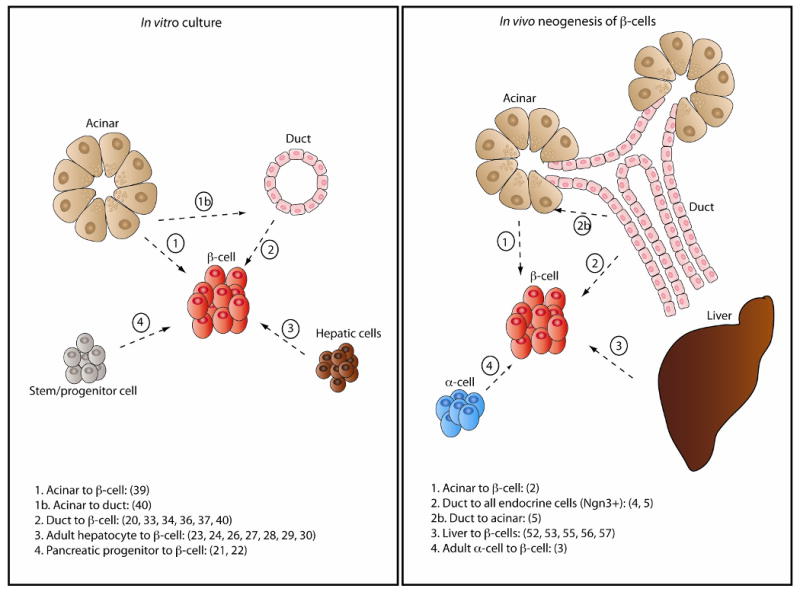
Multiple groups have shown that adult pancreatic ducts, acinar and even endocrine cells exhibit cellular plasticity and can differentiate into beta-cells in vivo. Several different approaches, including misexpression of transcription factors and tissue injury, have induced neogenesis of insulin-expressing cells in vivo and ameliorated diabetes.
Recent breakthroughs demonstrating cellular plasticity of adult pancreatic cells to form new beta-cells are a positive first step towards developing in-vivo regeneration-based therapy for diabetes. Currently, neogenesis processes are inefficient and do not generate sufficient amounts of beta-cells required to normalize hyperglycemia. However, an improved understanding of mechanisms regulating neogenesis of beta-cells from adult pancreatic cells and of their maturation into functional glucose-responsive beta-cells can make therapies based on in-vivo regeneration a reality.
糖尿病是由于胰腺β细胞功能不足所致,因此补充新的葡萄糖反应性β细胞是一种重要的治疗选择。除了复制现有的β细胞外,还可以通过体外或体内方法从已分化的成体细胞产生新的β细胞。本文将总结目前在体内由非β细胞(新生)产生β细胞的最新进展,并讨论克服这一过程局限性的方法。
多个研究小组表明,成年胰腺导管、腺泡甚至内分泌细胞具有细胞可塑性,可在体内分化为β细胞。多种不同的方法,包括转录因子的过表达和组织损伤,已在体内诱导了胰岛素表达细胞的新生,并改善了糖尿病。
最近的突破证明了成年胰腺细胞的细胞可塑性,能够形成新的β细胞,这是开发基于体内再生的糖尿病治疗方法的积极的第一步。目前,新生过程效率低下,无法产生足够数量的β细胞来使高血糖正常化。然而,对调节成年胰腺细胞新生为功能性葡萄糖反应性β细胞的机制及其成熟的更好理解,可以使基于体内再生的治疗方法成为现实。