Liao Shu-Yuan, Darcy Kathleen M, Randall Leslie M, Tian Chunqiao, Monk Bradley J, Burger Robert A, Fruehauf John P, Peters William A, Stock Richard J, Stanbridge Eric J
Department of Epidemiology, University of California at Irvine, School of Medicine, Irvine, CA, USA.
Gynecol Oncol. 2010 Mar;116(3):452-8. doi: 10.1016/j.ygyno.2009.10.062. Epub 2009 Nov 13.
This study aimed to determine whether carbonic anhydrase-IX (CA-IX) was associated with progression-free survival (PFS) and overall survival (OS) in women with high-risk, early-stage cervical cancer treated with adjuvant pelvic radiotherapy with or without radiosensitizing chemotherapy.
CA-IX expression was detected using an immunohistochemistry assay and categorized as low when <or=80% of tumor cells exhibited CA-IX staining and high when >80% tumor cells display CA-IX staining. Associations between CA-IX expression and clinical characteristics, angiogenesis marker expression, and clinical outcome were evaluated.
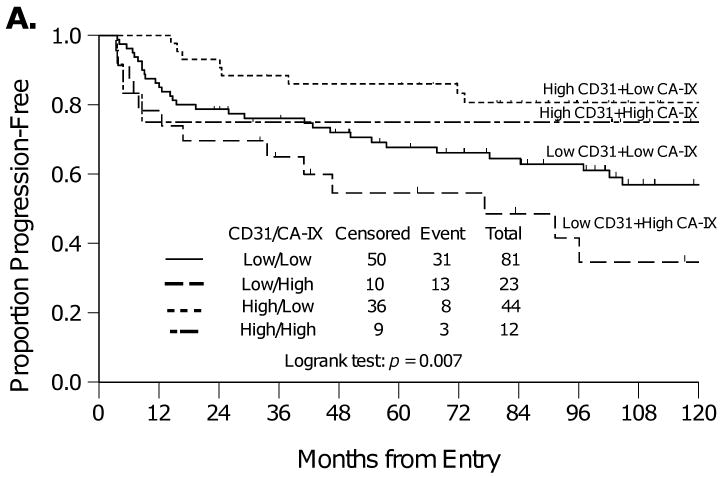
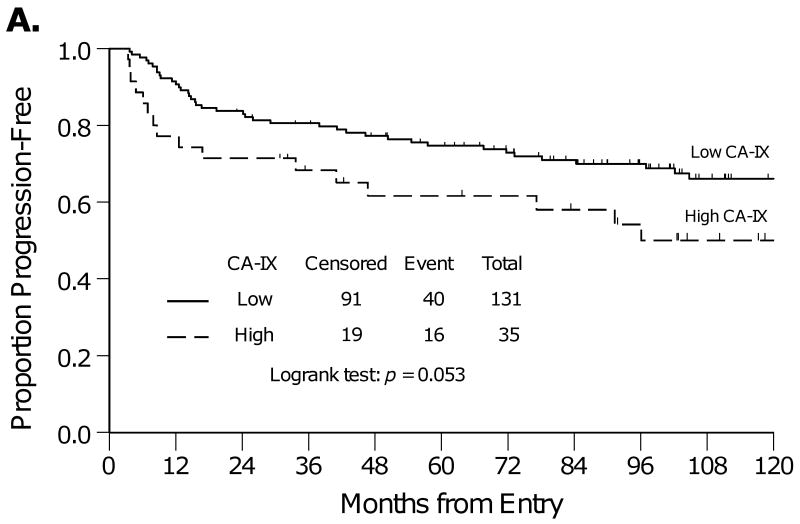
High CA-IX expression was observed in 35/166 (21.1%) of cases. CA-IX expression was not associated with age, race, stage, cell type, grade, positive margins, parametrial extensions, positive lymph nodes, or lymphovascular space invasion but was associated with tumor size categorized as <2 , 2-2.9 , or >or=3 cm (high expression: 4.7% vs. 23.2% vs. 32.5%, P=0.003) and cervical invasion confined to the inner two-thirds compared with the outer third of the cervix (high expression: 6.1% vs. 23.7%, P=0.028). CA-IX expression was not associated with immunohistochemical expression of p53, CD31, CD105, thrombospondin-1, or vascular endothelial growth factor-A. Women with high versus low CA-IX expression had similar PFS (P=0.053) and significantly worse OS (P=0.044). After adjusting for prognostic clinical covariates, high CA-IX expression was an independent prognostic factor for PFS (hazard ratio [HR]=2.12; 95% confidence interval [CI]=1.13-3.95; P=0.019) and OS (HR=2.41; 95% CI=1.24-4.68; P=0.009).
Tumor hypoxia measured by immunohistochemical expression of CA-IX is an independent prognostic factor for both PFS and OS in high-risk, early-stage cervical cancer.
本研究旨在确定碳酸酐酶-IX(CA-IX)是否与接受辅助盆腔放疗加或不加放射增敏化疗的高危早期宫颈癌女性的无进展生存期(PFS)和总生存期(OS)相关。
采用免疫组织化学检测CA-IX表达,当≤80%的肿瘤细胞呈现CA-IX染色时分类为低表达,当>80%的肿瘤细胞呈现CA-IX染色时分类为高表达。评估CA-IX表达与临床特征、血管生成标志物表达及临床结局之间的关联。
166例中有35例(21.1%)观察到高CA-IX表达。CA-IX表达与年龄、种族、分期、细胞类型、分级、切缘阳性、宫旁浸润、淋巴结阳性或脉管间隙浸润无关,但与肿瘤大小分类为<2 cm、2 - 2.9 cm或≥3 cm相关(高表达:4.7%对23.2%对32.5%,P = 0.003),且与宫颈浸润局限于宫颈内三分之二相比外三分之一相关(高表达:6.1%对23.7%,P = 0.028)。CA-IX表达与p53、CD31、CD105、血小板反应蛋白-1或血管内皮生长因子-A的免疫组化表达无关。CA-IX高表达与低表达的女性PFS相似(P = 0.053),但OS显著更差(P = 0.044)。在调整预后临床协变量后,高CA-IX表达是PFS(风险比[HR]=2.12;95%置信区间[CI]=1.13 - 3.95;P = 0.019)和OS(HR = 2.41;95% CI = 1.24 - 4.68;P = 0.009)的独立预后因素。
通过CA-IX免疫组化表达测定的肿瘤缺氧是高危早期宫颈癌PFS和OS的独立预后因素。